answer.
Ask question
Login Signup
Ask question
All categories
  • English
  • Mathematics
  • Social Studies
  • Business
  • History
  • Health
  • Geography
  • Biology
  • Physics
  • Chemistry
  • Computers and Technology
  • Arts
  • World Languages
  • Spanish
  • French
  • German
  • Advanced Placement (AP)
  • SAT
  • Medicine
  • Law
  • Engineering
anzhelika [568]
2 years ago
10

A small sphere with mass m is attached to a massless rod of length L that is pivoted at the top, forming a simple pendulum. The

pendulum is pulled to one side so that the rod is at an angle θ from the vertical, and released from rest.
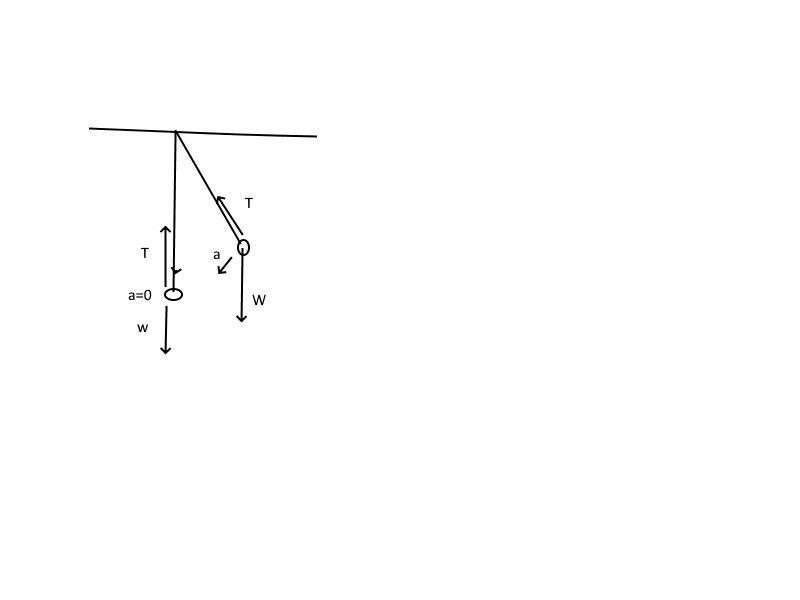
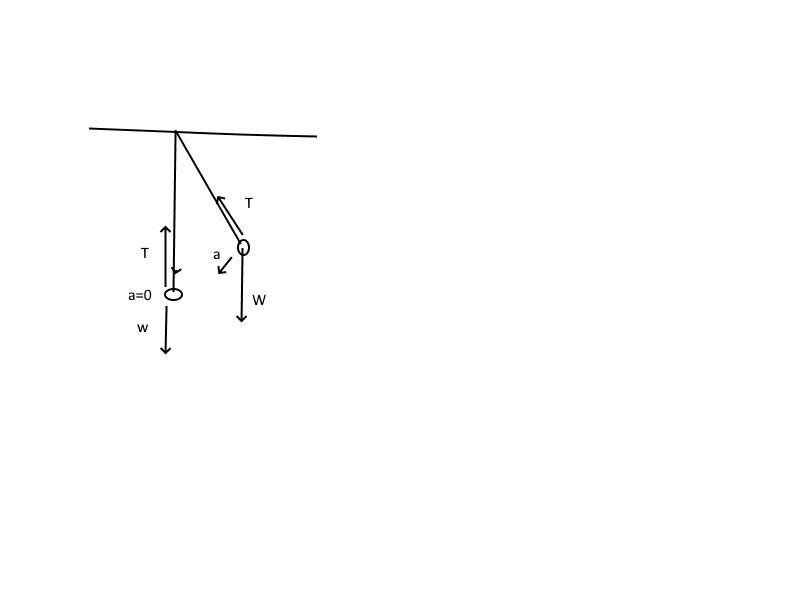
a. Show the pendulum just after it is released. Draw vectors representing the forces acting on the small sphere and the acceleration of the sphere. Accuracy counts! At this point, what is the linear acceleration of the sphere?
b. Repeat part (a) for the instant when the pendulum rod is at an angle 9/2 from the vertical.
c. Repeat part (a) for the instant when the pendulum rod is vertical. At this point, what is the linear speed of the sphere?

Physics
1 answer:
USPshnik [31]2 years ago
4 0

Answer:

a) see attached, a = g sin θ

b)

c)   v = √(2gL (1-cos θ))

Explanation:

In the attached we can see the forces on the sphere, which are the attention of the bar that is perpendicular to the movement and the weight of the sphere that is vertical at all times. To solve this problem, a reference system is created with one axis parallel to the bar and the other perpendicular to the rod, the weight of decomposing in this reference system and the linear acceleration is given by

          Wₓ = m a

          W sin θ = m a

          a = g sin θ

b) The diagram is the same, the only thing that changes is the angle that is less

                θ' = 9/2  θ


c) At this point the weight and the force of the bar are in the same line of action, so that at linear acceleration it is zero, even when the pendulum has velocity v, so it follows its path.

The easiest way to find linear speed is to use conservation of energy

Highest point

            Em₀ = mg h = mg L (1-cos tea)

Lowest point

          Emf = K = ½ m v²

          Em₀ = Emf

          g L (1-cos θ) = v² / 2

              v = √(2gL (1-cos θ))

You might be interested in
Consider two circular metal wire loops each carrying the same current I as shown below. In what r... Consider two circular metal
NeX [460]

Answer:

1) The magnetic field outside the loop is zero.

In region III the magnetic fields due to the two wire loops point in the opposite direction andhence cancel each other. Therefore the magnetic field is zero in region I, III and V

The diagram is attached

6 0
2 years ago
A roller coaster travels 200 feet horizontally and then rises 135 feet at an angle of 30 degrees above the ground. What is the m
Delvig [45]
Say the initial point is (0,0)

The final point is

x = 200 + 135*cos(30) = 200 + 135*sqrt(3)/2 = 316.91 ft
y = 135*sin(30) = 135/2 = 67.5 ft

Resultant vector = (316.91, 67.5) - (0,0) = 316.91, 67.5) ft
8 0
2 years ago
You know that you sound better when you sing in the shower. This has to do with the amplification of frequencies that correspond
luda_lava [24]

Answer:

a) L = 0.75m   f₁ = 113.33 Hz , f₃ = 340 Hz, b) L=1.50m   f₁ = 56.67 Hz ,  f₃ = 170 Hz

Explanation:

This resonant system can be simulated by a system with a closed end, the tile wall and an open end where it is being sung

In this configuration we have a node at the closed end and a belly at the open end whereby the wavelength

With 1  node         λ₁ = 4 L

With 2 nodes      λ₂ = 4L / 3

With 3 nodes       λ₃ = 4L / 5

The general term would be      λ_n= 4L / n         n = 1, 3, 5, ((2n + 1)

The speed of sound is

         v = λ f

         f = v / λ

         f = v  n / 4L

Let's consider each length independently

L = 0.75 m

        f₁ = 340 1/4 0.75 = 113.33 n

         f₁ = 113.33 Hz

        f₃ = 113.33   3

       f₃ = 340 Hz

L = 1.5 m

       f₁ = 340 n / 4 1.5 = 56.67 n

       f₁ = 56.67 Hz

       f₃ = 56.67 3

       f₃ = 170 Hz

8 0
2 years ago
How, if at all, would the equations written in Parts C and E change if the projectile was thrown from the cliff at an angle abov
sveta [45]

Answer:

x = v₀ cos θ   t ,   y = y₀ + v₀ sin θ t - ½ g t2

Explanation:

This is a projectile launch exercise, in this case we will write the equations for the x and y axes

Let's use trigonometry to find the components of the initial velocity

              sin θ = v_{oy} / v₀

              cos θ = v₀ₓ / v₀

              v_{y} = v_{oy} sin θ

              v₀ₓ = vo cos θ

now let's write the equations of motion

X axis

         x = v₀ₓ t

         x = v₀ cos θ   t

        vₓ = v₀ cos θ

Y axis

        y = y₀ + v_{oy} t - ½ g t2

        y = y₀ + v₀ sin θ t - ½ g t2

        v_{y} = v₀ - g t

       v_{y} = v₀  sin θ - gt

        v_{y}^{2} = v_{oy}^2 sin² θ - 2 g y

As we can see the fundamental change is that between the horizontal launch and the inclined launch, the velocity has components

7 0
2 years ago
Ferdinand the frog is hopping from lily pad to lily pad in search of a good fly
loris [4]

Answer: 36.86\°

Explanation:

According to the described situation we have the following data:

Horizontal distance between lily pads: d=2.4 m

Ferdinand's initial velocity: V_{o}=5 m/s

Time it takes a jump: t=0.6 s

We need to find the angle \theta at which Ferdinand jumps.

In order to do this, we first have to find the <u>horizontal component (or x-component)</u> of this initial velocity. Since we are dealing with parabolic movement, where velocity has x-component and y-component, and in this case we will choose the x-component to find the angle:

V_{x}=\frac{d}{t} (1)

V_{x}=\frac{2.4 m}{0.6 s} (2)

V_{x}=4 m/s (3)

On the other hand, the x-component of the velocity is expressed as:

V_{x}=V_{o}cos\theta (4)

Substituting (3) in (4):

4 m/s=5 m/s cos\theta (5)

Clearing \theta:

\theta=cos^{-1} (\frac{4 m/s}{5 m/s})

\theta=36.86\° This is the angle at which Ferdinand the frog jumps between lily pads
4 0
2 years ago
Other questions:
  • If the frequencies of two component waves are 24 Hz and 20 Hz, they should produce _______ beats per second.
    10·2 answers
  • In a digital multimeter, what changes inside the meter when you push the button to change from 200v range to the 20v range? by w
    7·1 answer
  • Rachel has an unknown sample of a radioisotope listed in the table. Using a special technique, she is able to measure the mass o
    8·2 answers
  • Platinum (pt) has the fcc crystal structure, an atomic radius of 0.1387 nm, and an atomic weight of 195.08 g/mol. what is its th
    15·2 answers
  • You are a member of an alpine rescue team and must get a box of supplies, with mass 2.20 kg , up an incline of constant slope an
    12·1 answer
  • A man stands on his balcony, 130 feet above the ground. He looks at the ground, with his sight line forming an angle of 70° with
    7·1 answer
  • Each metal is illuminated with 400 nm (3.10 eV) light. Rank the metals on the basis of the maximum kinetic energy of the emitted
    14·1 answer
  • Lasers are classified according to the eye-damage danger they pose. Class 2 lasers, including many laser pointers, produce visib
    15·1 answer
  • The point on the graph that lies on the y-axis (vertical axis) is called the y-intercept. What does the y-intercept tell you abo
    12·1 answer
  • A student throws a 0.22 kg rock horizontally at 20.0 m/s from 10.0 m above the ground. Find the initial kinetic energy of the ro
    5·1 answer
Add answer
Login
Not registered? Fast signup
Signup
Login Signup
Ask question!