answer.
Ask question
Login Signup
Ask question
All categories
  • English
  • Mathematics
  • Social Studies
  • Business
  • History
  • Health
  • Geography
  • Biology
  • Physics
  • Chemistry
  • Computers and Technology
  • Arts
  • World Languages
  • Spanish
  • French
  • German
  • Advanced Placement (AP)
  • SAT
  • Medicine
  • Law
  • Engineering
Licemer1 [7]
2 years ago
3

Another metal phosphate is iron(III) phosphate. It will behave similar to calcium phosphate in an acid solution, and will form a

n equilibrium between reactants and products.
What is the net ionic equation including phases for FePO4(s) dissolving in H3O (aq)?
Chemistry
1 answer:
Harrizon [31]2 years ago
7 0

Answer:

Fe^3+(aq) + 3OH^-(aq). -----------> Fe(OH)3(s)

Explanation:

Fe^3+(aq) + 3OH^-(aq). -----------> Fe(OH)3(s)

When iron III phosphate reacts with acid ,(H3O^+), iron III hydroxide is formed and precipitates out of solution as a solid. The ionic equation for this reaction is shown above. The acid exists in form of the oxonium ion (H3O^+).

You might be interested in
Functional group and bond hybridization of vanillin
lana66690 [7]

Vanillin is the common name for 4-hydroxy-3-methoxy-benzaldehyde.

See attached figure for the structure.

Vanillin have 3 functional groups:

1) aldehyde group:  R-HC=O, in which the carbon is double bonded to oxygen

2) phenolic hydroxide group: R-OH, were the hydroxyl group is bounded to a carbon from the benzene ring

3) ether group: R-O-R, were hydrogen is bounded through sigma bonds to carbons

Now for the hybridization we have:

The carbon atoms involved in the benzene ring and the red carbon atom (from the aldehyde group) have a <u>sp²</u> hybridization because they are involved in double bonds.

The carbon atom from the methoxy group (R-O-CH₃) and the blue oxygen's have a  <u>sp³</u>  hybridization because they are involved only in single bonds.

7 0
2 years ago
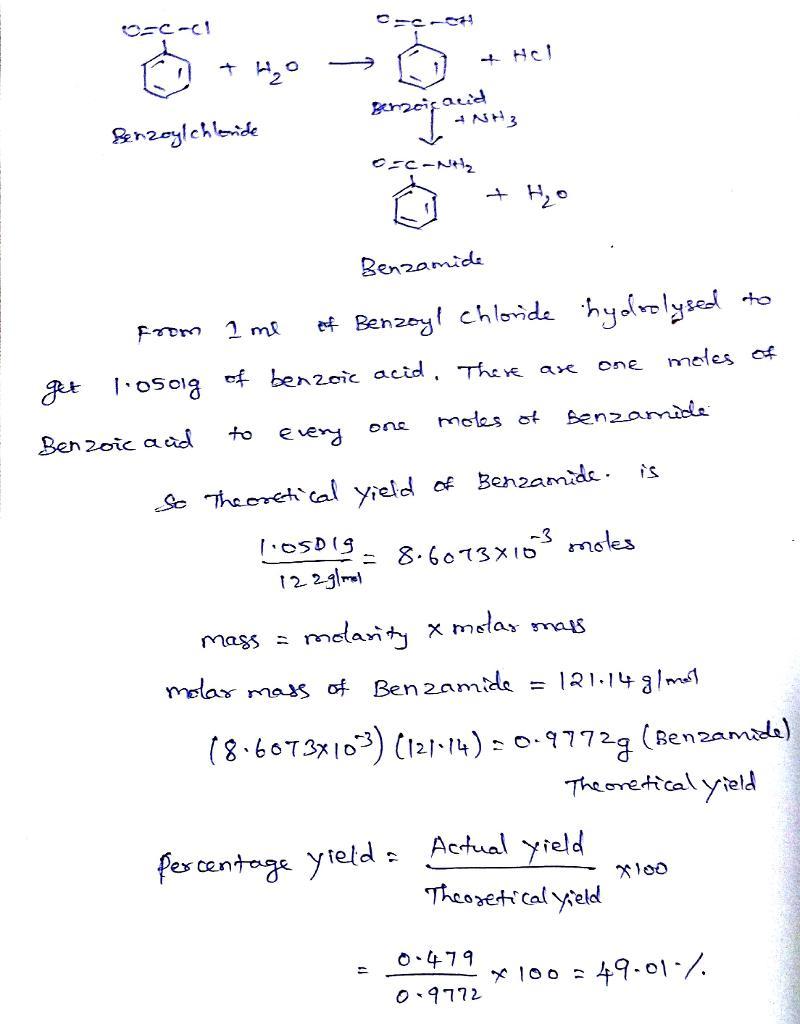
Consider the ammonolysis of benzoyl chloride by adding concentrated ammonium hydroxide to form the final product, benzamide. Rea
gizmo_the_mogwai [7]

Answer:

Explanation: see attachment below

4 0
2 years ago
A solution of 20.0 g of which hydrated salt dissolved in 200 g H2O will have the lowest freezing point? (A) CuSO4 • 5 H2O (M = 2
Andrews [41]

Answer:

(D) Na₂SO₄•10H₂O (M = 286).

Explanation:

  • The depression in freezing point of water by adding a solute is determined using the relation:

ΔTf = i.Kf.m,

Where, <em>ΔTf </em>is the depression in freezing point of water.

<em>i</em> is van't Hoff factor.

<em>Kf </em>is the molal depression constant.

<em>m</em> is the molality of the solute.

  • Since, Kf and m is constant for all the mentioned salts. So, the depression in freezing point depends strongly on the van't Hoff factor (i).
  • van't Hoff factor is the ratio between the actual concentration of particles produced when the substance is dissolved and the concentration of a substance as calculated from its mass.

(A) CuSO₄•5H₂O:

CuSO₄ is dissociated to Cu⁺² and SO₄²⁻.

So, i = dissociated ions/no. of particles = 2/1 = 2.

(B) NiSO₄•6H₂O:

NiSO₄ is dissociated to Ni⁺² and SO₄²⁻.

So, i = dissociated ions/no. of particles = 2/1 = 2.

(C) MgSO₄•7H₂O:

MgSO₄ is dissociated to Mg⁺² and SO₄²⁻.

So, i = dissociated ions/no. of particles = 2/1 = 2.

(D) Na₂SO₄•10H₂O:

Na₂SO₄ is dissociated to 2 Na⁺ and SO₄²⁻.

So, i = dissociated ions/no. of particles = 3/1 = 3.

∴ The salt with the high (i) value is Na₂SO₄•10H₂O.

So, the highest ΔTf resulted by adding Na₂SO₄•10H₂O salt.

4 0
2 years ago
In the citric acid cycle, after the acetyl-group (2C) from acetyl-CoA is transferred to oxaloacetate (4C) to produce citrate (6C
Alborosie

Answer:

The carbons of the acetyl group oxidize which generate CO2, and in turn H2O.

Explanation:

The pyruvic acid that is generated during glycolysis enters the mitochondria. Inside this organelle, the acid molecules undergo a process called oxidative decaborxylation in which an enzyme of several cofactors is involved, one of which is coenzyme A. Pyruvic acid is transformed into an acetyl molecule and these are been introduced to the begining of the Krebs Cycle where the acetyl-group (2C) from acetyl-CoA is transferred to oxaloacetate (4C) to produce citrate (6C). As the molecule cycles the two carbons of the acetyl oxidize and are released in the form of CO2. Then the energy of the Krebs cycle becomes sufficient to reduce three NAD +, which means that three NADH molecules are formed. Although a small portion of energy is used to generate ATP, most of it is used to reduce not only the NAD + but also the FAD which, if oxidized, passes to its reduced state, FADH2

8 0
2 years ago
At a given temperature, you have a mixture of benzene (vapor pressure of pure benzene = 745 torr) and toluene (vapor pressure of
swat32
Ideal solutions obey Raoult's law, which states that:

P_i = x_i*(P_pure)_i

where
P_i is the partial pressure of component i above a solution
x_i is the mole fraction of component i in the solution
(P_pure)_i is the vapor pressure of pure component i

In this case,

P_benzene = 0.59 * 745 torr = 439.6 torr
P_toluene = (1-0.59) * 290 torr = 118.9 torr

The total vapor pressure above the solution is the sum of the vapor pressures of the individual components:

P_total = (439.6 + 118.9) torr = 558.5 torr

Assuming the gas phase also behaves ideally, the partial pressure of each gas in the vapor phase is proportional to its molar concentration, so the mole fraction of toluene in the vapor phase is:

118.9 torr/558.5 torr = 0.213
8 0
2 years ago
Other questions:
  • X-ray photons with a wavelength of 0.135 nm . express the energy numerically in kilojoules per mole.
    7·2 answers
  • Please Help Potassium sulfate has a solubility of 15g/100g water at 40 Celsius. A solution is prepared by adding 39.0g of potass
    10·1 answer
  • A 4.305-g sample of a nonelectrolyte is dissolved in 105 g of water. the solution freezes at -1.23c. calculate the molar mass of
    7·1 answer
  • Diborane, B2H6 a possible rocket propellant, can be made by using lithium hydride (LiH): 6 LiH+ 2 BCl2àB2H6+ 6 LiCl . If you mix
    14·1 answer
  • A class is given a demonstration of solution chemistry and solubility equilibria.Passage: A 6.57-g sample of NiSO4•6H2O (molar m
    10·1 answer
  • During a titration the following data were collected. A 50.0 mL portion of an HCl solution was titrated with 0.500 M NaOH; 200.
    7·1 answer
  • A student constructs an electrochemical cell. A diagram of the operating cell and the unbalanced ionic equation representing the
    12·1 answer
  • A 8.00g of a certain Compound X, known to be made of carbon, hydrogen and perhaps oxygen, and to have a molecular molar mass of
    5·1 answer
  • A student places 1.38g of unknown metal at 99.6C into 60.50g of water at 22.1C. The entire system reaches a uniform temperature
    14·1 answer
  • A student obtained an unknown metal sample that weighed 65.3 g and at a temperature of 99.8oC, he placed it in a calorimeter con
    11·1 answer
Add answer
Login
Not registered? Fast signup
Signup
Login Signup
Ask question!