answer.
Ask question
Login Signup
Ask question
All categories
  • English
  • Mathematics
  • Social Studies
  • Business
  • History
  • Health
  • Geography
  • Biology
  • Physics
  • Chemistry
  • Computers and Technology
  • Arts
  • World Languages
  • Spanish
  • French
  • German
  • Advanced Placement (AP)
  • SAT
  • Medicine
  • Law
  • Engineering
liberstina [14]
2 years ago
8

In the citric acid cycle, after the acetyl-group (2C) from acetyl-CoA is transferred to oxaloacetate (4C) to produce citrate (6C

), subsequent reactions eventually result in 4C intermediates that are rearranged to regenerate oxaloacetate. What happens to the other two carbons?
Chemistry
1 answer:
Alborosie2 years ago
8 0

Answer:

The carbons of the acetyl group oxidize which generate CO2, and in turn H2O.

Explanation:

The pyruvic acid that is generated during glycolysis enters the mitochondria. Inside this organelle, the acid molecules undergo a process called oxidative decaborxylation in which an enzyme of several cofactors is involved, one of which is coenzyme A. Pyruvic acid is transformed into an acetyl molecule and these are been introduced to the begining of the Krebs Cycle where the acetyl-group (2C) from acetyl-CoA is transferred to oxaloacetate (4C) to produce citrate (6C). As the molecule cycles the two carbons of the acetyl oxidize and are released in the form of CO2. Then the energy of the Krebs cycle becomes sufficient to reduce three NAD +, which means that three NADH molecules are formed. Although a small portion of energy is used to generate ATP, most of it is used to reduce not only the NAD + but also the FAD which, if oxidized, passes to its reduced state, FADH2

You might be interested in
Why are the concentrations of [H3O+] and [OH−] equal in pure water?
kotegsom [21]

Answer : The correct option is, (A) [H_3O^+]=[OH^-] because one of each is produced every time an [H^+] transfers from one water molecule to another.

Explanation :

As we know that, when the two water molecule combine to produced hydronium ion and hydroxide ion.

The balanced reaction will be:

HOH+HOH\rightarrow H_3O^++OH^-

Acid : It is a substance that donates hydrogen ion when dissolved in water.

Base : It is a substance that accepts hydrogen ion when dissolved in water.

From this we conclude that, the hydrogen ion are transferred from one water molecule to the another water molecule to form hydronium ion and hydroxide ion. In this reaction, one water molecule will act as a base and another water molecule will act as an acid.

Hence, the correct option is, (A)

3 0
2 years ago
Albus Dumbledore provides his students with a sample of 19.3 g of sodium sulfate. How many oxygen atoms are in this sample
Dimas [21]

Answer:

<em>3.27·10²³ atoms of O</em>

Explanation:

To figure out the amount of oxygen atoms in this sample, we must first evaluate the sample.

The chemical formula for sodium sulfate is <em>Na₂SO₄, </em>and its molar mass is approximately 142.05\frac{g}{mol}.

We will use stoichiometry to convert from our mass of <em>Na₂SO₄ </em>to moles of <em>Na₂SO₄</em>, and then from moles of <em>Na₂SO₄ </em>to moles of <em>O </em>using the mole ratio; then finally, we will convert from moles of <em>O </em>to atoms of <em>O </em>using Avogadro's constant.

19.3g <em>Na₂SO₄</em> · \frac{1 mol Na^2SO^4}{142.05g Na^2SO^4} · \frac{4 mol O}{1 mol Na^2SO^4} ·\frac{6.022x10^2^3}{1 mol O}

After doing the math for this dimensional analysis, you should get a quantity of approximately <em>3.27·10²³ atoms of O</em>.

3 0
2 years ago
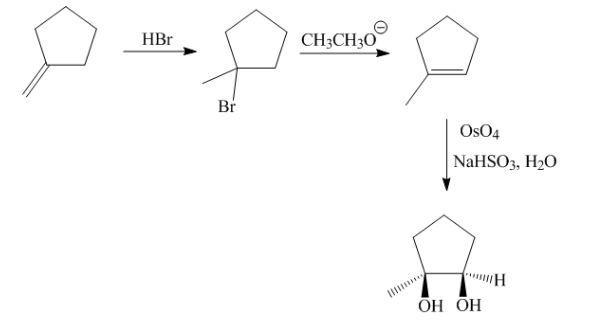
The target diol is synthesized in one step from 1-methylcyclopentene, but your lab partner exhausted the supply of that alkene.
andrezito [222]

Answer:

The reagents are CH_{3}CH_{3}O^{-},OsO_{4},NaHSO_{3}and H_{2}O.

Explanation:

1-Methylenecyclopentene is treated with HBr form 1-bromo-1-methylcyclopentane, which is treated with strong base ethoxide ion and forms 1-methylcyclopent-1-ene.

This alkene is treated with osmium tetraoxide in the presence of sodium bisulfite to form target product.

The chemical reaction is as follows.

4 0
2 years ago
Explain why you hear a “whoosh” sound when you open a can containing a carbonated drink. Which gas law applies?
Lana71 [14]

Carbonated drinks have the air under pressure so that carbon bubbles are forced into the drink, keeping it carbonated. So when you open a can, the air under pressure in the can comes out of the can at a high speed, making a "whooshing" sound. The gas law that applies to this concept is the Boyle's Law (PV=k or P1V1=P2V2).

6 0
2 years ago
Read 2 more answers
Phosphorous acid, H3PO3(aq), is a diprotic oxyacid that is an important compound in industry and agriculture. K pKa1 K pKa2 1.30
FrozenT [24]

Answer:

* Before addition of any KOH:

pH = 0,0301

*After addition of 25.0 mL KOH:

pH = 1,30

*After addition of 50.0 mL KOH:

pH = 2,87

*After addition of 75.0 mL KOH:

pH = 6,70

*After addition of 100.0 mL KOH:

pH = 10,7

Explanation:

H₃PO₃ has the following equilibriums:

H₃PO₃ ⇄ H₂PO₃⁻ H⁺

k = [H₂PO₃⁻] [H⁺] / [H₃PO₃] k = 10^-(1,30) <em>(1)</em>

H₂PO₃⁻ ⇄ HPO₃²⁻ + H⁺

k = [HPO₃²⁻] [H⁺] / [H₂PO₃⁻] k = 10^-(6,70) <em>(2)</em>

Moles of H₃PO₃ are:

0,0500L×(1,8mol/L) = 0,09 moles of H₃PO₃

* Before addition of any KOH:

Using (1), moles in equilibrium are:

H₃PO₃: 0,09-x

H₂PO₃⁻: x

H⁺: x

Replacing:

10^{-1.30} = \frac{x^2}{0.09-x}

4.51x10⁻³ - 0.050x -x² = 0

The right solution of x is:

x = 0.0466589

As volume is 0,050L

[H⁺] = 0.0466589moles / 0,050L = 0,933M

As pH = -log [H⁺]

<em>pH = 0,0301</em>

*After addition of 25.0 mL KOH:

0,025L×1,8M = 0,045 moles of KOH that reacts with H₃PO₃ thus:

KOH + H₃PO₃ → H₂PO₃⁻ + H₂O

That means moles of KOH will be the same of H₂PO₃⁻ and moles of H₃PO₃ are 0,09moles - 0,045moles = 0,045moles

Henderson-Hasselbalch formula is:

pH = pka + log₁₀ [A⁻] /[HA]

Where A⁻ is H₂PO₃⁻ and HA is H₃PO₃.

Replacing:

pH = 1,30 + log₁₀ [0,045mol] / [0,045mol]

<em>pH = 1,30</em>

*After addition of 50.0 mL KOH:

The addition of 50.0 mL KOH consume all H₃PO₃. Thus, in the solution you will have just H₂PO₃⁻. Thus, moles in solution for the equilibrium will be:

H₂PO₃⁻: 0,09-x

HPO₃²⁻: x

H⁺: x

Replacing:

10^{-6.70} = \frac{x^2}{0.09-x}

1.8x10⁻⁸ - 2x10⁻⁷x - x² = 0

The right solution of x is:

x = 0.000134064

As volume is 50,0mL + 50,0mL = 100,0mL

[H⁺] = 0.000134064moles / 0,100L = 1.34x10⁻³M

As pH = -log [H⁺]

<em>pH = 2,87</em>

*After addition of 75.0 mL KOH:

Applying Henderson-Hasselbalch formula you will have 0,045 moles of both H₂PO₃⁻ HPO₃²⁻ and pka: 6,70:

pH = 6,70 + log₁₀ [0,045mol] / [0,045mol]

<em>pH = 6,70</em>

*After addition of 100.0 mL KOH:

You will have just 0,09moles of HPO₃²⁻, the equilibrium will be:

HPO₃²⁻ + H₂O ⇄ H₂PO₃⁻ + OH⁻ with kb = kw/ka = 1x10⁻¹⁴/10^-(6,70) = 5,01x10⁻⁸

kb = [H₂PO₃⁻] [OH⁻] / [HPO₃²⁻]

Moles are:

H₂PO₃⁻: x

OH⁻: x

HPO₃²⁻: 0,09-x

Replacing:

5.01x10^{-8} = \frac{x^2}{0.09-x}

4.5x10⁻⁹ - 5.01x10⁻⁸x - x² = 0

The right solution of x is:

x = 0.000067057

As volume is 50,0mL + 100,0mL = 150,0mL

[OH⁻] = 0.000067057moles / 0,150L = 4.47x10⁻⁴M

As pH = 14-pOH; pOH = -log [OH⁻]

<em>pH = 10,7</em>

<em></em>

I hope it helps!

6 0
2 years ago
Other questions:
  • What is effective nuclear charge of S2- and S? Does the Zeff differs from ions and atoms of the same element.
    14·2 answers
  • If the coefficient 2 is placed in front of the product tetraiodine nonaoxide (I4O9), then, how many atoms of each element must b
    14·1 answer
  • a quantity of 18.68 mL of KOH solution is needed to neutralize 0.4218 g of KHP. What is the concentration (in molarity) of the K
    8·1 answer
  • Which scientist provided a foundation for John Dalton’s work on the atomic structure?
    8·1 answer
  • recheck Fusion reactions power the in space. Humans currently use fusion in , but researchers are seeking more applications.
    14·1 answer
  • A lithium salt used in lubricating grease has the formula LiCnH2n+1O2. The salt is soluble in water to the extent of 0.036 g per
    14·1 answer
  • Which of the following elements will gain electrons to form an
    5·1 answer
  • Old aspirin exposed to moisture often smells like acetic acid (vinegar). When aspirin is heated in boiling water, it decomposes
    8·1 answer
  • Aluminum has a specific heat of 0.902 j/gC. How much heat is lost when a piece of aluminum with a mass of 23.984 g cools from a
    6·1 answer
  • How much energy is required to vaporize 1.5 KG of aluminum
    8·1 answer
Add answer
Login
Not registered? Fast signup
Signup
Login Signup
Ask question!