answer.
Ask question
Login Signup
Ask question
All categories
  • English
  • Mathematics
  • Social Studies
  • Business
  • History
  • Health
  • Geography
  • Biology
  • Physics
  • Chemistry
  • Computers and Technology
  • Arts
  • World Languages
  • Spanish
  • French
  • German
  • Advanced Placement (AP)
  • SAT
  • Medicine
  • Law
  • Engineering
levacccp [35]
2 years ago
13

A 50-kN hydraulic press performs pressing and clamping actions. The clamping cylinder force is 4 kN. The pressing cylinder strok

e is 30 cm and its extension speed is 8 cm/s. Design the hydraulic circuits, perform the preliminary calculations, and select the needed hydraulic elements. Then, calculate the different operating modes of the system.

Engineering
1 answer:
galben [10]2 years ago
4 0

Answer:

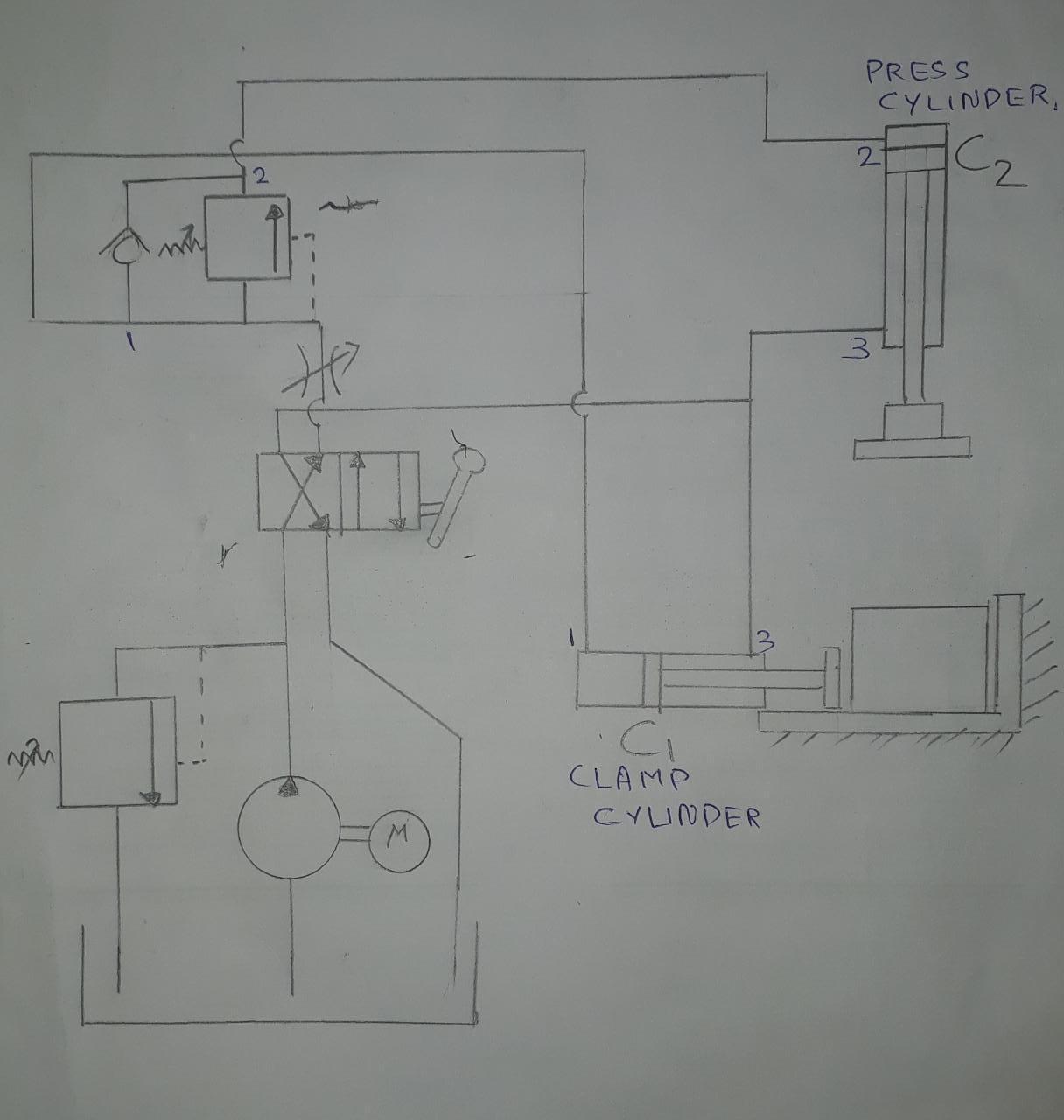
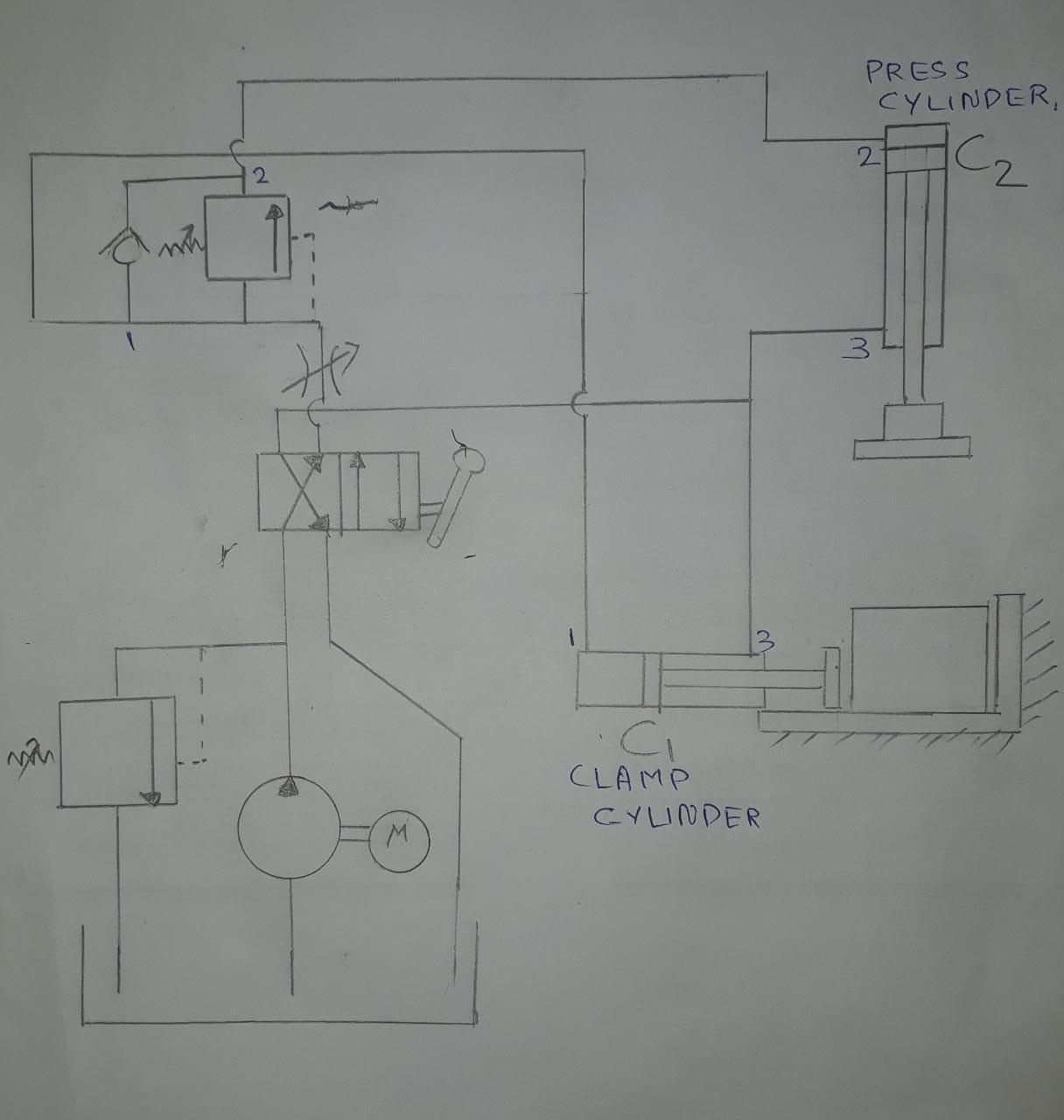
The attached figure shows the hydraulic circuit using one sequence valve to control two simultaneous operations performed in proper sequence in one direction only. In the other direction, both the operations are simultaneous.

When we keep the 4/2 DCV in crossed arrow position, oil under pressure is supplied to the inlet port of the sequence valve. It directly flows to Head end port-1. Hence Cylinder 'C1' extends first.

By the end of the extension of cylinder 'C1', pressure in the line increases and hence poppet of sequence valve is lifted off from its seat and allows oil to flow to port-2 and hence, Cylinder 'C2 extends completing the pressing operation.

In the straight-arrow position of 4/2 DCV the oil under pressure reaches the rod end of both the cylinders C1 and C2 simultaneously through port-3. This causes both the cylinders to retract simultaneously.

Also, a Flow control valve is provided tho control the velocity of clamping

Explanation:

find attached the figure

You might be interested in
Effects of biological hazards are widespread. Select the answer options which describe potential effects of coming into contact
s2008m [1.1K]

Answer:

- Allergic Reactions

- Life Threatinging Events

Explanation:

Sources of biological hazards may include bacteria, viruses, insects, plants, birds, animals, and humans. These sources can cause a variety of health effects ranging from skin irritation and allergies to infections (e.g., tuberculosis, AIDS), cancer and so on.

7 0
2 years ago
Compute the mass fractions of α ferrite and cementite in pearlite. Assume T=726⁢ C∘.
kotykmax [81]

Answer:

The mass composition of ∝ ferrite is 88.94%.

The mass composition of cementite is 11.05%.

Explanation:

Given that

T=726 °C

We have to find the mass fractions of ferrite nad cementite in pearlite.

Lets take data from ideal Iron -carbon diagram at 726 °C

Composition of ∝ ferrite=0.022 5

Composition of pearlite =0.76 %

Composition of cementite =7.6%

We know that if we want to find the mass fraction the  we use Lever rule .So now by using lever rule

The\ mass\ composition\ of\alpha \ ferrite =\dfrac{6.7-0.76}{6.7-0.022}

So the mass composition of ∝ ferrite is 88.94%.

The\ mass\ composition\ of\ cementite =\dfrac{0.76-0.022}{6.7-0.022}

So the mass composition of cementite is 11.05%.

4 0
2 years ago
A heat pump cycle operating at steady state receives energy by heat transfer from well water at 10oC and discharges energy by he
Marta_Voda [28]

Answer: the total amount of energy transferred by work into the heat pump over the 14-day period is 5.8GJ

Explanation: since the meter reading for the 14 days period is 1620kW.h

Electrical power Ep is

Ep = 1620*10^3W.h

In 14 days there are 14*24 hrs = 336hrs

Ep = (1620*10^3)/336 = 4821.42W

This means 4821.42J of work is done per sec. Therefore for 14 days we have,

3600*24*14*4821.42J of enegy

= 5831989632J = 5.8GJ

Answer 2 = the amount of energy that the heat pump receives by heat transfer from the well water over the 14-day period is 41.2GJ

Explanation: rate of energy transfer as heat to building is 1.4*10^5 kJ/hr

That is 1.4*10^8 J/hr

In 14 days it becomes

24*14*1.4*10^8 = 47GJ

Energy received from well by heat pump =

Energy transfered - energy received

= 47 - 5.8 =41.2GJ

Answer 3. the heat pump’s coefficient of performance is 0.12

Explanation: COP = energy obtained/ work done

COP = 5.8/47 = 0.12

8 0
2 years ago
A non-licensed person may be the SOLE owner of a civil, electrical, or mechanical engineering business under which of the follow
kotegsom [21]

Answer:

(d) None. No provisions exist.

Explanation:

B&P Code § 6738 prohibits a non-licensed person from being the sole proprietor of an engineering business. The non-licensed can be a partner in an engineering business that offers civil, electrical, or mechanical services. It is mandatory that at least one licensed engineer must be a co-owner of the business.

5 0
2 years ago
A submarine submerges by admitting seawater (S = 1.03) into its ballast tanks. The amount of water admitted is controlled by air
ser-zykov [4K]

Answer:

Explanation:

Fw= y looking symbol sea water (2010.62-168171.2727/h+32.935)ft^3
6 0
2 years ago
Other questions:
  • A three-point bending test was performed on an aluminum oxide specimen having a circular cross section of radius 3.5 mm (0.14 in
    11·1 answer
  • Write a simple phonebook program that reads in a series of name-number pairs from the user (that is, name and number on one line
    12·1 answer
  • A jar made of 3/16-inch-thick glass has an inside radius of 3.00 inches and a total height of 6.00 inches (including the bottom
    6·1 answer
  • At a certain college, 30% of the students major in engineering, 20% play club sports, and 10% both major in engineering and play
    14·1 answer
  • A gas turbine operates with a regenerator and two stages of reheating and intercooling. Air enters this engine at 14 psia and 60
    11·1 answer
  • The working substance of a certain Carnot engine is 1.20 mol of an ideal monatomic gas. During the isothermal expansion portion
    8·1 answer
  • Add an Overflow output to the 32-bit ALU from Exercise 5.9. The output is TRUE when the result of the adder overflows. Otherwise
    12·1 answer
  • Based in bonding theory, explain why heat capacity increases when you consider metals, ceramics and polymers.
    14·1 answer
  • Consider a convergent-divergent duct with exit and throat areas of 0.5 m2 and 0.25 m2, respectively. The inlet reservoir pressur
    6·1 answer
  • The ground temperature a few meters below the surface is fairly constant throughout the year and is near the average value of th
    9·1 answer
Add answer
Login
Not registered? Fast signup
Signup
Login Signup
Ask question!