answer.
Ask question
Login Signup
Ask question
All categories
  • English
  • Mathematics
  • Social Studies
  • Business
  • History
  • Health
  • Geography
  • Biology
  • Physics
  • Chemistry
  • Computers and Technology
  • Arts
  • World Languages
  • Spanish
  • French
  • German
  • Advanced Placement (AP)
  • SAT
  • Medicine
  • Law
  • Engineering
Nina [5.8K]
2 years ago
9

Analysis of a sample of a gaseous compound shows that it contains 85.7% C and 14.3% H by mass. At standard conditions, 112 mL of

the gaseous compound weighs 0.21 g. What is the molecular formula for the compound
Chemistry
1 answer:
KIM [24]2 years ago
4 0

Answer: The molecular formula for the given compound is C_3H_6

Explanation : Given,

Percentage of C = 85.7 %

Percentage of H = 14.3 %

Let the mass of compound be 100 g. So, percentages given are taken as mass.

Mass of C = 85.7 g

Mass of H = 14.3 g

To formulate the empirical formula, we need to follow some steps:

Step 1: Converting the given masses into moles.

Moles of Carbon =\frac{\text{Given mass of Carbon}}{\text{Molar mass of Carbon}}=\frac{85.7g}{12g/mole}=7.14moles

Moles of Hydrogen = \frac{\text{Given mass of Hydrogen}}{\text{Molar mass of Hydrogen}}=\frac{14.3g}{1g/mole}=14.3moles

Step 2: Calculating the mole ratio of the given elements.

For the mole ratio, we divide each value of the moles by the smallest number of moles calculated which is 7.14 moles.

For Carbon = \frac{7.14}{7.14}=1

For Hydrogen  = \frac{14.3}{7.14}=2.00\approx 2

Step 3: Taking the mole ratio as their subscripts.

The ratio of C : H = 1 : 2

The empirical formula for the given compound is C_1H_2=CH_2

Mass of empirical formula = CH_2  = 1(12) + 2(1) = 14 g/eq.

Now we have to determine the molar mass of compound.

As, 112 mL of volume contains 0.21 g of compound

So, 22400 mL of volume contains \frac{22400}{112}\times 0.21=42g of compound

For determining the molecular formula, we need to determine the valency which is multiplied by each element to get the molecular formula.

The equation used to calculate the valency is :

n=\frac{\text{molecular mass}}{\text{empirical mass}}

We are given:

Mass of molecular formula = 42 g/mol

Mass of empirical formula = 14 g/mol

Putting values in above equation, we get:

n=\frac{42}{14}=3

Multiplying this valency by the subscript of every element of empirical formula, we get:

CH_2=(CH_2)_n=(CH_2)_3=C_3H_6

Thus, the molecular formula for the given compound is C_3H_6

You might be interested in
A particular first-order reaction has a rate constant of 1.35 × 10² s-1 at 25.0°c. what is the magnitude of k at 75.0°c if ea =
IgorC [24]
According to this formula:
K= A*(e^(-Ea/RT) when we have K =1.35X10^2 & T= 25+273= 298K &R=0.0821
Ea= 85.6 KJ/mol So by subsitution we can get A:
1.35x10^2 = A*(e^(-85.6/0.0821*298))
1.35x10^2 = A * 0.03
A= 4333
by substitution with the new value of T(75+273) = 348K & A to get the new K
∴K= 4333*(e^(-85.6/0.0821*348)
  = 2.16 x10^2
8 0
2 years ago
How many moles of chromium(iii) nitrate are produced when chromium reacts with 0.85 moles of lead(iv) nitrate to produce chromiu
Alexxandr [17]
The  moles  of  chromium (iii)  nitrate  produced  is  calculated  as   follows

write  the  equation  for  reaction

 3  Pb(NO3)2  +  2 Cr  =  2 Cr(NO3)3  +  3  Pb

by  use  of  mole  ratio  between  Pb(NO3)2  to  Cr(NO3)3  which  is  3  :  2  the  moles  of  Cr(NO3)3  is therefore  
=  0.85  x2  /3  =  0.57   moles
5 0
2 years ago
0.45 g of hydrated sodium carbonate crystals were heated until 3.87 of anhydrous power remained.
snow_tiger [21]

Formula of hydrated sodium carbonate : Na₂CO₃.10H₂O, so moles of water in one mole of hydrated salt = 10

<h3>Further explanation</h3>

Hydrate is a compound that binds water (H₂O), usually in the form of crystals/ solids

If these compounds are dissolved in water or heated, the hydrates can decompose:

Example: X.YH₂O (s) → X (aq) + YH₂O (l)

The formula for the hydrated compound contains: YH2O

The mole ratio shows the ratio of the coefficients of the hydrate compound

10.45 hydrated sodium carbonate(Na₂CO₃.xH₂O) were heated until 3.87 of 3.87of anhydrous (Na₂CO₃) remained, so

mass H₂O released :

\tt 10.45-3.87=6.58~g

mass Na₂CO₃ = 3.87 g

mol ratio Na₂CO₃(MW= g/mol) : H₂O(MW=18 g/mol) =

\tt \dfrac{3.87}{105,9888}\div \dfrac{6.58}{18}=0.0365\div 0.3655=1\div 10

6 0
2 years ago
mixture or pure substance: 1.blood 2.dyes 3.self-raising flour 4.muesli 5.copper wire 6.distilled water 7.table salt 8.milk 9.br
jenyasd209 [6]

Answer: Mixture: Blood , Self raising flour,muesli ,dyes, milk, tea, air, bronze

Pure substance: Copper wire, distilled water, table salt, oxygen.

Explanation:

Mixture is a substance which is made up two or more number of compounds which chemically inactive and retain their distinct chemical properties.

Blood , Self raising flour,muesli ,dyes, milk, tea, air, bronze

Pure substance is defined as anything with uniform and unchanging composition is known s pure substance.

Copper wire, distilled water, table salt, oxygen.

5 0
2 years ago
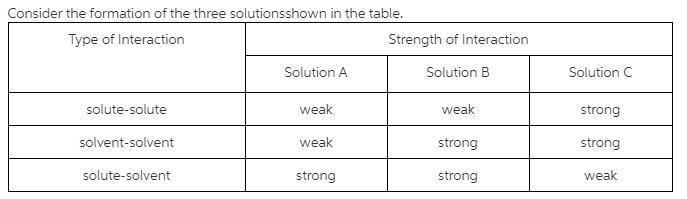
Rank the formation of the solutions A, B, and C from the most exothermic to the most endothermic. Rank the enthalpy of solution
Elodia [21]

This is an incomplete question, the table is attached below.

Answer : The correct ranking of the solution from most exothermic to most endothermic will be: A, B and C.

Explanation :

As we know that the intermolecular force of attraction play an important role in the interaction of solute-solute, solute-solvent and solvent solvent solution.

In the solution A, the solute-solute and solvent-solvent interactions are weak. So, their solute-solvent interaction will be strong. That means, the solution will be more exothermic.

In the solution C, the solute-solute and solvent-solvent interactions are strong. So, their solute-solvent interaction will be weak. That means, the solution will be more endothermic.

Thus, the correct ranking of the solution from most exothermic to most endothermic will be: A, B and C.

4 0
2 years ago
Other questions:
  • Reaction 1: c3h8(g)+5o2(g)→3co2(g)+4h2o(g), δh1=−2043 kj reaction 2: 6c3h8(g)+30o2(g)→18co2(g)+24h2o(g), δh2=?
    10·2 answers
  • What would the pOH of a solution that causes the cyanidin indicator to turn purple be?
    11·1 answer
  • Water's surface tension and heat storage capacity are accounted for by its ______. A) orbitals B) weight C) hydrogen bonds D) ma
    10·1 answer
  • Aluminum–lithium (Al–Li) alloys have been developed by the aircraft industry to reduce the weight and improve the performance of
    8·1 answer
  • Rubbing alcohol contains 615g of isopropanol (C3H7OH) per liter (aqueous solution). Calculate the molality of this solution. Giv
    12·1 answer
  • Challenge question: This question is worth 6 points. As you saw in problem 9 we can have species bound to a central metal ion. T
    7·1 answer
  • Chose the statements that are TRUE from the list below Group of answer choices Ions exist alone in nature We add calcium carbona
    5·1 answer
  • In a voltaic cell made of a Ag strip and an Al strip immersed in 1.0 M aqueous AgNO_3 and Al(NO_3)_3 solutions, respectively, wi
    6·1 answer
  • What types of compounds are CaCl2, Cu, C2H6, respectively.
    6·1 answer
  • A food web showing the flow of energy through a freshwater ecosystem is shown below. Which of the animals shown in the food web
    11·2 answers
Add answer
Login
Not registered? Fast signup
Signup
Login Signup
Ask question!