answer.
Ask question
Login Signup
Ask question
All categories
  • English
  • Mathematics
  • Social Studies
  • Business
  • History
  • Health
  • Geography
  • Biology
  • Physics
  • Chemistry
  • Computers and Technology
  • Arts
  • World Languages
  • Spanish
  • French
  • German
  • Advanced Placement (AP)
  • SAT
  • Medicine
  • Law
  • Engineering
ddd [48]
2 years ago
15

A single-effect evaporator is concentrating a feed of 9072 kg/h of a 10 wt % solution of NaOH in water at temperature of 288.8 K

to a product of 50% solids. The pressure of the saturated steam used is 42 kPa (gage) and the pressure in the vapor space of the evaporator is 20 kPa (abs).
a)Neglecting boiling point raise and the heat of solution, calculate the steamused, the steam economy in kg vaporized/kg steam, required surface area ofthe evaporator.


b)Repeat the calculations taking into consideration boiling point raise and heatof solution

Chemistry
2 answers:
Reil [10]2 years ago
7 0

Answer:

Check the explanation

Explanation:

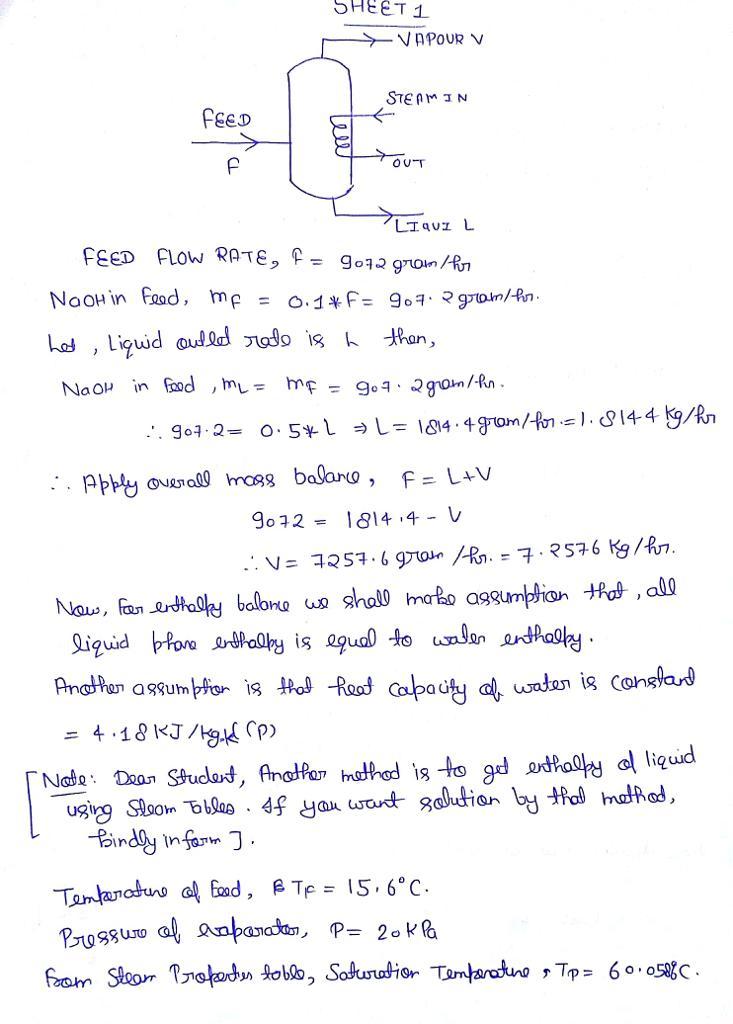
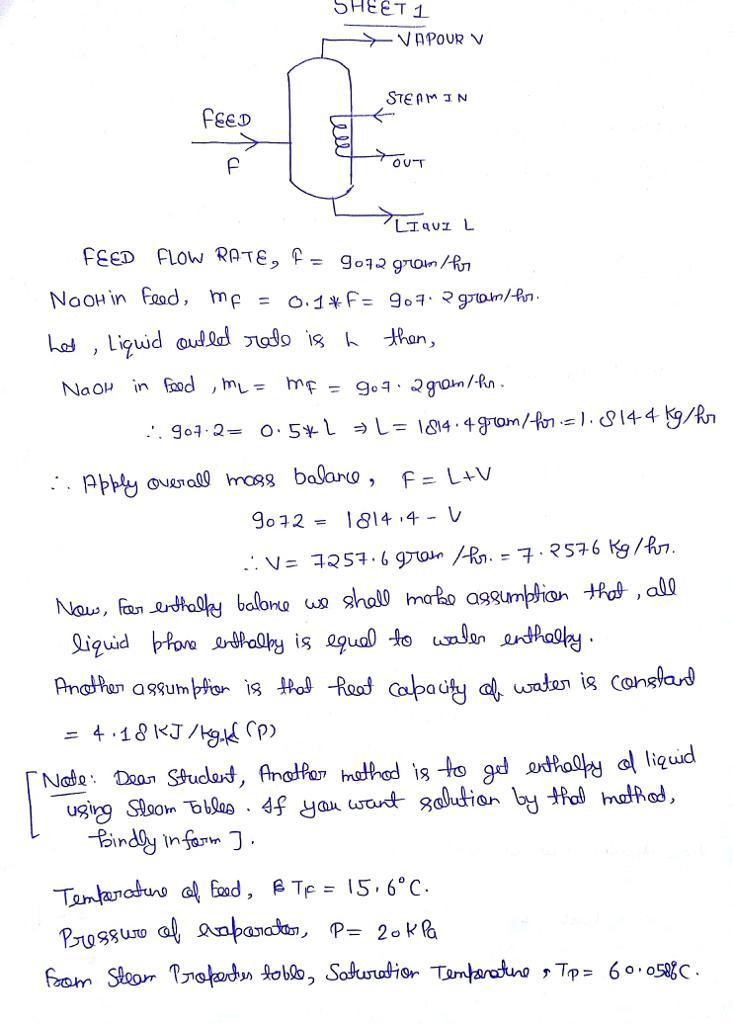
Going by the question above for parta, the feed flow rate is stated to be 9072g/hr.& result is offered for part a considering the same. if the unit is kg/hr, then kindly let me know & i shall make slight modification that might be required in solution which in that case, area & steam consumption answer shall differ.

In the b part of the question, reduced flow rate is higher than the initial flow rate therefore same has been considered in gram /hr.

Kindly check the attached images below to see the step by step solution to the above question.

Aloiza [94]2 years ago
6 0

Answer:

a) steam used = 8440 kg/hr

b)  Because as per calculation done in a), Steam is sufficient to evaporate 7257.6 kg/hr water from feed. Since feed is less than this amount, therefore whole water will be evaporated and 100% solid product will be obtained in bottom collection

Explanation:

Saturated steam pressure = 42KPag=1.42 bar

From steam table, Steam temperature = 110 C

Latent heat of this steam = 2230 KJ/kg

Process side pressure = 20 Kpaa = .2 bar

Water latent heat at this Pressue = 2360 KJ/kg

Water boiling Point at this Pressure =60 C

Feed Inlet temperature = 15.6 C

Total Heat required = Heat required to rise feed temperature from 15.6 to 60 degree C + Evaporation of water to concentrate the feed

Total Water evaporation required = 9072*(100-10)/100-9072*.1/.5*.5=7257.6 Kg/hr

Specific heat of feed assumed = 4.2 KJ/kg/K

=> Total heat required = 9072*4.2*(60-15.6)+7257.6*2360=18819682 KJ/hr

LMTD = ((110-60)-(110-15.6))/LN((110-60)/(110-15.6))=69.8 C

U, Overall Heat transfer coefficient = 1988 W/m2/K

Total heat required = U*A*LMTD

=> Area required of evaporator, A=18819682 *1000/3600/1988/59.8=44 m2

Steam used = 18819682/2230=8440 kg/hr

Energy required to condense vaporised feed = 7257.6*2360=17127936 KJ/hr

=> Steam efficiency = (18819682-17127936)/18819682=9%

b) Because as per calculation done in a), Steam is sufficient to evaporate 7257.6 kg/hr water from feed. Since feed is less than this amount, therefore whole water will be evaporated and 100% solid product will be obtained in bottom collection
You might be interested in
Which of the following compounds has the highest pKa value? A)CCl3CH2NH2
Rudik [331]
The lower the pKa<span> of a Bronsted acid, the more easily it gives up its proton. The </span>higher<span> the </span>pKa<span> of a Bronsted acid, the more tightly the proton is held, and the less easily the proton is given up.

Here we need the highest pKa, so we need to see which compound  will less likely to give proton or hydrogen ion.

</span><span>Now, all Nitrogen contains a lone pair. But HALOGEN groups( F, Cl, only) being electronegative than NITROGEN [electronegativity of N=3, F=4 and Cl=3], pulls electron pair towards itself. 
</span>
The more the lone pair of nitrogen is pulled, the more strong bond between N and H will become, which means less likely to give hydrogen ion.
means high Pka

C) option is the answer because it has 3 F very close to N.
3 0
2 years ago
Select the correct answer.
Phoenix [80]

Answer:

Molecular formula =  C₆H₁₂O₆

Explanation:

Given data:

Mass of hydrogen = 31.7 g

Mass of carbon = 283.4 g

Mass of oxygen = 377.4 g

Molar mass of compound = 176.124 g/mol

Molecular formula = ?

Solution:

Number of gram atoms of H = 31.7 / 1.01 = 31.4

Number of gram atoms of O = 377.4 / 16 = 23.6

Number of gram atoms of C = 283.4 / 12 = 23.6

Atomic ratio:

            C                      :      H                 :         O

           23.6/23.6         :     31.4/23.6     :       23.6/23.6

              1                      :        1.33              :        1

C : H : O =3 (1 : 1.33 : 1 )

Empirical formula is C₃H₄O₃.

Molecular formula:

Molecular formula = n (empirical formula)

n = molar mass of compound / empirical formula mass

Empirical formula mass  = 3×12+4+3×16 = 88

n = 176.124 / 88

n = 12

Molecular formula = n (empirical formula)

Molecular formula = 2 (C₃H₄O₃)

Molecular formula =  C₆H₁₂O₆

7 0
2 years ago
A patient needs to be given exactly 500 ml of a 5.0% (w/v) intravenous glucose solution. the stock solution is 35% (w/v). how ma
N76 [4]
In this question, the <span>patient needs to be given exactly 500 ml of a 5.0%. The content of the glucose should be:
</span>weight= volume * density* concentration<span>
500ml * 1mg/ml *5%= 25mg.

The </span><span>stock solution is 35%, then the amount needed in ml would be: 
weight= volume * density* concentration
25mg= volume * 1mg/ml *35%
volume= 25/35%= 500/7= 71.43ml</span>
6 0
2 years ago
Read 2 more answers
If the kinetic energy of a particle is equal to twice its rest mass, what is the velocity of the particle? Determine if relativi
ivann1987 [24]

Answer:

The velocity of the particle is 2 m/s,

Explanation:

Kinetic energy is defined as energy of the body due to its motion. It is given by :

K.E=\frac{1}{2}mv^2

Where :

m = mass of the object

v = velocity of the object

We have , particle with mass m and its kinetic energy is twice its mass.

K.E=2m

2m=\frac{1}{2}mv^2

v^2=\frac{4}{1}

v=2

And unit of velocity are m/s , so the velocity of the particle is 2 m/s.

8 0
2 years ago
As Danny was pouring cereal for his breakfast, he noticed that the cereal box says that the cereal contains 5 milligrams of iron
Vinil7 [7]

Answer:

Correct, because B it is reported to the nearest miligram

Explanation:

4.6 rounded up is 5

6 0
2 years ago
Other questions:
  • How many moles of hydrogen gas are produced when 0.066 mole of sodium is completely reacted?
    14·2 answers
  • Convert mass to moles for both reactants. (round to 2 significant figures.) 2.50 g cuci2 equals moles e 0.25 g Al equals moles D
    5·2 answers
  • What mass of ni2+ is produced in solution by passing a current of 67.0 a for a period of 14.0 h , assuming the cell is 90.0 % ef
    15·1 answer
  • Carbonic acid reacts with water to yield bicarbonate ions and hydronium ions: h2co3+h2o⇌hco3−+h3o+ identify the conjugate acid-b
    15·2 answers
  • a student uses universal pH paper to find the pH of three solutions . solution A has a pH of 5 solution B has a pH of 11 and sol
    12·1 answer
  • Janet observes that the shape of a dented table tennis ball is restored by heating the ball gently in warm water. Which of the f
    13·1 answer
  • Identify the number of moles in 369 grams of calcium hydroxide. Use the periodic table and the polyatomic ion resource.
    6·1 answer
  • Classify each of these soluble solutes as a strong electrolyte, a weak electrolyte, or a nonelectrolyte. Solutes Formula Hydroch
    5·2 answers
  • Answer the following questions regarding bond lengths and bond strengths. Choose all that apply. Choose all that apply. Single b
    11·1 answer
  • Shelby measured the volume of a cylinder and determined it to be 54.5 cm3 . The teacher told her that she was 4.25% too high in
    13·1 answer
Add answer
Login
Not registered? Fast signup
Signup
Login Signup
Ask question!