answer.
Ask question
Login Signup
Ask question
All categories
  • English
  • Mathematics
  • Social Studies
  • Business
  • History
  • Health
  • Geography
  • Biology
  • Physics
  • Chemistry
  • Computers and Technology
  • Arts
  • World Languages
  • Spanish
  • French
  • German
  • Advanced Placement (AP)
  • SAT
  • Medicine
  • Law
  • Engineering
stealth61 [152]
2 years ago
9

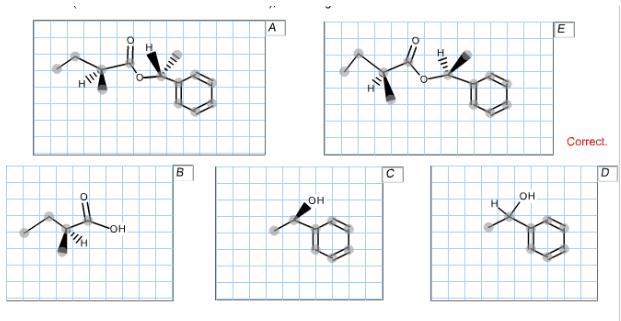
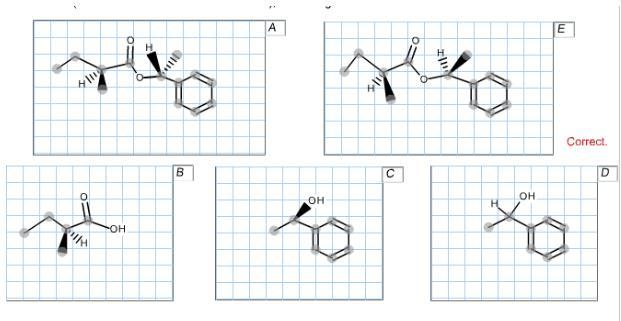
Exactly 2.00 g of an ester A containing only C, H, and O was saponified with 15.00 mL of a 1.00 M NaOH solution. Following the s

aponification, the solution required 5.30 mL of 1.00 M HCl to titrate the unused NaOH. Ester A, as well as its acid and alcohol saponification products B and C, respectively, were all optically active. Compound A was not oxidized by K2Cr2O7, nor did compound A decolorize Br2 in CH2Cl2. Alcohol C was oxidized to acetophenone by K2Cr2O7. When acetophenone was reduced with NaBH4, a compound D was formed that reacted with the acid chloride derived from B to give two optically active compounds: A (identical to the starting ester) and E. Propose a neutral structure for each compound that is consistent with the data. Note that the absolute stereochemical configurations of chiral substances cannot be determined from the data. Arbitrarily draw a configuration for an enantiomer (and be consistent with the derivatives); omit wedge/dash bonds for a racemate.

Chemistry
1 answer:
Anna11 [10]2 years ago
5 0

Answer:

Explanation:

check the attachment for the propose neutral  structure for each compound that is  consistent with the data.

You might be interested in
What is effective nuclear charge of S2- and S? Does the Zeff differs from ions and atoms of the same element.
Elan Coil [88]
<span>Effective nuclear charge is an estimate of the charge experienced by the valence electrons.
</span><span>Sulfur has 6 valence electrons and a charge of 6+.
</span><span>The 3s electrons in sulfur are the 3p electrons, because the former spend more time closer to the nucleus.</span>
<span>Using Slater's Rules, effective nuclear charge of sulfur is +5.5.

2) No!</span><span> The Zeff doesn't differ from ions and atoms of the same element.</span>
7 0
2 years ago
Read 2 more answers
To calculate the relative age of rocks, geologists use the rate of radioactive decay of isotopes present in their samples. What
GenaCL600 [577]
A

I have had this question!!
Hope this helps!!!
4 0
2 years ago
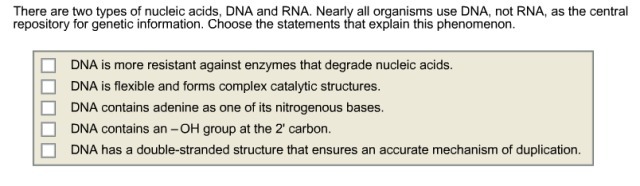
There are two types of nucleic acids, dna and rna. nearly all organisms use dna, not rna, as the central repository for genetic
Leya [2.2K]
Found the choices. Pls see attachment. 

The statements that explains this phenomenon are:
1) DNA contains adenine as one of its nitrogenous bases.
2) DNA has a double-stranded structure that ensures an accurate mechanism of duplication.

6 0
2 years ago
Does oxygen have a greater mass than chlorine
rjkz [21]
Atomic oxygen does not have a greater atomic mass than chlorine, nor does molecular oxygen.

Hope this help...


5 0
2 years ago
What is the sequence of energy transformations that occur in a nuclear reactor? nuclear energy Right arrow. Mechanical energy Ri
Mademuasel [1]

Answer:

NUCLEAR ENERGY -----> MECHANICAL ENERGY -------> THERMAL ENERGY --------> ELECTRICAL ENERGY

Explanation:

In nuclear reactor, various energy transformations occur in order to generate electricity. Nuclear reactor converts the energy released from nuclear fission and the heat generated is removed from the reactor by a cooling system where steam is generated. The steam then drives a turbine which powers a generator to produce electricity.

A nuclear reactor is hence an equipment where nuclear chain reactions occur and control can be obtained. The nuclear reactor uses mostly uranium-235 and Plutonium-239. When these radioactive substances absorbs neutrons, they undergo nuclear fission causing the nucleus to split into two or more smaller compounds with  the release of kinetic energy a form of mechanical energy, gamma radiations and others.The kinetic energy is then harnessed in the equipment as heat (thermal energy) which is received by a cooling system and steam is generated. The steam can then power the generator from which electricity is obtained (electrical energy).

So therefore, in a nuclear reactor, the nuclear energy is transformed to mechanical energy and then thermal energy which powers the generation of the electrical energy.
6 0
2 years ago
Other questions:
  • How many grams of Cl are in 38.0 g of each sample of chlorofluorocarbons (CFCs)?
    15·1 answer
  • Name the complex ion [cu(cn)6]4−. the oxidation number of copper is +2.enter the name.
    12·1 answer
  • A chemist adds 180.0 mL of a 1.42M sodium carbonate (Na CO,) solution to a reaction flask. Calculate the millimoles of sodium ca
    8·1 answer
  • One of the emission lines of the hydrogen atom has a wavelength of 93.07 nm. Determine the initial value of n associated with th
    8·2 answers
  • What is the change in enthalpy associated with the combustion of 530 g of methane (CH4)?Report your answer in scientific notatio
    5·1 answer
  • The pressure and temperature inside a bike tire is 10 atm and 10k respectively. What will the pressure become in the tire when t
    7·1 answer
  • The elements chlorine and iodine have similar chemical properties because they _____. Group of answer choices have the same numb
    7·1 answer
  • Polymerization starts at the ________ end of the template.
    6·1 answer
  • Josie bought some frozen meat in a vacuum sealed package. What is one of the main reasons the manufacturer used this packaging?
    6·2 answers
  • Consider the energy diagram below.
    12·2 answers
Add answer
Login
Not registered? Fast signup
Signup
Login Signup
Ask question!