answer.
Ask question
Login Signup
Ask question
All categories
  • English
  • Mathematics
  • Social Studies
  • Business
  • History
  • Health
  • Geography
  • Biology
  • Physics
  • Chemistry
  • Computers and Technology
  • Arts
  • World Languages
  • Spanish
  • French
  • German
  • Advanced Placement (AP)
  • SAT
  • Medicine
  • Law
  • Engineering
Marina CMI [18]
2 years ago
7

Derive an algebraic equation for the vertical force that the bench exerts on the book at the lowest point of the circular path i

n terms of the book’s mass mb , tangential speed vb , radius R of the path, and physical constants, as appropriate. Do not substitute any numerical values for variables or physical constants.

Physics
1 answer:
qwelly [4]2 years ago
4 0

a)

i) 120 s

ii) 1.57 m/s

b)

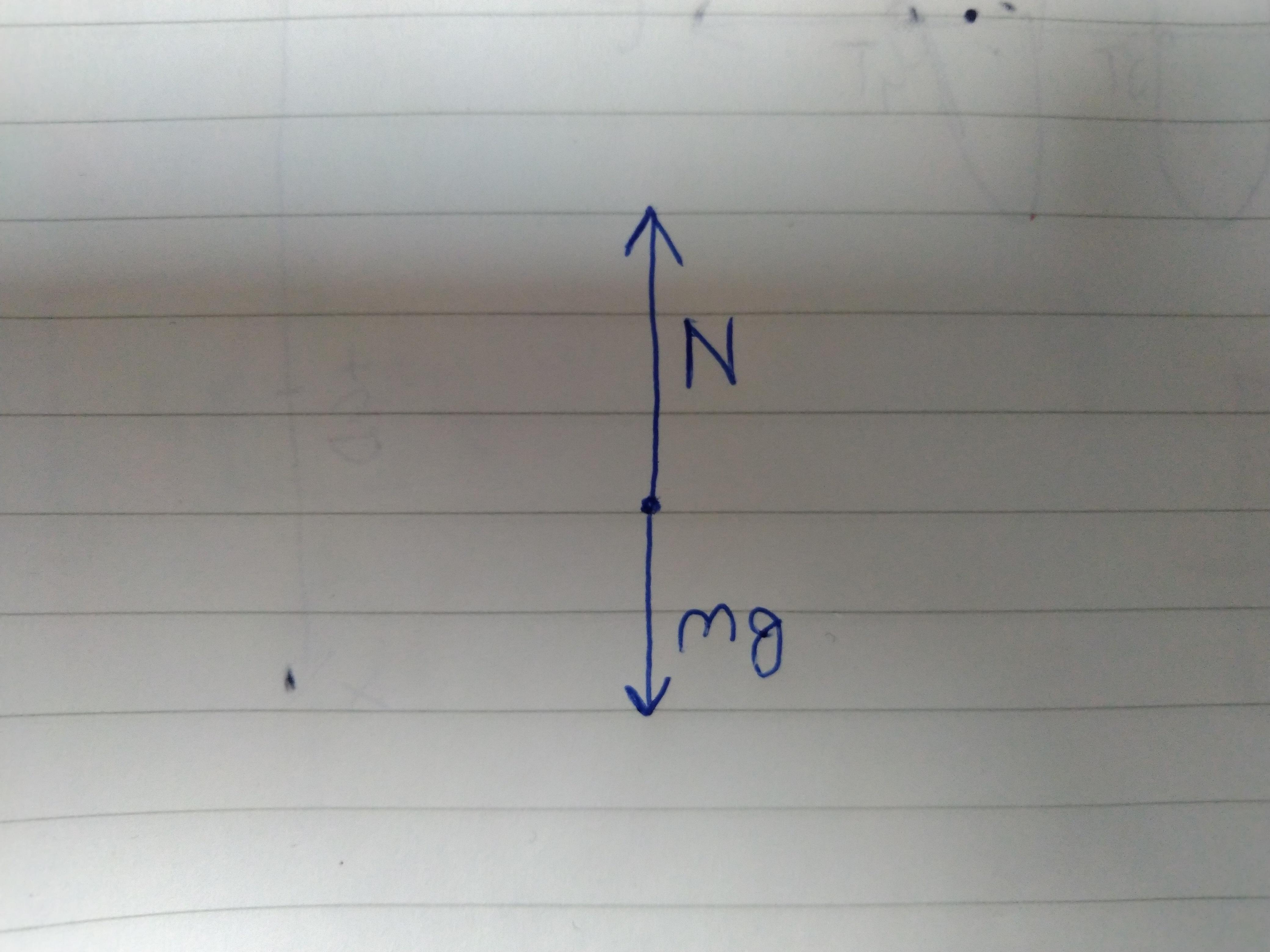
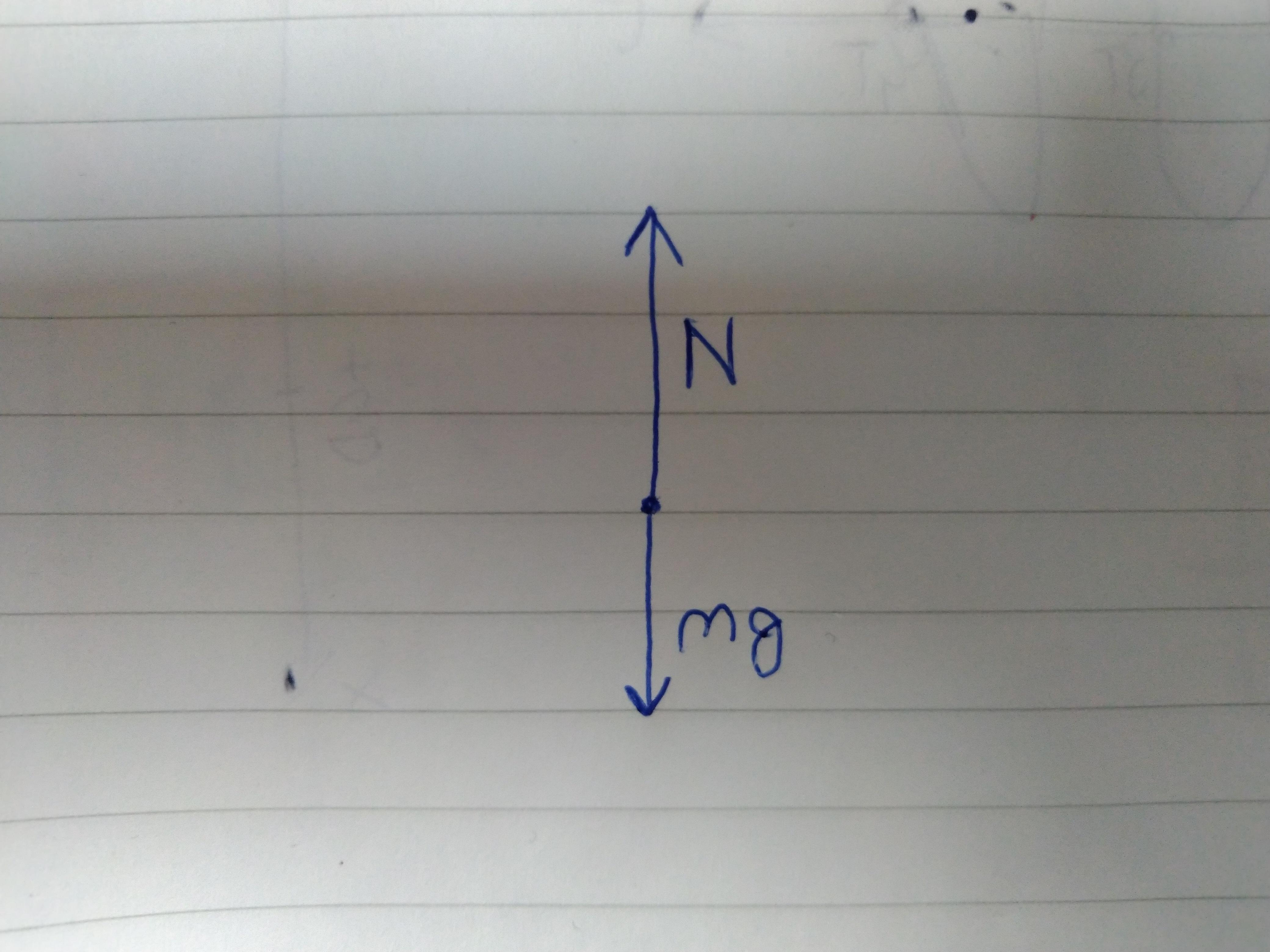
i) See attachment

ii) Up

c) N=mg+m\frac{v_b^2}{R}

d) Greater than

Explanation:

The problem is incomplete: find the complete text in attachments.

a)

i) The period of revolution of the book is equal to the total time taken by the book to complete one revolution.

Looking at the graph, the period of revolution can be estimated by evaluating the difference in time between two consecutive points of the motion of the book that have the same shape.

For instance, we can evaluate the period by calculating the difference in time between two consecutive crests. We see that:

- The first crest occur at t = 90 s

- The second crest occurs at t = 210 s

Therefore, the period of revolution is

T = 210 - 90 = 120 s

ii)

The tangential speed of the book is given by the ratio between the distance covered during one revolution (so, the perimeter of the wheel) and the period of revolution.

Mathematically:

v_b=\frac{2\pi R}{T}

where

R is the radius of the wheel

T = 120 s is the period

From the graph, we see that the maximum position of the book is x = +30 m, while the minimum position is x = -30 m, so the diameter of the wheel is

d = +30 - (-30) = 60 m

So the radius is

R = d/2 = 30 m

So, the speed is

v_b=\frac{2\pi (30)}{120}=1.57 m/s

b)

i) See in attachment the free-body diagram of the book at its lowest position.

There are 2 forces acting on the book at the lowest position:

- The weight of the book, of magnitude

W=mg

where m is the mass of the book and g the acceleration due to gravity. This force acts downward

- The normal force exerted by the bench on the book, of magnitude N. This force acts upward

ii)

When the book is at its lowest position, it is moving horizontally at constant speed.

However, the book is accelerating. In fact, acceleration is the rate of change of velocity, and velocity is a vector, so it has both a speed and a direction; here the speed is not changing, however, the direction is changing (upward), so the book has an upward net acceleration.

According to Newton's second law of motion, the net vertical force on the book is proportional to its net vertical acceleration:

F=ma

where F is the net force, m is the mass, a is the acceleration. Therefore, since a is different  from zero, the book has a net vertical force, in the same direction of the acceleration (so, upward).

c)

As we said in part b), there are two forces acting on the book at its lowest position:

- The weight, W=mg, downward

- The normal force of the bench, N, upward

Since the book is in uniform circular motion, the net force on it must be equal to the centripetal force m\frac{v_b^2}{R}, so we can write:

N-mg=m\frac{v_b^2}{R}

where

v_b is the speed of the book

R is the radius of the path

Therefore, we find an expression for the normal force:

N=mg+m\frac{v_b^2}{R}

d)

As we said in part c) and d):

- The normal force acting on the book at its lowest position is

N=mg+m\frac{v_b^2}{R}

- The weight (force of gravity) of the book is

W=mg

By comparing the two equations above, we observe that

N>W

Therefore, we can conclude that the normal force exerted by the bench on the book is greater than the weight of the book.
You might be interested in
The potential energy for a certain mass moving in one dimension is given by U(x)=(2.0J/m3)x3−(15J/m2)x2+(36J/m)x−23JU(x)=(2.0J/m
Angelina_Jolie [31]

Answer:x=2 and x=3

Explanation:

Given

Potential Energy for a certain mass is

U(x)=2x^3-15x^2+36x-23

and we know force is given by

F=-\frac{\mathrm{d} U}{\mathrm{d} x}

F=-(2\times 3x^2-15\times 2x+36)

For Force to be zero F=0

\Rightarrow 6x^2-30x+36=0

\Rightarrow x^2-5x+6=0

\Rightarrow x^2-2x-3x+6=0

\Rightarrow (x-2)(x-3)=0

Therefore at x=2 and x=3 Force on particle is zero.

8 0
2 years ago
A student decides to give his bicycle a tune up. He flips it upside down (so there’s no friction with the ground) and applies a
Alinara [238K]

Answer:

Tangential velocity = 10.9 m/S

Explanation:

As per the data given in the question,

Force = 20 N

Time = 1.2 S

Length = 16.5 cm

Radius = 33.0 cm

Moment of inertia = 1200 kg.cm^2 = 1200 × 10^(-4) kg.m^2

= 1200 × 10^(-2) m^2

Revolution of the pedal ÷ revolution of wheel = 1

Torque on the pedal = Force × Length

= 20 × 16.5 10^(-2)

= 3.30 N m

So, Angular acceleration = Torque ÷ Moment of inertia

= 3.30 ÷ 12 × 10^(-2)

= 27.50 rad ÷ S^2

Since wheel started rotating from rest, so initial angular velocity = 0 rad/S

Now, Angular velocity = Initial angular velocity + Angular Acceleration × Time

= 0 + 27.50 × 1.2

= 33 rad/S

Hence, Tangential velocity = Angular velocity × Radius

= 33 × 33 × 10^(-2)

= 10.9 m/S

7 0
2 years ago
When a gas is rapidly compressed (say, by pushing down a piston) its temperature increases. When a gas expands against a piston,
shusha [124]

Answer:

Explained in explanation

Explanation:

The first law of thermodynamics states that the change in internal energy of a system(ΔU) is equal to the sum of the net heat transfer into the system(Q) and the net work done on the system(W). In equation, this law is;

ΔU = Q + W

Now, when there's gas inside a container with a movable piston that's tightly fitting, we will assume that the piston can move up and down thereby compressing the gas or allowing the gas to expand against it.

Now these gas molecules inside the container possess kinetic energy. Thus, the internal energy(U) of the system is simply the sum of all the kinetic energies of the individual gas molecules present in the container.

Therefore, if the temperature(T) of the gas increases, then the speed and internal energy(U) of the gas molecules will also increase. In the same way, if the temperature of the gas decreases, the speed and internal energy of the gas molecules would also decrease.

Now, back to the question, when the piston is pushed down, it does work on the gas and the gas does negative work on the piston. Thus, the gas will be get compressed to a smaller space, and thereby making the gas molecules to hit the piston at a faster rate. Thus, there is a decrease in speed and as we saw earlier that when there is a decrease in speed, it means temperature has decreased.

Whereas, when the piston is moved up, the gas does positive work on the piston and the speed of the gas molecules will increase. Like I said earlier that increase in speed means increase in temperature.

4 0
2 years ago
two students are on a balcony 19.6 m above the street. one student throws a ball vertically downward at 14.7 m:ds. at the same i
NARA [144]

A. The difference in the two ball's time in the air is 3 seconds

B. The velocity of each ball as it strikes the ground is 24.5 m/s

C. The balls 0.500 s after they are thrown are 14.7 m apart

<h3>Further explanation</h3>

Acceleration is rate of change of velocity.

\large {\boxed {a = \frac{v - u}{t} } }

\large {\boxed {d = \frac{v + u}{2}~t } }

<em>a = acceleration ( m/s² )</em>

<em>v = final velocity ( m/s )</em>

<em>u = initial velocity ( m/s )</em>

<em>t = time taken ( s )</em>

<em>d = distance ( m )</em>

Let us now tackle the problem!

<u>Given:</u>

Initial Height = H = 19.6 m

Initial Velocity = u = 14.7 m/s

<u>Unknown:</u>

A. Δt = ?

B. v = ?

C. Δh = ?

<u>Solution:</u>

<h2>Question A:</h2><h3>First Ball</h3>

h = H - ut - \frac{1}{2}gt^2

0 = 19.6 - 14.7t - \frac{1}{2}(9.8)t^2

0 = 19.6 - 14.7t - 4.9t^2

4.9t^2 + 14.7t - 19.6 = 0

t^2 + 3t - 4 = 0

(t + 4)(t - 1) = 0

(t - 1) = 0

\boxed {t = 1 ~ second}

<h3>Second Ball</h3>

h = H + ut - \frac{1}{2}gt^2

0 = 19.6 + 14.7t - \frac{1}{2}(9.8)t^2

0 = 19.6 + 14.7t - 4.9t^2

4.9t^2 - 14.7t - 19.6 = 0

t^2 - 3t - 4 = 0

(t - 4)(t + 1) = 0

(t - 4) = 0

\boxed {t = 4 ~ seconds}

The difference in the two ball's time in the air is:

\Delta t = 4 ~ seconds - 1 ~ second

\large {\boxed {\Delta t = 3 ~ seconds} }

<h2>Question B:</h2><h3>First Ball</h3>

v^2 = u^2 - 2gH

v^2 = (-14.7)^2 + 2(-9.8)(-19.6)

v^2 = 600.25

v = \sqrt {600.25}

\boxed {v = 24.5 ~ m/s}

<h3>Second Ball</h3>

v^2 = u^2 - 2gH

v^2 = (14.7)^2 + 2(-9.8)(-19.6)

v^2 = 600.25

v = \sqrt {600.25}

\boxed {v = 24.5 ~ m/s}

The velocity of each ball as it strikes the ground is 24.5 m/s

<h2>Question C:</h2><h3>First Ball</h3>

h = H - ut - \frac{1}{2}gt^2

h = 19.6 - 14.7(0.5) - \frac{1}{2}(9.8)(0.5)^2

\boxed {h = 11.025 ~ m}

<h3>Second Ball</h3>

h = H + ut - \frac{1}{2}gt^2

h = 19.6 + 14.7(0.5) - \frac{1}{2}(9.8)(0.5)^2

\boxed {h = 25.725 ~ m}

The difference in the two ball's height after 0.500 s is:

\Delta h = 25.725 ~ m - 11.025 ~ m

\large {\boxed {\Delta h = 14.7 ~ m} }

<h3>Learn more</h3>
  • Velocity of Runner : brainly.com/question/3813437
  • Kinetic Energy : brainly.com/question/692781
  • Acceleration : brainly.com/question/2283922
  • The Speed of Car : brainly.com/question/568302

<h3>Answer details</h3>

Grade: High School

Subject: Physics

Chapter: Kinematics

Keywords: Velocity , Driver , Car , Deceleration , Acceleration , Obstacle

6 0
2 years ago
A basketball with mass of 0.8 kg is moving to the right with velocity 6 m/s and hits a volleyball with mass of 0.6 kg that stays
IceJOKER [234]

Answer:

26.67 m/s

Explanation:

From the law of conservation of linear momentum, the initial sum of momentum equals the final sum.

p=mv where p is momentum, m is the mass of object and v is the speed of the object

Initial momentum

The initial momentum will be that of basketball and volleyball, Since basketball is initially at rest, its initial velocity is zero

p_i= m_bv_b+m_vv_v=8*6+0.6*0=48 Kg.m/s

Final momentum

p_f= m_bv_b+m_vv_v=8*4+0.6*v_v=32+0.6v Kg.m/s\\32+0.6v_v=48\\0.6v=16\\v_v=16/0.6=26.66666667\approx 26.67 m/s

4 0
2 years ago
Other questions:
  • It's a cloudy and rainy day. The air pressure is most likely _____.
    9·1 answer
  • An electron is in a vacuum near the surface of the Earth. Where should a second electron be placed so that the net force on the
    9·1 answer
  • A car traveling at 70 mph70 mph down the interstate collides with a bug trying to cross the highway. Which of the following stat
    9·1 answer
  • A factory robot drops a 10 kg computer onto a conveyor belt running at 3.1 m/s. The materials are such that
    9·1 answer
  • A block moves at 5 m/s in the positive x direction and hits an identical block, initially at rest. A small amount of gunpowder h
    10·1 answer
  • A large solar panel on a spacecraft in Earth orbit produces 1.0 kW of power when the panel is turned toward the sun. What power
    9·1 answer
  • Dante uses 14 J of work to lift a weight for 30 seconds. How much power did he use?
    14·1 answer
  • A hot air balloon must be designed to support a basket, cords, and one person for a total payload weight of 1300 N plus the addi
    9·1 answer
  • Adam takes a bus on a school field trip. The bus route is split into the five legs listed in the table. Find the average velocit
    10·1 answer
  • A woman is applying 300N/m2 of pressure on to door with her hand. Her hand has area of 0.02m2. Work out the force being applied​
    12·1 answer
Add answer
Login
Not registered? Fast signup
Signup
Login Signup
Ask question!
