answer.
Ask question
Login Signup
Ask question
All categories
  • English
  • Mathematics
  • Social Studies
  • Business
  • History
  • Health
  • Geography
  • Biology
  • Physics
  • Chemistry
  • Computers and Technology
  • Arts
  • World Languages
  • Spanish
  • French
  • German
  • Advanced Placement (AP)
  • SAT
  • Medicine
  • Law
  • Engineering
Ira Lisetskai [31]
2 years ago
15

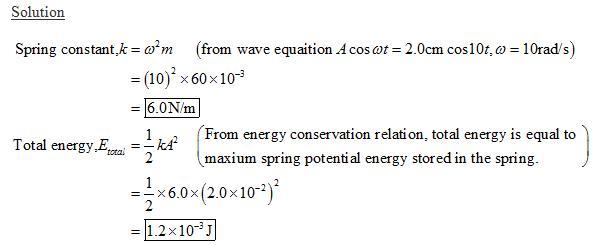
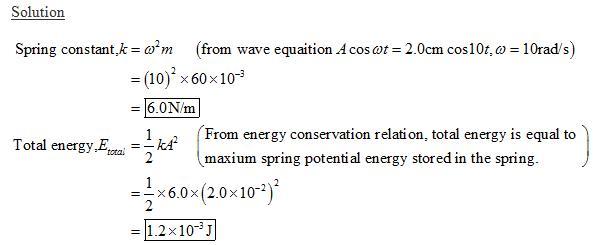
To practice Tactics Box 14.1 Identifying and analyzing simple harmonic motion. A complete description of simple harmonic motion

must take into account several physical quantities and various mathematical relations among them. This Tactics Box summarizes the essential information needed to solve oscillation problems of this type. The position of a 60 g oscillating mass is given by x(t)=(2.0cm)cos(10t), where t is in seconds. Determine the velocity at t=0.40s. Assume that the oscillating mass described in Part A is attached to a spring. What would the spring constant k of this spring be? What is the total energy E of the mass described in the previous parts?

Physics
1 answer:
bulgar [2K]2 years ago
7 0

Answer:

1.2x10^-3J

Explanation:

See attached file

You might be interested in
An infinite conducting cylindrical shell of outer radius r1 = 0.10 m and inner radius r2 = 0.08 m initially carries a surface ch
gayaneshka [121]

Answer:

Explanation:

Solution is in the picture attached

8 0
2 years ago
Gbenga needs to get glasses to correct his farsightedness. His eyes currently cannot focus on objects that are within 2 ft (or 6
Scilla [17]

Answer:

Focal Length = 38.61cm, Power = 2.59 Diopter, Converging lens.

Explanation:

When an object is placed 25cm from Gbenga's eye, the glasses lens must produce an image 61cm away (Gbenga's eye near point).

An image 61cm from the eye will be (61cm - 1.6cm) from the glasses.

i.e. d_{i}=61cm-1.6cm=59.4cm

and d_{o} = 25cm - 1.6cm = 23.4cm

note d_{i} will be negative because the image is formed on the same side as the object.

finally, d_{i}=-59.4cm\\d_{o}=23.4cm

the formula for finding the focal length f is given as

f=\frac{d_{i}d_{o}  }{d_{o}+d_{i}  }

f=\frac{-59.4*23.4}{23.4-59.4} \\

f=\frac{-1389.96}{-36}

f=38.61cm

The focal length is positive which indicates converging lens

power p=\frac{1}{f}

but f\\ must be in metres

Therefore, f=38.61cm=0.3861m

p=\frac{1}{0.3861}

p=2.59 Diopter

3 0
2 years ago
Two rigid rods are oriented parallel to each other and to the ground. The rods carry the same current in the same direction. The
bazaltina [42]

Answer:

The current in the rods is 171.26 A.

Explanation:

Given that,

Length of rod = 0.85 m

Mass of rod = 0.073 kg

Distance d = 8.2\times10^{-3}\ m

The rods carry the same current in the same direction.

We need to calculate the current

I is the current  through each of the wires then the force per unit length on each of them is

Using formula of force

\dfrac{F}{L}=\dfrac{\mu_{0}I^2}{2\pi d}

\dfrac{mg}{L}=\dfrac{\mu_{0}I^2}{2\pi d}

Where, m = mass of rod

l = length of rod

Put the value into the formula

I^2=\dfrac{mgd}{\mu L}

I^2=\dfrac{0.073\times9.8\times8.2\times10^{-3}}{2\times10^{-7}}

I=\sqrt{29331.4}

I=171.26\ A

Hence, The current in the rods is 171.26 A.

5 0
2 years ago
A historical society is testing an old cannon. They
sveta [45]

Answer:

26.2 m/s

Explanation:

We can find the speed of the cannonball just by analyzing its vertical motion. In fact, the initial vertical velocity is

u_y = u sin \theta (1)

where u is the initial speed and \theta = 45.0^{\circ} is the angle of projection.

We can therefore use the following suvat equation for the vertical motion of the ball:

v_y = u_y + at

where v_y is the vertical velocity at time t, and a=g=-9.8 m/s^2 is the acceleration of gravity. The time of flight is 3.78 s, so we know that the ball reaches its maximum height at half this time:

t=\frac{3.78}{2}=1.89 s

And at the maximum height, the vertical velocity is zero:

v_y=0

Substituting these values, we find the initial vertical velocity:

u_y = v_y - at = 0-(-9.8)(1.89)=18.5 m/s

And using eq.(1) we now find the initial speed:

u=\frac{u_y}{sin \theta}=\frac{18.5}{sin 45.0^{\circ}}=26.2 m/s

4 0
2 years ago
Calculate the speed of the car at each checkpoint by dividing the distance between each checkpoint, in meters, by the change in
Ivenika [448]

Answer:

1.09

1.95

2.37

2.80

Explanation:

just did it

8 0
2 years ago
Read 2 more answers
Other questions:
  • At what time t is the turtle second time a distance of 10.0 cm from its starting point?
    13·1 answer
  • Jeremy accidently dropped his toy stuffed animal from the balcony of his apartment on the fourth floor. The toy hit the ground a
    11·1 answer
  • A 16-Ω loudspeaker, an 8.0-Ω loudspeaker, and a 4.0-Ω loudspeaker are connected in parallel across the terminals of an amplifier
    9·1 answer
  • A 0.0500-kg golf ball heads off from the tee with an initial speed of 78.2 m/s and reaches to its maximum height of 37.8 m. If a
    6·1 answer
  • A block moves at 5 m/s in the positive x direction and hits an identical block, initially at rest. A small amount of gunpowder h
    10·1 answer
  • A dog of mass 10 kg sits on a skateboard of mass 2 kg that is initially traveling south at 2 m/s. The dog jumps off with a veloc
    9·1 answer
  • A swimmer standing near the edge of a lake notices a cork bobbing in the water. While watching for one minute, she notices the c
    10·1 answer
  • The diagram below depicts all the forces acting on an object. Use both vector resolution and vector
    12·1 answer
  • If a 110 kg go-cart traveling at a velocity of 13.41 m/s has a collision with an impulse of 615 Nxs, what is the
    12·1 answer
  • A car is traveling at 20.0 m/s on tires with a diameter of 70.0 cm. The car slows down to a rest after traveling 300.0 m. If the
    12·1 answer
Add answer
Login
Not registered? Fast signup
Signup
Login Signup
Ask question!