answer.
Ask question
Login Signup
Ask question
All categories
  • English
  • Mathematics
  • Social Studies
  • Business
  • History
  • Health
  • Geography
  • Biology
  • Physics
  • Chemistry
  • Computers and Technology
  • Arts
  • World Languages
  • Spanish
  • French
  • German
  • Advanced Placement (AP)
  • SAT
  • Medicine
  • Law
  • Engineering
Westkost [7]
2 years ago
11

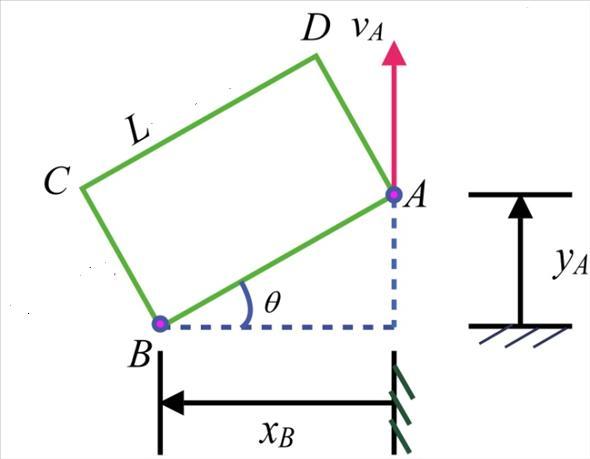
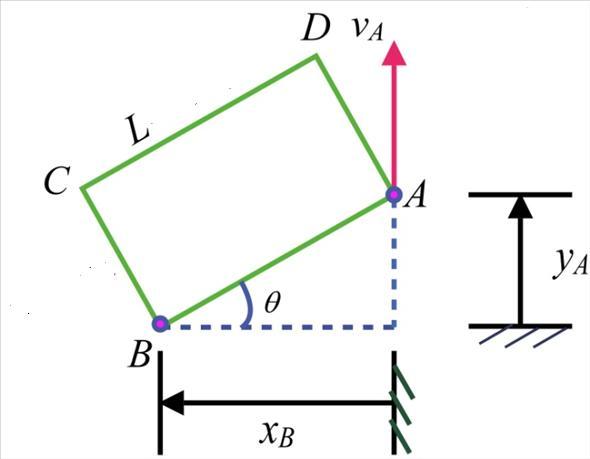
The hydraulic cylinder imparts a constant upward velocity vA = 0.23 m/s to corner A of the rectangular container during an inter

val of its motion. For the instant when θ = 23°, determine the velocity vB and acceleration aB of roller B. Also, determine the corresponding angular velocity ω of edge CD. The velocity and acceleration of B are positive if to the right, negative if to the left. The angular velocity of CD is positive if counterclockwise, negative if clockwise.

Physics
1 answer:
s344n2d4d5 [400]2 years ago
5 0

Answer:

vB = 0.5418 m/s (→)

aB = - (0.3189/L)  m/s²

ωcd = (0.2117/L)  rad/s

Explanation:

a) Given:

vA = 0.23 m/s (↑) (constant value)

If

tan θ = vA/vB

For the instant when θ = 23° we have

vB = vA/ tan θ

⇒ vB = 0.23 m/s/tan 23°

⇒ vB = 0.5418 m/s (→)

b) If tan θ = vA/vB   ⇒   vA = vB*tan θ

⇒  d(vA)/dt = d(vB*tan θ)/dt

⇒  0 = tan θ*d(vB)/dt + vB*Sec²θ*dθ/dt

Knowing that  

aB = d(vB)/dt

ωcd = dθ/dt

we have

⇒  0 = tan θ*aB + vB*Sec²θ*ωcd

ωcd = - Sin (2θ)*aB/(2*vB)

If

v = ωcd*L

where v = vA*Cos θ   ⇒  ωcd = v/L = vA*Cos θ/L

⇒ vA*Cos θ/L = - Sin (2θ)*aB/(2*vB)

⇒ aB = - vA*vB/((Sin θ)*L)

We plug the known values into the equation

aB = - (0.23 m/s)*(0.5418 m/s)/(L*Sin 23°)

⇒ aB = - (0.3189/L)  m/s²

Finally we obtain the angular velocity of CD as follows

ωcd = vA*Cos θ/L

⇒ ωcd = 0.23 m/s*Cos 23°/L

⇒ ωcd = (0.2117/L)  rad/s
You might be interested in
A circular loop of wire is rotated at constant angular speed about an axis whose direction can be varied. In a region where a un
katovenus [111]

Answer:

here the coil must be oriented in such a way that its plane is perpendicular to the magnetic field

Explanation:

As we know by Faraday's law of electromagnetic induction

Rate of change in magnetic flux will induce EMF in the coil

so here we will have

EMF = \frac{d\phi}{dt}

here we know that

\phi = NB.A

now if the magnetic flux will change with time then it will induce EMF in the coil

EMF = N\frac{d}{dt}(B.A)

so here induced EMF will be zero in the coil if the flux linked with the coil will remain constant

so here the coil must be oriented in such a way that its plane is perpendicular to the magnetic field

In such a way when coil will rotate then the flux linked with the coil will remains constant and there will be no induced EMF in it

5 0
2 years ago
A glider moving with a speed of 200 kilometers/hour experiences a cross wind of 30 kilometers/hour. What is the resultant speed
liraira [26]
You didn't say so, but we must assume that the "200 km/hr" is
the glider's air-speed, that is, speed relative to the air. 

If the air itself is moving at 30 km/hr relative to the ground and
across the glider's direction, then the glider's speed relative to
the ground is

                 √(200² + 30²)

             =  √(40,000 + 900)

             =  √(40,900)  =  202.24... km/hr   (rounded) 
5 0
2 years ago
(b) The density of aluminum is 2.70 g/cm3. The thickness of a rectangular sheet of aluminum foil varies
vekshin1

Answer:

(i) 22.48 cm^3

(ii) 1.5 mm

Explanation:

Let t be the average thickness of the sheet.

Given that:

Density of the aluminum sheet is 2.70 g/cm^3

Mass of sheet = 60.7 g

Length of sheet  = 50.0 cm

Width of sheet  = 30.0 cm

(i) Using, Density=Mass/Volume

\Rightarrow \text{Volume}=\frac{\text{Mass}}{\text{Density}}

\Rightarrow \text{Volume}=\frac{60.7}{2.7}=22.48 cm^3

Hence, the volume of the sheet is 22.48 cm^3.

(ii) Now, as this aluminum sheet is in the shape of a cuboid, so the volume of the sheet is

\text{Volume}=\text{Length}\times\text{Width}\times\text{Thickness}

\Rightarrow 22.48=50\times 30 \times w

\Rightarrow w=\frac{22.48}{50\times 30}=0.015 cm

Hence, the average thickness of the sheet is 1.5 mm.

6 0
2 years ago
A car is traveling at 20.0 m/s on tires with a diameter of 70.0 cm. The car slows down to a rest after traveling 300.0 m. If the
cupoosta [38]

Answer: deceleration of 1.904\ rad/s^2

Explanation:

Given

Car is traveling at a speed of u=20 m/s

The diameter of the car is d=70 cm

It slows down to rest in 300 m

If the car rolls without slipping, then it must be experiencing pure rolling i.e. a=\alpha \cdot r

Using the equation of motion

v^2-u^2=2as\\

Insert v=0,u=20,s=300

0-(20)^2=2\times a\times 300\\\\a=\dfrac{-400}{600}\\\\a=-\dfrac{2}{3}\ m/s^2

Write acceleration as a=\alpha \cdot r

-\dfrac{2}{3}=\alpha \times 0.35\\\\\alpha =-\dfrac{2}{1.05}\\\\\alpha =-1.904\ rad/s^2

So, the car must be experiencing the deceleration of 1.904\ rad/s^2.

4 0
2 years ago
In the absence of air resistance, at what other angle will a thrown ball go the same distance as one thrown at an angle of 75 de
snow_tiger [21]

As we know that range of the projectile motion is given by

R = \frac{v^2 sin(2\theta)}{g}

here we know that range will be same for two different angles

so here we can say the two angle must be complementary angles

so the two angles must be

\theta, 90 - \theta

so it is given that one of the projection angle is 75 degree

so other angle for same range must be 90 - 75 = 15 degree

so other projection angle must be 15 degree

5 0
2 years ago
Other questions:
  • Einstein's equation E=mc2 helps scientists understand the sun's energy because the equation..
    11·2 answers
  • A 60 kg bicyclist going 2 m/s increased his work output by 1,800 J. What was his final velocity?
    7·2 answers
  • If a 1.50 kg mass revolves at the end of a string 0.50 m long, and its tangential speed is 6.0 m/s, calculate the centripetal fo
    11·2 answers
  • What is the effect of the following change on the volume of 1 mol of an ideal gas? The initial pressure is 722 torr, the final p
    13·1 answer
  • Vertically polarized light with an intensity of 36.8 lux passes through a polarizer whose transmission axis is an angle of 51.0°
    15·1 answer
  • Step gently onto a bathroom scale, read the dial, and then jump from a chair onto the same scale.
    13·1 answer
  • You are driving on the highway, and you come to a steep downhill section. As you roll down the hill, you take your foot off the
    12·2 answers
  • If the lattice constant of silicon is 5.43 Å, calculate?
    7·1 answer
  • Suppose we have a radar dish that generates a strong signal that travels out to hit an asteroid 10^9 kilometres away.
    14·1 answer
  • What results when energy is transformed while juggling three bowling pins?
    13·1 answer
Add answer
Login
Not registered? Fast signup
Signup
Login Signup
Ask question!