answer.
Ask question
Login Signup
Ask question
All categories
  • English
  • Mathematics
  • Social Studies
  • Business
  • History
  • Health
  • Geography
  • Biology
  • Physics
  • Chemistry
  • Computers and Technology
  • Arts
  • World Languages
  • Spanish
  • French
  • German
  • Advanced Placement (AP)
  • SAT
  • Medicine
  • Law
  • Engineering
blsea [12.9K]
2 years ago
12

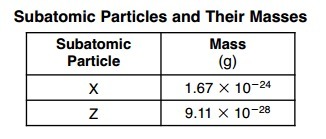
The table below gives the masses of two different subatomic particles found in an atom.

Chemistry
2 answers:
kap26 [50]2 years ago
7 0
I think the subatomic particles that are paired with each of their corresponding name would be :
1. X , proton and z, electron

hope this helps
KonstantinChe [14]2 years ago
3 0
The best and most correct answer among the choices provided by the question is the first choice. Particle X is a proton, which has a higher mass, while particle Z is the electron. I hope my answer has come to your help. God bless and have a nice day ahead!
You might be interested in
What is the empirical formula? A compound is used to treat iron deficiency in people. It contains 36.76% iron, 21.11% sulfur, an
Mandarinka [93]

Answer: The empirical formula of the compound is Fe_1S_1O_4

Explanation:

Empirical formula is defined formula which is simplest integer ratio of number of atoms of different elements present in the compound.

Percentage of iron in a compound = 36.76 %

Percentage of sulfur in a compound = 21.11 %

Percentage of oxygen in a compound = 42.13 %

Consider in 100 g of the compound:

Mass of iron in 100 g of compound = 36.76 g

Mass of iron in 100 g of compound = 21.11 g

Mass of iron in 100 g of compound = 42.13 g

Now calculate the number of moles each element:

Moles of iron=\frac{36.76 g}{55.84 g/mol}=0.658 mol

Moles of sulfur=\frac{21.11 g}{32.06 g/mol}=0.658 mol

Moles of oxygen=\frac{42.13 g}{16 g/mol}=2.633 mol

Divide the moles of each element by the smallest number of moles to calculated the ratio of the elements to each other

For Iron element = \frac{0.658 mol}{0.658 mol}=1

For sulfur element = \frac{0.658 mol}{0.658 mol}=1

For oxygen element = \frac{2.633 mol}{0.658 mol}=4.001\approx 4

So, the empirical formula of the compound is Fe_1S_1O_4

4 0
2 years ago
Read 2 more answers
Consider the dissolution of 1.50 grams of salt XY in 75.0 mL of water within a calorimeter. The temperature of the water decreas
-BARSIC- [3]

Answer:

The quantity of heat lost by the surroundings is 258,5J

Explanation:

The dissolution of salt XY is endothermic because the water temperature decreased.

The total heat consumed by the dissolution process is:

4,184 J/g°C × (75,0 + 1,50 g) × 0,93°C = 297,7 J

This heat is consumed by the calorimeter and by the surroundings.

The heat consumed by the calorimeter is:

42,2 J/°C × (0,93°C) = 39,2 J

That means that the quantity of heat lost by the surroundings is:

297,7J - 39,2J = <em>258,5 J</em>

I hope it helps!
8 0
2 years ago
Tear gas has the composition 40.25% carbon, 6.19% hydrogen, 8.94% oxygen, 44.62% bromine. what is the empirical formula of this
andre [41]
<span>Calculating the moles and the moles ratio of the elements gives us the ratio of atoms in each element. Converting the percentage of element into grams 40.25% carbon = 40.25/100 = .4025 * 100 g of carbon = 40.25g of C 6.19% hydrogen = 6.19/100 = .0619 * 100g g of hydrogen = 6.19g of H 8.94% oxygen = 8.94/100 = .0819 * 100 g of oxygen = 8.19g of O 44.62% bromine = 44.62/100 = .4462 * 100 g of bromine = 44.62g of Br Converting the grams of element into moles (48.38 g C) (1 mol/ 12.10 g C) = 4.028 mol C (8.12 g H) (1 mol/ 1.008 g H) = 8.056 mol H (53.38 g O) (1 mol/ 16.00 g O) = 3.336 mol O (44.62g of Br)(0.012515018021626 moles) = 0.55842 mol Br Calculating the moles ratio of elements by dividing the small number of moles of an element 4.028 mol C /0.55842 = 7.2 mol C x 5 = 36 mol C 8.056 mol H / 0.55842 = 14.42 mol H = 72 mol H 3.336 mol O / 0.55842 = 5.97 mol O = 30 mol O 0.55842 mol Br / 0.55842 = 1mol Br = 5 mol Br So the empirical formula is (C6H12O5)6Br5</span>
8 0
2 years ago
Read 2 more answers
in the early studies of chemistry, scientists used properties and changed to help identify compounds. this is still done today.
Kaylis [27]
The salt water is a mixture because the salt and the water can be separated from each other. The dissolution of salt inside water is a physical change.  At the same time, the salt water is an electrolyte, because it conducts electricity. The electricity that was pass through the water led to the decomposition of the water; those bubbles that form inside the water represent oxygen gas which is a product of decomposition of water, therefore the electricity that was passed through the salt water has caused chemical change to occur inside the salt water.<span />
6 0
2 years ago
How many SO32- ions are contained in 99.6 mg of Na2SO3? The molar mass of Na2SO3 is 126.05 g/mol.
DochEvi [55]
99.6 mg= .0996 g
.0996g x (1mol/125.05g) x (1 mol SO3/1 mol Na2SO2) x (6.02 x 10^22/1mol SO3) = 4.79 x 10^19 SO32- ions
6 0
2 years ago
Read 2 more answers
Other questions:
  • A compound contains 69.94 percent iron and 30.06 percent oxygen. What is its molecular formula if the molar mass of the compound
    15·2 answers
  • A chemist in an imaginary universe, where electrons have a different charge than they do in our universe, performs the millikan
    6·1 answer
  • How many total atoms are in 0.670 g of p2o5?
    9·1 answer
  • A compound is 40.0% C, 6.70% H, and 53.3% O by mass. Assume that we have a 100.-g sample of this compound. Part A What are the s
    10·2 answers
  • Which of the following is an extensive property of liquid benzene?
    15·1 answer
  • Acetaldehyde decomposes at 750 K: CH3CHO → CO + CH4. The reaction is first order in acetaldehyde and the half-life of the reacti
    7·1 answer
  • How many L of carbon dioxide at 1.00 atm and 298.15 K are released from a car's engine upon consumption of a 60.0 L LIQUID tank
    10·1 answer
  • Hydrogen peroxide, H2O2, is common in many households and is used as a bleaching agent. It usually comes in a dark, opaque bottl
    5·1 answer
  • A 75 lb (34 kg) boy falls out of a tree from a height of 10 ft (3 m). i. What is the kinetic energy of the boy when he hits the
    6·1 answer
  • Which statements describe lattice energy?
    7·1 answer
Add answer
Login
Not registered? Fast signup
Signup
Login Signup
Ask question!
