answer.
Ask question
Login Signup
Ask question
All categories
  • English
  • Mathematics
  • Social Studies
  • Business
  • History
  • Health
  • Geography
  • Biology
  • Physics
  • Chemistry
  • Computers and Technology
  • Arts
  • World Languages
  • Spanish
  • French
  • German
  • Advanced Placement (AP)
  • SAT
  • Medicine
  • Law
  • Engineering
PolarNik [594]
2 years ago
14

Explain how the following experimental errors affect the final calculation of the kilocalories per gram for a food item. Be spec

ific as to whether the final value will be higher or lower than if the error had not been made.
a. The student misread the scale and recorded 110.3 g for the final mass of the soda can plus water instead of 101.3 g.
b. Part of the unburned marshmallow fell off before the final mass was determined.
c. The food would not keep burning and had to be relit several times.
d. The thermometer got stuck in the aluminum foil while the food was burning and the final temperature was made with the thermometer in the air above the water and not in the water.
Chemistry
1 answer:
Ainat [17]2 years ago
6 0

Answer:

a) the final kilocalories per gram for food will be less because the mass was reduced

b)the final kilocalories per gram for food will be less since

c) the final kilocalories per gram for food will be less since the reaction will eventually go to completion

d) the final kilocalories per gram for food will be more.

Explanation:

a) the final kilocalories per gram for food will be less because the mass was reduced from 110.3 to 101.3g

b)the final kilocalories per gram for food will be less since some marshmallow fell off before the reaction

c) the final kilocalories per gram for food will be less since the reaction will eventually go to completion

d) the final kilocalories per gram for food will be more since the thermometer that got stuck will add to the value of final kilocalories per gram

You might be interested in
What will be the charge of the ion formed from each of these atoms ?
Galina-37 [17]

Answer:

Si14- Si^4+

As33- As^3-

Mg12- Mg^2+

Rb37- Rb^+

F9- F^-

Ge32- Ge^4+

Sn50- Sn^2+, Sn^4+

Explanation:

The elements shown in the answer have their common ions written beside them.

Silicon mostly forms positive ions in oxyacids and complex ions. Arsenic mostly forms its anion. Magnesium forms only the +2cation just as rubidium only forms the +1 cation. The fluoride ion is F^- while tin may for a +2*or +4 cation. Germanium usually forms the +4 cation.

4 0
2 years ago
In 100 grams of sweet peas there are 14.5 carbohydrates,5.7 grams of sugars,5.1 grams of dietary fiber, 5.4 grams of protein and
Brums [2.3K]
14.5 % carb
5.7% sugar
5.1% fiber
5.4% protein
0.4% fat
7 0
2 years ago
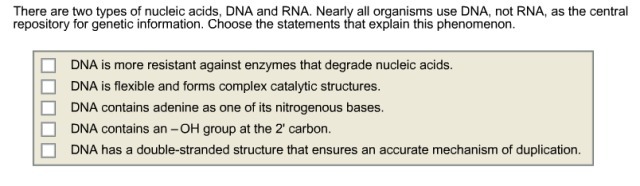
There are two types of nucleic acids, dna and rna. nearly all organisms use dna, not rna, as the central repository for genetic
Leya [2.2K]
Found the choices. Pls see attachment. 

The statements that explains this phenomenon are:
1) DNA contains adenine as one of its nitrogenous bases.
2) DNA has a double-stranded structure that ensures an accurate mechanism of duplication.

6 0
2 years ago
An oxygen atom has a mass of and a glass of water has a mass of . Use this information to answer the question below. Be sure you
MariettaO [177]

Answer:

Number of moles of oxygen atoms having equal mass as  glass of water = 3.12 moles

<em>Note: The given question is missing some figures. Here is a complete similar question below.</em>

<em>An oxygen atom has a mass of 2.66*10^-23 g and a glass of water has a mass of 0.050 kg. What is the mass of 1 mole of oxygen atoms? Round your answer to 3 significant digits. How many moles of oxygen atoms have a mass equal to the mass of a glass of water? Round your answer to 2 significant digits.</em>

Explanation:

A mole of a substance contains the Avogadro number of particles = 6.02 * 10²³

Therefore a mole of oxygen atoms contains 6.02*10²³ atoms.

mass of 1 atom of oxygen = 2.66*10⁻²³ g

Mass of 1 mole of oxygen atoms = mass of 1 atom * number of atoms in 1 mole

Mass of 1 mole of oxygen atoms = 2.66*10⁻²³ g * 6.02*10²³  = 16. 01 g

Mass of a glass of water = 0.050 Kg or 50 g

To determine the number of moles of oxygen atoms that have a mass equal to a glass of water i.e. 50 g, the formula below is used;

<em>number of moles = mass/molar mass</em>

mass of oxygen atoms= 50 g, molar mass or mass of one mole of oxygen atoms = 16.01 g

Therefore, number of moles of oxygen atoms = 50 g / 16.01 g = 3.12 moles

4 0
2 years ago
Jared sprayed a pesticide on his garden three times. The first time, many insects died. The second time fewer insects died. The
olga_2 [115]

Answer:

C. The species became more resistant to the insecticide.

Explanation:

The more of something you receive, the more immune you are to it. For example, every year, many people get a flu shot. Flu shots contain small amounts of the flu, and it is inserted into your blood stream so that you may become more immune to the disease when it comes around. The same happens for many living things, including insects.

5 0
2 years ago
Read 2 more answers
Other questions:
  • What is the molarity of a solution of 14.0 g NH4Br in enough H2O to make 150 mL of solution?
    5·2 answers
  • Why can metallic elements bend, while solid but non-metallic break or crumble?
    5·2 answers
  • What is the minimum total energy released when an electron and its antiparticle (positron) annihilate each other?
    8·2 answers
  • In which region are most particles moving the fastest?
    12·2 answers
  • What do pH and conductivity have in common?
    6·2 answers
  • Name the complex ion [cu(cn)6]4−. the oxidation number of copper is +2.enter the name.
    12·1 answer
  • A new potential heart medicine, code-named X-281, is being tested by a pharmaceutical company, Pharma-pill. As a research techni
    13·1 answer
  • How many milliliters of a 0.8 M solution of citric acid would be needed to react with 15 grams of baking soda? Show your work.
    6·1 answer
  • You mix 500.0 mL of 0.250 M iron(III) chloride solution with 425.0 mL of 0.350 M barium chloride solution. Assuming the volumes
    13·1 answer
  • A cylinder container can hold 2.45 L of water. It’s radius is 4.00 cm. What is the volume of it in cubic centimeters?
    7·1 answer
Add answer
Login
Not registered? Fast signup
Signup
Login Signup
Ask question!