answer.
Ask question
Login Signup
Ask question
All categories
  • English
  • Mathematics
  • Social Studies
  • Business
  • History
  • Health
  • Geography
  • Biology
  • Physics
  • Chemistry
  • Computers and Technology
  • Arts
  • World Languages
  • Spanish
  • French
  • German
  • Advanced Placement (AP)
  • SAT
  • Medicine
  • Law
  • Engineering
RoseWind [281]
2 years ago
3

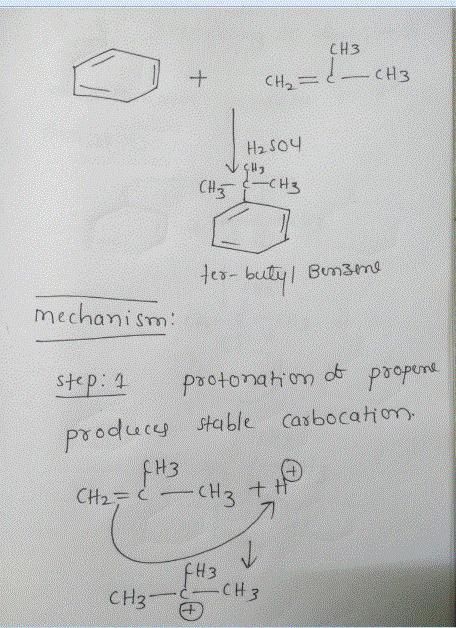
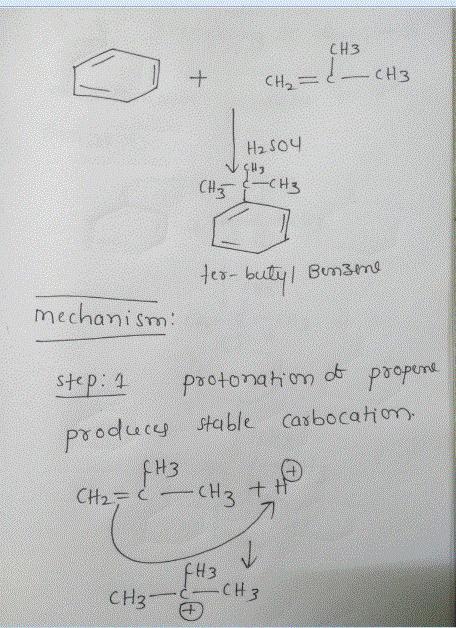
Practice Problem 18.48 When benzene is treated with 2-methylpropene and sulfuric acid, the product obtained is tert-butylbenzene

. Propose a mechanism for this transformation. For the mechanism, draw the curved arrows as needed. Include lone pairs and charges in your answer. Do not draw out any hydrogen explicitly in your products. Do not use abbreviations such as Me or Ph.

Chemistry
1 answer:
Olin [163]2 years ago
4 0

Answer:

See Explaination

Explanation:

We can describe tert-Butylbenzene as an organic compound that is classified as an aromatic hydrocarbon.

Its structure consists of a benzene ring substituted with a tert-butyl group. It is a flammable colorless liquid which is nearly insoluble in water but miscible with organic solvents.

See attachment please for the diagram.

You might be interested in
Small quantities of h2 gas can be collected by adding hcl to zn. a sample of 195 ml of h2 gas was collected over water at 25 c a
Umnica [9.8K]
<span>15.4 milligrams The ideal gas law is PV = nRT where P = pressure of the gas V = volume of the gas n = number of moles of gas R = Ideal gas constant (8.3144598 L*kPa/(K*mol) ) T = absolute temperature. So let's determine how many moles of gas has been collected. Converting temperature from C to K 273.15 + 25 = 298.15 K Converting pressure from mmHg to kPa 753 mmHg * 0.133322387415 kPa/mmHg = 100.3917577 kPa Taking idea gas equation and solving for n PV = nRT PV/RT = n n = PV/RT Substituting known values n = PV/RT n = (100.3917577 kPa 0.195 L) / (8.3144598 L*kPa/(K*mol) 298.15 K) n = (19.57639275 L*kPa) / (2478.956189 L*kPa/(mol) ) n = 0.007897031 mol So we have a total of 0.007897031 moles of gas particles. Now let's get rid of that percentage that's water vapor. The percentage of water vapor is the vapor pressure of water divided by the total pressure. So 24/753 = 0.03187251 The portion of hydrogen is 1 minus the portion of water vapor. So 1 - 0.03187251 = 0.96812749 So the number of moles of hydrogen is 0.96812749 * 0.007897031 mol = 0.007645332 mol Now just multiple the number of moles by the molar mass of hydrogen gas. Start with the atomic weight. Atomic weight hydrogen = 1.00794 Molar mass H2 = 1.00794 * 2 = 2.01588 g/mol Mass H2 = 2.01588 g/mol * 0.007645332 mol = 0.015412073 g Rounding to 3 significant figures gives 0.0154 g = 15.4 mg</span>
7 0
2 years ago
Read 2 more answers
Select all of the correct statements pertaining to the first and second ionization energies of different elements. check all tha
sertanlavr [38]
The First Ionization energy of Nitrogen is greater (Not smaller)than that of Phosphorous. This is because going down the group (N and P are in same group) the number of shells increases, the distance of valence electrons from Nucleus increases and hence due to less interaction between nucleus and valence electrons it becomes easy to knock out the electron.

<span>The second ionization energy of Na is larger than that of Mg because after first loss of electron Na has gained Noble Gas Configuration (Stable Configuration) and now requires greater energy to loose both second electron and Noble Gas Configuration. While Mg after second ionization attains Noble Gas Configuration hence it prices less energy.</span>
8 0
2 years ago
Read 2 more answers
Mass in grams of 6.25 mol of copper (II) nitrate?
podryga [215]
Cu = 63.546
N= 14.001 g/mol
O= 15.999 g/mol * 3 = 47.997

Copper (II) Nitrate has a MW of 125.544 g/mol

6.25 x 125.544

= 784.65 <--- is your answer, if there were was a multiple choice or not :)
8 0
2 years ago
Read 2 more answers
Which milligram quantity contains a total of four significant figures
denis23 [38]
D has a total of four significant figures.
7 0
2 years ago
Read 2 more answers
On a trip to the natural history museum you find two minerals that are similar in color. You can see from their chemical formula
lianna [129]

Answer:Yes they are in the same mineral group

Explanation:zinc is the central elements there. The rest of the elements are present as impurities due to where it was found. Like carbon is can be found in the soil, silicon with oxygen is basically sand, hydrogen is in the atmosphere and also in water and soil too. So apart from zinc, the rest are normal day to day elements.
7 0
2 years ago
Other questions:
  • How does the written lewis structure for potassium chloride differ from that of hydrogen chloride?
    9·1 answer
  • Dry air is 78.08% nitrogen, 20.95% oxygen and 0.93% argon with the 0.04% being other gases. if the atmospheric pressure is 760.0
    8·2 answers
  • A 10.0-ml sample of 0.200 m hydrocyanic acid (hcn) is titrated with 0.0998 m naoh. what is the ph at the equivalence point? for
    7·1 answer
  • Josh is studying pH calculations and tests a basic solution with a pH meter. He finds that the solution has a pH equal to 9.2. W
    15·1 answer
  • Which statements correctly describe the process of nuclear fusion?
    13·2 answers
  • A liquid mixture containing 30.0 mole% benzene (B), 25.0% toluene (T), and the balance xylene (X) is fed to a distillation colum
    13·1 answer
  • he solutions in the arms of a U-tube are separated at the bottom of the tube by a selectively permeable membrane. The membrane i
    10·1 answer
  • A chemist dissolves 0.9 g of an unknown monoprotic (one acidic H) acid in water. She finds that 14.6 mL of 0.426 M NaOH are requ
    15·1 answer
  • In one compound of lead and sulfur, there are 6.46 g of lead
    13·1 answer
  • Compound X has a molar mass of 104.01·gmol−1 and the following composition: element mass % nitrogen 26.93% fluorine 73.07% Write
    6·2 answers
Add answer
Login
Not registered? Fast signup
Signup
Login Signup
Ask question!
