answer.
Ask question
Login Signup
Ask question
All categories
  • English
  • Mathematics
  • Social Studies
  • Business
  • History
  • Health
  • Geography
  • Biology
  • Physics
  • Chemistry
  • Computers and Technology
  • Arts
  • World Languages
  • Spanish
  • French
  • German
  • Advanced Placement (AP)
  • SAT
  • Medicine
  • Law
  • Engineering
vitfil [10]
2 years ago
3

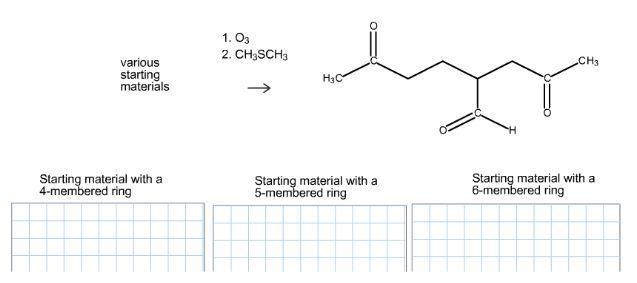
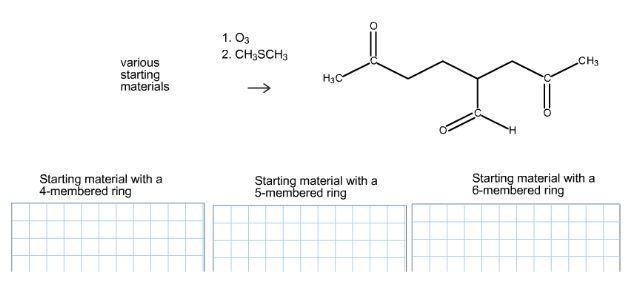
Provide the structures of the three possible starting materials for the following reaction. One has a six-membered ring, one has

a five-membered ring, and one has a four-membered ring. Put them in the appropriately labeled boxes. Your starting materials should all be hydrocarbons (i.e., no atoms other than C and H). (Note that in all cases, there is also a CH2

Chemistry
1 answer:
makvit [3.9K]2 years ago
8 0

Question;

The question is not complete. The reaction was not attached to your question. Find attached of the reaction and the possible answer.

Explanation:

Find attached of the explanation

You might be interested in
The mass of a container is determined to be 1.2 g. A sample of a compound is transferred to this container, and the mass of the
Nikitich [7]

Answer:

Sorry I don't know what you

3 0
1 year ago
Determine Z and V for steam at 250°C and 1800 kPa by the following: (a) The truncated virial equation [Eq. (3.38)] with the foll
makvit [3.9K]

Answer:

Explanation:

Given that:

the temperature T_1 = 250 °C= ( 250+ 273.15 ) K = 523.15 K

Pressure = 1800 kPa

a)

The truncated viral equation is expressed as:

\frac{PV}{RT} = 1 + \frac{B}{V} + \frac{C}{V^2}

where; B = - 152.5 \ cm^3 /mol   C = -5800 cm^6/mol^2

R = 8.314 × 10³ cm³ kPa. K⁻¹.mol⁻¹

Plugging all our values; we have

\frac{1800*V}{8.314*10^3*523.15} = 1+ \frac{-152.5}{V} + \frac{-5800}{V^2}

4.138*10^{-4}  \ V= 1+ \frac{-152.5}{V} + \frac{-5800}{V^2}

Multiplying through with V² ; we have

4.138*10^4  \ V ^3 = V^2 - 152.5 V - 5800 = 0

4.138*10^4  \ V ^3 - V^2 + 152.5 V + 5800 = 0

V = 2250.06  cm³ mol⁻¹

Z = \frac{PV}{RT}

Z = \frac{1800*2250.06}{8.314*10^3*523.15}

Z = 0.931

b) The truncated virial equation [Eq. (3.36)], with a value of B from the generalized Pitzer correlation [Eqs. (3.58)–(3.62)].

The generalized Pitzer correlation is :

T_c = 647.1 \ K \\ \\ P_c = 22055 \  kPa  \\ \\ \omega = 0.345

T__{\gamma}} = \frac{T}{T_c}

T__{\gamma}} = \frac{523.15}{647.1}

T__{\gamma}} = 0.808

P__{\gamma}} = \frac{P}{P_c}

P__{\gamma}} = \frac{1800}{22055}

P__{\gamma}} = 0.0816

B_o = 0.083 - \frac{0.422}{T__{\gamma}}^{1.6}}

B_o = 0.083 - \frac{0.422}{0.808^{1.6}}

B_o = 0.51

B_1 = 0.139 - \frac{0.172}{T__{\gamma}}^{ \ 4.2}}

B_1 = -0.282

The compressibility is calculated as:

Z = 1+ (B_o + \omega B_1 ) \frac{P__{\gamma}}{T__{\gamma}}

Z = 1+ (-0.51 +(0.345* - 0.282) ) \frac{0.0816}{0.808}

Z = 0.9386

V= \frac{ZRT}{P}

V= \frac{0.9386*8.314*10^3*523.15}{1800}

V = 2268.01 cm³ mol⁻¹

c) From the steam tables (App. E).

At T_1 = 523.15 \  K \ and  \ P = 1800 \ k Pa

V = 0.1249 m³/ kg

M (molecular weight) = 18.015 gm/mol

V  =  0.1249 × 10³ × 18.015

V = 2250.07 cm³/mol⁻¹

R = 729.77 J/kg.K

Z = \frac{PV}{RT}

Z = \frac{1800*10^3 *0.1249}{729.77*523.15}

Z = 0.588

3 0
2 years ago
a gas sample is heated from -20.0 C to 57.0 C and the volume is increased from 2.00L to 4.50L. If the initial pressure is 0.109a
Andreas93 [3]
Idk what this is im not good at this 
7 0
2 years ago
The highest principal enegy level of period 2 elements is 2. Period 3 elements all have six 3p electrons. Period 4 elements have
Dmitrij [34]

Explanation:

The highest principal energy level of period 2 elements is 2. (True)

The highest principle energy level of elements of any period is equal to period number. So the given statement is true.

Period 3 elements all have six 3p electrons – (False)  

For example, sodium and sulfur are period 3 elements but do not contain six 3p electrons. Only Argon of period possesses six p-electrons.

Period 4 elements have an inner electron configuration of [Ar]- (True)

Atomic number of elements belonging to period 4 have atomic number more than 18 (atomic number of Ar). So they must have an inner electron configuration of [Ar]

The valence electrons of group 5A elements are in the 6s subshell – [FALSE]

Elements of group 5A are nitrogen, arsenic, antimony and bismuth. They are p-block elements. Therefore, valence electrons are present in p-subshell.

Group 8A elements have full outer principal s and p subshells –(True)  

Group 8A elements are also known as noble gas element. Octets of noble gases are complete and hence, have full outer principal s and p subshells.

The valence electrons of group 2A elements are in an s subshell – (True)

Elements of group 2A are barium, magnesium, calcium, etc. They belong to s-block elements. Therefore, their valence electrons will be in s-subshell.

The highest principal energy level of period 3 elements is 4 – (False)

The highest principle energy level of elements of any period is equal to period number.

For example, sodium is present in 3rd period, so its principle quantum number will be 3.

Period 5 elements have an inner electron configuration of [Xe] – (False)

Period 5 elements have an inner electron configuration of [Kr]. The first member of this period is rubidium. 37 and that of Kr is 36.  
6 0
2 years ago
Now explain your diagnosis. Start your argument by writing something like this: "My group believes that Elisa has/does not have
likoan [24]

Answer:

Explanation:I would need more info to understand this question but explaining molecules is pretty easy tho

4 0
1 year ago
Other questions:
  • A 12.2-g sample of x reacts with a sample of y to form 78.9 g of xy. what is the mass of y that reacted?
    9·1 answer
  • Of the elements: b, c, f, li, and na. the element with the highest ionization energy is
    5·1 answer
  • Consider a buffer solution containing CH3COOH and CH3COO-, with an equilibrium represented by: CH3COOH(aq) + H2O (l) ←----→ H3O+
    5·1 answer
  • Each of the following substances is a liquid at –50°C. Place these liquids in order of increasing vapor pressure: dimethyl ether
    9·1 answer
  • You are asked to identify compound X (a white, crystalline solid), which was extracted from a plant seized by customs inspectors
    15·1 answer
  • A sample of an unknown compound was decomposed and found to be composed of 1.36 mol oxygen, 4.10 mol hydrogen, and 2.05 mol carb
    9·1 answer
  • A student wants to measure the heat of neutralization reaction. To do this they mixed in a coffer cup calorimeter 58.0 mL of 0.5
    7·1 answer
  • How many moles of lithium chloride will be formed by the reaction of chlorine with 0.046 mol of lithium bromide in the following
    6·1 answer
  • Which statements describe lattice energy?
    7·1 answer
  • Using the equation pH = -log [H+], determine the pH of a solution with a hydrogen ion concentration, or [H+], of 1x10⁻⁵. HINT: l
    7·1 answer
Add answer
Login
Not registered? Fast signup
Signup
Login Signup
Ask question!