answer.
Ask question
Login Signup
Ask question
All categories
  • English
  • Mathematics
  • Social Studies
  • Business
  • History
  • Health
  • Geography
  • Biology
  • Physics
  • Chemistry
  • Computers and Technology
  • Arts
  • World Languages
  • Spanish
  • French
  • German
  • Advanced Placement (AP)
  • SAT
  • Medicine
  • Law
  • Engineering
vampirchik [111]
2 years ago
5

PLEASE HELP I HAVE A TIME LIMIT

Chemistry
1 answer:
Readme [11.4K]2 years ago
8 0

Answer:

13.279

Explanation:

24g/56.1056g/mol= 0.42 (mol KOH)

0.42 mol KOH/ 2.25 L= 0.19 M KOH

-log(0.19)= pOH= 0.72

pH=14-pOH

pH=14-0.72=13.279

sorry it's not the best explanation but since you're on a time crunch i hope this helps

You might be interested in
The graph shows the amount of a gaseous product formed over time during two trials of a reaction. A different concentration of a
ss7ja [257]

Answer:

Trial 2, because the amount of product formed per unit time is higher.

Explanation:

Message me for extra help.

8 0
2 years ago
Read 2 more answers
An ionic bond results from electrical attraction between
navik [9.2K]

Answer:An ionic bond results from electrical attraction between oppositely charged ions.

Explanation:

Ionic bonding is a type of chemical bonding that involves the electrostatic attraction between oppositely charged ions ( where one ion is positively charged and the other one is negatively charged), and is the primary interaction occurring in ionic compounds.

5 0
2 years ago
A vessel contains 18.06*10^23 molecules of ammonia gas at 25°c. Calculate the number of hydrogen atoms present in the ammonia ga
velikii [3]

Answer:

Explanation:

<h2>Before you use log you have to multiply the answer of 8.66 mol by 6.02⋅1023 by 3 because the answer of 8.66 mol by 6.02⋅1023 gives you the number of ammonia molecules and in each molecules there are 3 hydrogen atoms present. </h2><h2> </h2><h2>So it is: </h2><h2> </h2><h2>8.66⋅6.02⋅1023=5.21332⋅1024 </h2><h2>5.21332⋅1024⋅3=1.563996⋅1025 </h2><h2>log(1.563996⋅1025)=25.19 </h2>

8 0
2 years ago
Read 2 more answers
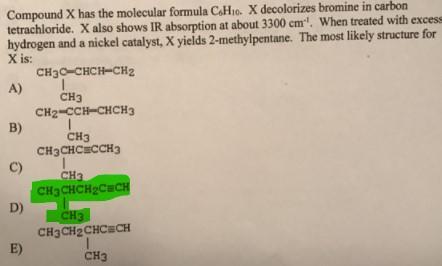
Compound X has the molecular formula C6H10. X decolorizes bromine in carbon tetrachloride. X also shows IR absorption at about 3
pychu [463]

Answer:

The correct answer is - option D. (check image)

Explanation:

Alkynes and alkenes both decolorized bromine in carbon tetrachloride. The absorption of the IR at about 3300 cm-1 for the X here that are found in the terminal alkynes absorption range only. In presence of excess hydrogen and a nickel catalyst, x gives the  2-methyl pentane.

The most likely structure for X is: CH3-CH3-ch-CH2-C≡CH

3 0
1 year ago
As illustrated, the below manometer consists of a gas vessel and an open-ended U-tube containing a nonvolatile liquid with a den
STALIN [3.7K]

Answer:

1.01atm is the pressure of the gas

Explanation:

The difference in heights in the two sides is because of the difference in  pressure of the enclosed gas and the atmospheric pressure. This difference is in mm of the nonvolatile liquid. The difference in mm Hg is:

32.3mm * (0.993g/mL / 13.6g/mL) = 2.36mmHg

As atmospheric pressure is 765mm Hg and assuming the gas has more pressure than the atmospheric pressure (There is no illustration), the pressure of the gas is:

765mm Hg + 2.36mm Hg = 767.36 mmHg

In atm:

767.36 mmHg * (1atm / 760 mmHg) =

1.01atm is the pressure of the gas

5 0
2 years ago
Other questions:
  • The molecular weight of a gas is ________ g/mol if 6.7 g of the gas occupies 6.3 l at stp.
    6·1 answer
  • A 63 kg object needs to be lifted 7 meters in a matter of 5 seconds. Approximately how much horsepower is required to achieve th
    14·2 answers
  • Which missing item would complete this beta decay reaction?<br> PLATO
    12·2 answers
  • A reaction A(aq)+B(aq)↽−−⇀C(aq) has a standard free‑energy change of −4.20 kJ/mol at 25 °C. What are the concentrations of A, B,
    8·1 answer
  • An airplane cabin is pressurized to 5.80x10^2.What is the pressure inside the cabin in atmospheres?
    14·1 answer
  • The diagram below shows the different phase transitions that occur in matter. Three bars are shown labeled Solid, Liquid, and Ga
    11·2 answers
  • Lithium chloride forms three hydrates. They are LiCl.H2O, LiCl.2H2O and LiCl.3H2O.
    5·1 answer
  • If a zero order reaction has a rate constant k of 0.0416Mmin and an initial concentration of 2.29 M, what will be its concentrat
    13·1 answer
  • A diamond can make permanent marks on glass. It can also cut glass. Most other materſals cannot do this.Which property of a diam
    15·1 answer
  • What percentage of the 20.0 g sample does sugar (sucrose) represent?
    7·1 answer
Add answer
Login
Not registered? Fast signup
Signup
Login Signup
Ask question!