answer.
Ask question
Login Signup
Ask question
All categories
  • English
  • Mathematics
  • Social Studies
  • Business
  • History
  • Health
  • Geography
  • Biology
  • Physics
  • Chemistry
  • Computers and Technology
  • Arts
  • World Languages
  • Spanish
  • French
  • German
  • Advanced Placement (AP)
  • SAT
  • Medicine
  • Law
  • Engineering
vovikov84 [41]
2 years ago
13

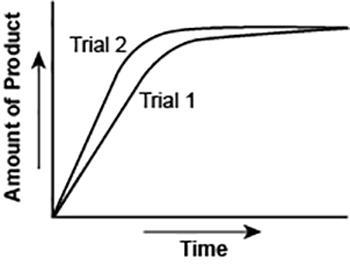
The graph shows the amount of a gaseous product formed over time during two trials of a reaction. A different concentration of a

reactant was used during each trial while other factors were kept constant. (see graph)
Which of the following statements explains which trial has a higher concentration of the reactant?

Trial 1, because the final amount of product formed is higher.

Trial 1, because this reaction lasted for a longer duration than Trial 2.

Trial 2, because this reaction was initially fast and slowed down later.

Trial 2, because the amount of product formed per unit time is higher.

Chemistry
2 answers:
ss7ja [257]2 years ago
8 0

Answer:

Trial 2, because the amount of product formed per unit time is higher.

Explanation:

Message me for extra help.

Delicious77 [7]2 years ago
4 0

Answer:

dude

Explanation:

I have the same question

You might be interested in
Trichloromethane consists of 10.05% carbon. 0.83% hydrogen and 89.12% chlorine. if uts relative molecular mass is 119.5g . find
Delicious77 [7]

Answer:

C24H2CL213

Explanation:

C

(10.05/100)x119.5

=12x2=24

H

(0.083/100)x119.5

=1x2=2

Cl

(89.12/100)x119.5

=106.5x2=213

4 0
2 years ago
Which choice below correctly completes the sentence? _______ reaches the Earth's surface through _______, then turns into ______
blondinia [14]

Answer:

d , before the molten rock becomes lava, it is first magma, and most people know that lava is ejected from volcanoes

4 0
2 years ago
Explain why groups 14 and 15 are better representatives of mixed groups than groups 13 and 16
Brrunno [24]
<h3><u>Answer</u>;</h3>

Groups 14 and 15 each contain metals, nonmetals, and metalloids while Group 13 contains metals and a metalloid, and Group 16 contains metalloids and nonmetals.

<h3><u>Explanation;</u></h3>
  • Groups 13–16 of the periodic table contain one or more metalloids, in addition to metals, nonmetals, or both.
  • Unlike other groups of the periodic table, which contain elements in one class, groups 13–16 referred to as mixed groups contain elements in at least two different classes. In addition to metalloids, they also contain metals, nonmetals, or both.
  • <em><u>Group 14 also known as the carbon group contains carbon which is a non metal, silicon and germanium which are metalloids and tin and lead which are metals.</u></em>
  • <em><u>Group 15 also known as the Nitrogen group contains non metals such as oxygen, metalloid tellurium and a metal polonium.</u></em>
3 0
2 years ago
ethylene glycol used in automobile antifreeze and in the production of polyester. The name glycol stems from the sweet taste of
Luden [163]

<u>Answer:</u> The empirical and molecular formula for the given organic compound is CH_3O and C_4H_{12}O_4

<u>Explanation:</u>

The chemical equation for the combustion of hydrocarbon having carbon, hydrogen and oxygen follows:

C_xH_yO_z+O_2\rightarrow CO_2+H_2O

where, 'x', 'y' and 'z' are the subscripts of Carbon, hydrogen and oxygen respectively.

We are given:

Mass of CO_2=9.06g

Mass of H_2O=5.58g

We know that:

Molar mass of carbon dioxide = 44 g/mol

Molar mass of water = 18 g/mol

  • <u>For calculating the mass of carbon:</u>

In 44g of carbon dioxide, 12 g of carbon is contained.

So, in 9.06 g of carbon dioxide, \frac{12}{44}\times 9.06=2.47g of carbon will be contained.

  • <u>For calculating the mass of hydrogen:</u>

In 18g of water, 2 g of hydrogen is contained.

So, in 5.58 g of water, \frac{2}{18}\times 5.58=0.62g of hydrogen will be contained.

  • Mass of oxygen in the compound = (6.38) - (2.47 + 0.62) = 3.29 g

To formulate the empirical formula, we need to follow some steps:

  • <u>Step 1:</u> Converting the given masses into moles.

Moles of Carbon =\frac{\text{Given mass of Carbon}}{\text{Molar mass of Carbon}}=\frac{2.47g}{12g/mole}=0.206moles

Moles of Hydrogen = \frac{\text{Given mass of Hydrogen}}{\text{Molar mass of Hydrogen}}=\frac{0.62g}{1g/mole}=0.62moles

Moles of Oxygen = \frac{\text{Given mass of oxygen}}{\text{Molar mass of oxygen}}=\frac{3.29g}{16g/mole}=0.206moles

  • <u>Step 2:</u> Calculating the mole ratio of the given elements.

For the mole ratio, we divide each value of the moles by the smallest number of moles calculated which is 0.206 moles.

For Carbon = \frac{0.206}{0.206}=1

For Hydrogen  = \frac{0.62}{0.206}=3

For Oxygen  = \frac{0.206}{0.206}=1

  • <u>Step 3:</u> Taking the mole ratio as their subscripts.

The ratio of C : H : O = 1 : 3 : 1

Hence, the empirical formula for the given compound is C_1H_{3}O_1=CH_3O

For determining the molecular formula, we need to determine the valency which is multiplied by each element to get the molecular formula.

The equation used to calculate the valency is:

n=\frac{\text{molecular mass}}{\text{empirical mass}}

We are given:

Mass of molecular formula = 124 amu = 124 g/mol

Mass of empirical formula = 31 g/mol

Putting values in above equation, we get:

n=\frac{124g/mol}{31g/mol}=4

Multiplying this valency by the subscript of every element of empirical formula, we get:

C_{(1\times 4)}H_{(3\times 4)}O_{(1\times 4)}=C_4H_{12}O_4

Thus, the empirical and molecular formula for the given organic compound is CH_3O and C_4H_{12}O_4

3 0
2 years ago
Based on the results of this lab, write a short paragraph that summarizes how to distinguish physical changes from chemical chan
Kaylis [27]

Physical changes occur when the properties of a substance are retained and/or the materials can be recovered after the change. Chemical changes involve the formation of a new substance. Formation of a gas, solid, light, or heat are possible evidence of chemical change.

6 0
2 years ago
Read 2 more answers
Other questions:
  • Oxides of nitrogen are pollutant gases which are emitted from car exhausts.
    14·2 answers
  • The circles, or orbits, for electrons are called energy levels. Each level can hold only a certain number of electrons. Add elec
    11·2 answers
  • What do pH and conductivity have in common?
    6·2 answers
  • A class is given a demonstration of solution chemistry and solubility equilibria.Passage: A 6.57-g sample of NiSO4•6H2O (molar m
    10·1 answer
  • Sulfur and oxygen react to produce sulfur trioxide. In a particular experiment, 7.9 grams of SO3 are produced by the reaction of
    12·1 answer
  • Which of the following statements about monosaccharide structure is true?
    7·1 answer
  • An equimolar mixture of N2(g) and Ar(g) is kept inside a rigid container at a constant temperature of 300 K. The initial partial
    9·1 answer
  • A student dissolved 4.00 g of Co(NO3)2 in enough water to make 100. mL of stock solution. He took 4.00 mL of the stock solution
    5·1 answer
  • A sample of an ideal gas occupies 2.78 x 10^3 mL at 25°C and 760 mm Hg.
    14·2 answers
  • Consider the following hypothetical reaction: 2 P + Q → 2 R + S The following mechanism is proposed for this reaction: P + P Q
    11·1 answer
Add answer
Login
Not registered? Fast signup
Signup
Login Signup
Ask question!