answer.
Ask question
Login Signup
Ask question
All categories
  • English
  • Mathematics
  • Social Studies
  • Business
  • History
  • Health
  • Geography
  • Biology
  • Physics
  • Chemistry
  • Computers and Technology
  • Arts
  • World Languages
  • Spanish
  • French
  • German
  • Advanced Placement (AP)
  • SAT
  • Medicine
  • Law
  • Engineering
mariarad [96]
2 years ago
6

The cytochromes are heme‑containing proteins that function as electron carriers in the mitochondria. Calculate the difference in

the reduction potential (ΔE∘′) and the change in the standard free energy (ΔG∘′) when the electron flow is from the carrier with the lower reduction potential to the higher. cytochrome c1 (Fe3+)+e−↽−−⇀cytochrome c1 (Fe2+)E∘′=0.22 V cytochrome c (Fe3+)+e−↽−−⇀cytochrome c (Fe2+)E∘′=0.254 V Calculate ΔE∘′ and ΔG∘′ . ΔE∘′= V ΔG∘′= kJ/mol

Chemistry
2 answers:
Reptile [31]2 years ago
7 0

Answer:

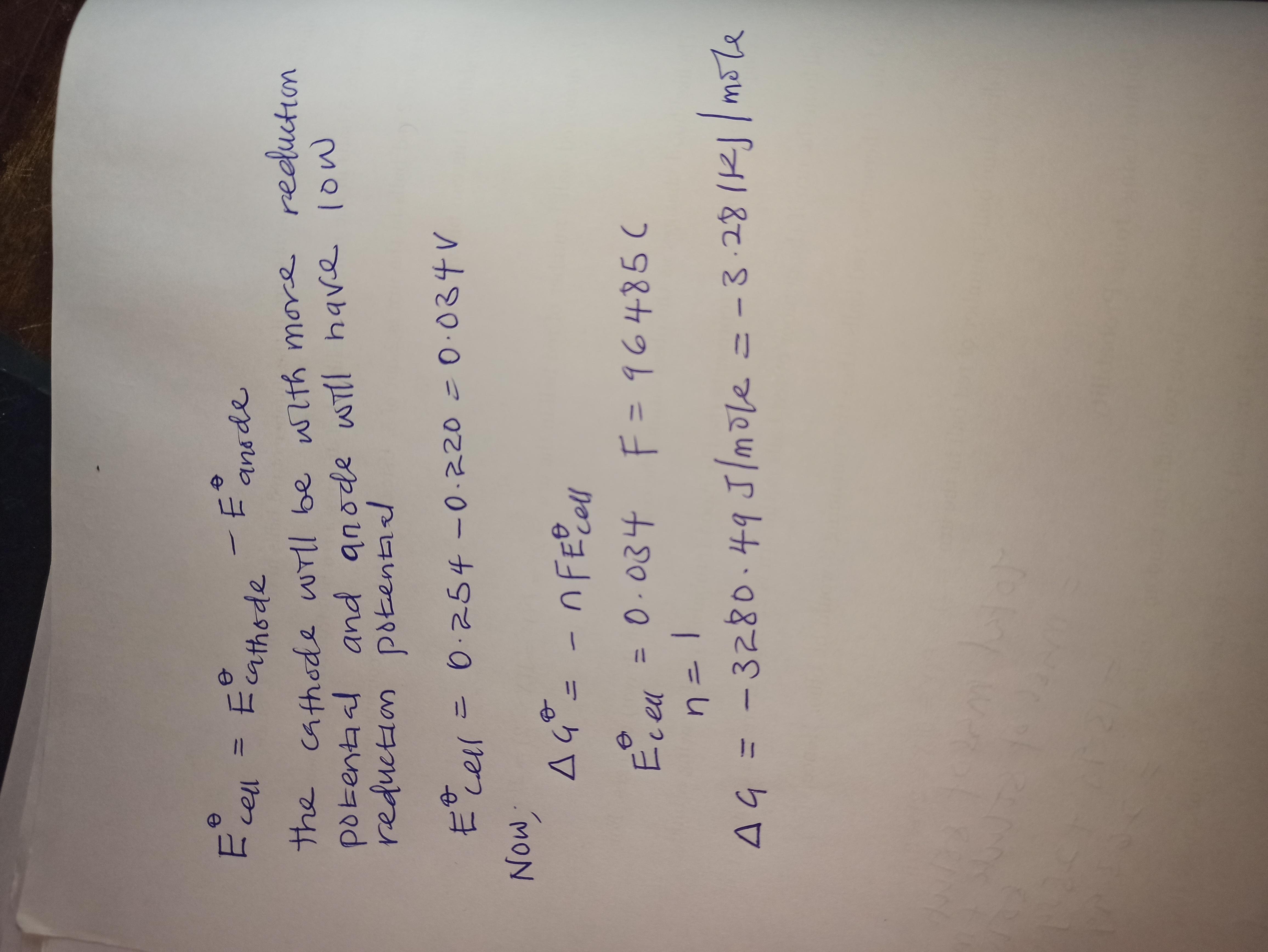
ΔE∘′= 0.034V

ΔG∘′=-3.281 kJ/mole

Explanation:

Check attachment

Contact [7]2 years ago
5 0

Answer:

DeltaG0 = -(1) X 96485 X 0.034 = -3280.49 J /mole = -3.281 KJ / mole

Explanation:

E0cell = E0cathode - E0anode

the cathode will be with more reduction potential and anode will have low reduction potential

E0cell = 0.254 - 0.220 = 0.034 V

Now

DeltaG0 = -nFE0cell

E0cell = 0.034 V

F = 96485 C

n = 1

Putting values

DeltaG0 = -(1) X 96485 X 0.034 = -3280.49 J /mole = -3.281 KJ / mole

You might be interested in
How many carbon atoms are contained in 2.8 g of c2h4 ?
MrRa [10]

Answer:

The answer to your question is:  1.205 x 10²³ atoms of Carbon

Explanation:

Data

Carbons atoms contained in 2.8 g C₂ H₄

MW C₂ H₄ = (12 x 2) + (4 x 1) = 24 + 4 = 28 g

                         28 g of C₂ H₄ ----------------  24 g of carbon

                         2.8 g C₂ H₄   -----------------    x

                         x = (2.8)(24) / (28)

                            = 2.4 grams of C

                             1 mol  -------------------   12 g of Carbon

                             x        -------------------    2.4 g

                            x = (2.4x 1) / 12 = 0.2 mol

                             1 mol -----------------   6.023 x 10 ²³ atoms

                           0.2 mol  --------------     x

                            x = (0.2 x 6.023 x 10 ²³) / 1

                              = 1.205 x 10²³ atoms

8 0
2 years ago
Read 2 more answers
Which of these is a trace fossil : shrimp burrow, seashell, dinosaur egg, shark tooth
Artyom0805 [142]

Answer:

Option (1)

Explanation:

Trace fossils are defined as those traces such as the impressions and signs of ancient remains of an organism, that are found over relatively softer sediment.  

These play a very important role in the field of paleontology as it provides information about the ancient organism that lived in the past in a particular location.

Some of the examples of trace fossils are track and trails, burrows, footprints, cast and mold.

Shrimp burrows are an example of trace fossils, which are made by the marine organisms named shrimps, that are usually found at the bottom of the ocean.

Thus, the correct answer is option (1).

5 0
2 years ago
Read 2 more answers
Sodium thiosulfate (Na2S2O3), photographer’s
vova2212 [387]

3Na2S2O3 + AgBr ------>Na5[Ag(S2O3) 3] +NaBr

from equation 3 mol 1 mol

given x mol 0.10 mol


x= (3*0.10)/1=0.30 mol Na2S2O3


Answer: 0.30 mol Na2S2O3

3 0
2 years ago
Read 2 more answers
If Co(NH3)63+ has a λmax at 440 nm, calculate ΔE for the complex. A) 2.72 x 10⁻⁴ kJ/mol B) 4.52 x 10⁻² kJ/mol C) 2.72 x 10 2 kJ/
riadik2000 [5.3K]

<u>Answer:</u> The energy of the complex is 2.72\times 10^2kJ

<u>Explanation:</u>

To calculate the energy of the complex, we use the equation given by Planck which is:

\Delta E=\frac{N_Ahc}{\lambda}

where,

\lambda = Wavelength of the complex = 440nm=4.40\times 10^{-7}m    (Conversion factor:  1m=10^9nm )

h = Planck's constant = 6.624\times 10^{-34}Js

c = speed of light = 3\times 10^8m/s

N_A = Avogadro's number = 6.022\times 10^{23}

\Delta E = energy of the complex

Putting values in above equation, we get:

\Delta E=\frac{6.022\times 10^{23}\times 6.624\times 10^{-34}\times 3\times 10^8}{4.40\times 10^{-7}}\\\\\Delta E=2.72\times 10^{5}J=2.72\times 10^2kJ

Conversion factor used:  1 kJ = 1000 J

Hence, the energy of the complex is 2.72\times 10^2kJ

5 0
2 years ago
Pure platinum is too soft to be used in jewelry because it scratches easily. To increase the hardness so that it can be used in
Zina [86]

Answer:

percentage mass of platinum in the alloy ≈ 90.60 %

Explanation:

The alloy is 8.528 g sample of an alloy containing platinum and cobalt . The alloy react with excess nitric acid to form cobalt(ii) nitrate . Platinum is resistant to acid so it will definitely not react with the acid only the cobalt metal in the alloy will react with the acid.

The chemical reaction can be represented as follows:

Co (s) + HNO₃ (aq) → Co(NO₃)₂ (aq) +  NO₂ (l) + H₂O (l)

The balanced equation

Co (s) + 4HNO₃ (aq) → Co(NO₃)₂(aq) + 2NO₂ (l) + 2H₂O (l)

Cobalt is the limiting reactant

atomic mass of cobalt = 58.933 g/mol

Molar mass of Co(NO₃)₂ = 58.933 + 14 × 2 + 16 × 6 = 58.933 + 28 + 96 = 182.933  g

58.933 g of cobalt produce 182.933  g of  Co(NO₃)₂

? gram of cobalt will produce 2.49 g of Co(NO₃)₂

cross multiply

grams of cobalt that will react = (58.933 × 2.49)/182.933

grams of cobalt that will react = 146.74317000/182.933

grams of cobalt that will react= 0.8021689362 g

grams of cobalt that will react = 0.802 g

mass of platinum in the alloy  = 8.528 g - 0.802 g = 7.726 g

percentage  mass of platinum in the alloy = 7.726/8.528 × 100 = 772.600/8.528 = 90 .595 %

percentage mass of platinum in the alloy ≈ 90.60 %

6 0
2 years ago
Other questions:
  • What is [h3o ] in a solution of 0.25 m ch3co2h and 0.030 m nach3co2?
    10·1 answer
  • A 10.0-ml sample of 0.200 m hydrocyanic acid (hcn) is titrated with 0.0998 m naoh. what is the ph at the equivalence point? for
    7·1 answer
  • Read the following passage.
    10·2 answers
  • From the options provided for each element below, choose the properties that it may have based on its location in the periodic t
    10·2 answers
  • From the list below, which items describe beta decay? Check all that apply. APEX
    7·1 answer
  • Which statement must be mentioned in explaining why amphipathic molecules line up at a water surface?Which statement must be men
    5·2 answers
  • QUESTION 18 Solid aluminum and gaseous oxygen react in a combination reaction to produce aluminum oxide: 4Al (s) 3O 2 (g) 2Al 2O
    15·1 answer
  • A 1.80 g sample of barium chloride hydrate, BaCl2 ⋅ xH2O is treated with excess sulfuric acid, forming a BaSO4 precipitate which
    6·2 answers
  • Adelyn cut herself on broken glass in the classroom she started bleeding and needed assistance from her teacher which should the
    9·2 answers
  • The molecules that make up soap have a region that contains polar covalent bonds and a region that contains nonpolar covalent bo
    11·1 answer
Add answer
Login
Not registered? Fast signup
Signup
Login Signup
Ask question!