answer.
Ask question
Login Signup
Ask question
All categories
  • English
  • Mathematics
  • Social Studies
  • Business
  • History
  • Health
  • Geography
  • Biology
  • Physics
  • Chemistry
  • Computers and Technology
  • Arts
  • World Languages
  • Spanish
  • French
  • German
  • Advanced Placement (AP)
  • SAT
  • Medicine
  • Law
  • Engineering
Lisa [10]
2 years ago
3

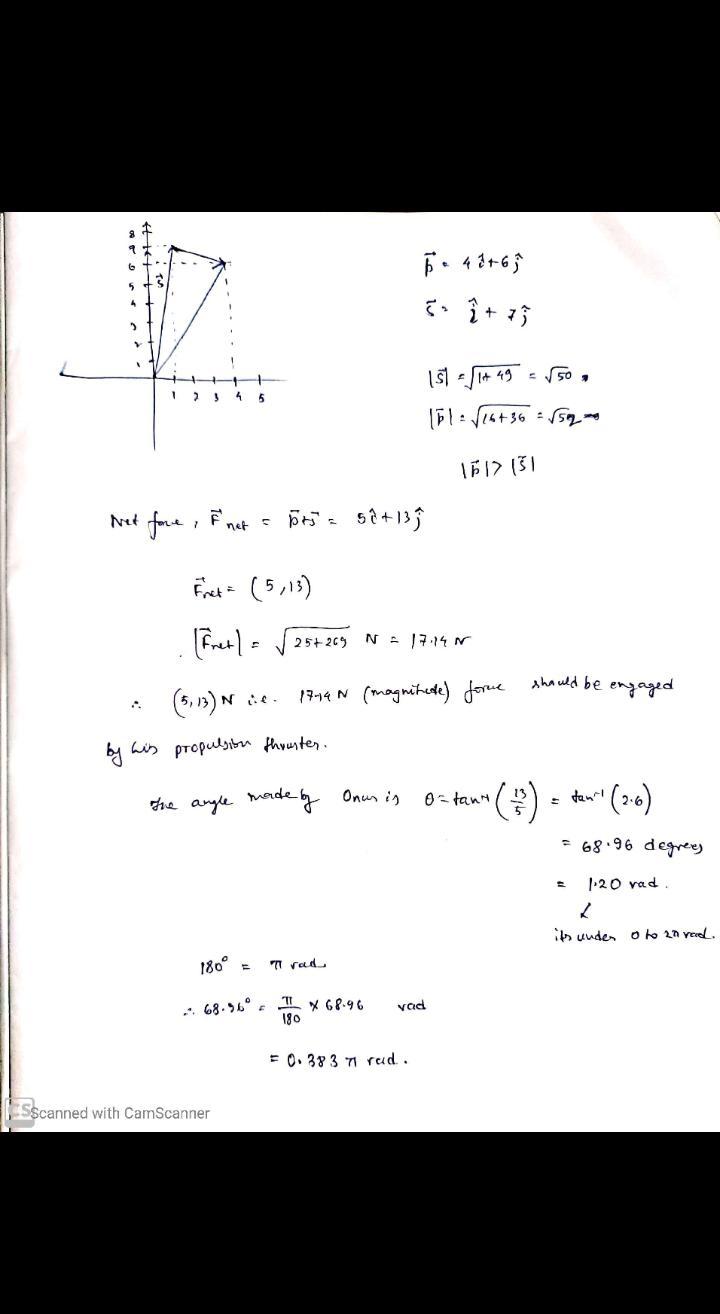
Onur is floating freely in outer space with a propulsion thruster to help him counteract the pull of gravity. The gravitational

forces pulling on his body are negligible except for those from the nearest planet (described by force vector \purple{\vec p}\, p ​ start color #9d38bd, p, with, vector, on top, end color #9d38bd) and the nearest star (described by force vector \blue{\vec s}\, s start color #6495ed, s, with, vector, on top, end color #6495ed). Onur, the planet, and the star are in the same plane, so we can describe the gravitational forces as two-dimensional vectors. \purple{\vec{p}} = (4,6) p ​ =(4,6)start color #9d38bd, p, with, vector, on top, end color #9d38bd, equals, left parenthesis, 4, comma, 6, right parenthesis \blue{\vec{s}} = (1,7) s =(1,7)start color #6495ed, s, with, vector, on top, end color #6495ed, equals, left parenthesis, 1, comma, 7, right parenthesis (Forces are given in newtons, \text{N}Nstart text, N, end text.)
Physics
1 answer:
ANEK [815]2 years ago
3 0

Answer:

O.383πrad

Explanation:

Please look below the document for the attached file

The calculation is been done in the attached file

You might be interested in
X-rays with an energy of 300 keV undergo Compton scattering from a target. If the scattered rays are detected at 30 relative to
lys-0071 [83]

Answer:

a) \Delta \lambda = \lambda' -\lambda_o = \frac{h}{m_e c} (1-cos \theta)

For this case we know the following values:

h = 6.63 x10^{-34} Js

m_e = 9.109 x10^{-31} kg

c = 3x10^8 m/s

\theta = 37

So then if we replace we got:

\Delta \lambda = \frac{6.63x10^{-34} Js}{9.109 x10^{-31} kg *3x10^8 m/s} (1-cos 37) = 4.885x10^{-13} m * \frac{1m}{1x10^{-15} m}= 488.54 fm

b) \lambda_0 = \frac{hc}{E_0}

With E_0 = 300 k eV= 300000 eV

And replacing we have:

\lambda_0 = \frac{1240 x10^{-9} eV m}{300000eV}=4.13 x10^{-12}m = 4.12 pm

And then the scattered wavelength is given by:

\lambda ' = \lambda_0 + \Delta \lambda = 4.13 + 0.489 pm = 4.619 pm

And the energy of the scattered photon is given by:

E' = \frac{hc}{\lambda'}= \frac{1240x10^{-9} eVm}{4.619x10^{-12} m}=268456.37 eV - 268.46 keV

c) E_f = E_0 -E' = 300 -268.456 kev = 31.544 keV

Explanation

Part a

For this case we can use the Compton shift equation given by:

\Delta \lambda = \lambda' -\lambda_0 = \frac{h}{m_e c} (1-cos \theta)

For this case we know the following values:

h = 6.63 x10^{-34} Js

m_e = 9.109 x10^{-31} kg

c = 3x10^8 m/s

\theta = 37

So then if we replace we got:

\Delta \lambda = \frac{6.63x10^{-34} Js}{9.109 x10^{-31} kg *3x10^8 m/s} (1-cos 37) = 4.885x10^{-13} m * \frac{1m}{1x10^{-15} m}= 488.54 fm

Part b

For this cas we can calculate the wavelength of the phton with this formula:

\lambda_0 = \frac{hc}{E_0}

With E_0 = 300 k eV= 300000 eV

And replacing we have:

\lambda_0 = \frac{1240 x10^{-9} eV m}{300000eV}=4.13 x10^{-12}m = 4.12 pm

And then the scattered wavelength is given by:

\lambda ' = \lambda_0 + \Delta \lambda = 4.13 + 0.489 pm = 4.619 pm

And the energy of the scattered photon is given by:

E' = \frac{hc}{\lambda'}= \frac{1240x10^{-9} eVm}{4.619x10^{-12} m}=268456.37 eV - 268.46 keV

Part c

For this case we know that all the neergy lost by the photon neds to go into the recoiling electron so then we have this:

E_f = E_0 -E' = 300 -268.456 kev = 31.544 keV

3 0
2 years ago
Read 2 more answers
If you calculate the thermal power radiated by typical objects at room temperature, you will find surprisingly large values, sev
OverLord2011 [107]

Answer:

best explanation of this is sentence B

Explanation:

The radiation emission of the bodies is given by the expression

     P = σ A e T⁴

Where P is the power emitted in watts, σ is the Stefan-Boltzmann constant, A is the surface area of ​​the body, e is the emissivity for black body e = 1 and T is the absolute body temperature in degrees Kelvin.

When the values ​​are substituted the power is quite high 2.5 KW, but the medium surrounding the box also emits radiation

   T box ≈ T room

    P box ≈ P room

As the two powers are similar and the box can absorbed, since it has the ability to emit and absorb radiation, as the medium is also close of the temperature of the box, the amount emitted is very similar to that absorbed, so the net change in energy is very small.

   In the case that the box is much hotter or colder than the surrounding medium if there is a significant net transfer.

Consequently, the best explanation of this is sentence B

5 0
2 years ago
Two friends of different masses are on the playground. They are playing on the seesaw and are able to balance it even though the
Westkost [7]

Answer:

They are able to balance torques due to gravity.

F_1 L_1 = F_2L_2

Explanation:

When two friends of different masses will balance themselves on see saw then at equilibrium position the see saw will remain horizontal

This condition will be torque equilibrium position where the see saw will not rotate

Here we can say

F_1 L_1 = F_2L_2

here we know that force is due to weight of two friends

and their positions are different with respect to the lever about which see saw is rotating

since both friends are of different weight so they will balance themselves are different positions as per above equation

5 0
2 years ago
Keisha looks out the window from a tall building at her friend Monique standing on the ground, 8.3 m away from the side of the b
Salsk061 [2.6K]

Answer:

Explanation:

GIVEN DATA:

Distance between keisha and her friend 8.3 m

angle made by keisha toside building 30 degree

height of her friend monique is 1.5 m

from the figure

\Delta ACB

tan 30 = \frac{8.3}{h}

h= \frac{8.3}{tan 30} = 14.376 m

therefore

height of keisha is = h  + 1.5 m

                               = 14.376 + 1.5

= 15.876 \simeq 16 m

therefore option c is correct

5 0
2 years ago
A heat pump absorbs heat from the cold outdoors at 3°c and supplies heat to a house at 20°c at a rate of 30,000 kj/h. if the p
Mazyrski [523]
A heat pump absorbs heat from the cold outdoors at 3 C and supplies heat to a
house at 20 C at a rate of 30,000 kJ/h. If the power consumed by the heat pump
<span>is 3 kW, find the coefficient of performance of the heat pump.</span>
6 0
2 years ago
Other questions:
  • Find τf, the torque about point p due to the force applied by the achilles' tendon.
    11·1 answer
  • For a flourish at the end of her act, a juggler tosses a single ball high in the air. She catches the ball 3.3 s later at the sa
    7·1 answer
  • 2. A pebble is dropped down a well and hits the water 1.5 s later. Using the equations for motion with constant acceleration, de
    14·1 answer
  • A calorimeter has a heat capacity of 1265 J/oC. A reaction causes the temperature of the calorimeter to change from 22.34oC to 2
    14·2 answers
  • Weddell seals make holes in sea ice so that they can swim down to forage on the ocean floor below. Measurements for one seal sho
    11·1 answer
  • Although 0 dB is often referred to as the lower threshold of human hearing, it is important to realize that the human ear is not
    13·1 answer
  • Three sticks are arranged in such a way that they form a right triangle. The
    8·1 answer
  • A statue and a coin are made out of exactly the same materials. Which property would you claim will likely be the same for both
    6·2 answers
  • To practice Problem-Solving Strategy 17.1 for wave interference problems. Two loudspeakers are placed side by side a distance d
    13·1 answer
  • Irrigation channels that require regular flow monitoring are often equipped with electromagnetic flowmeters in which the magneti
    13·1 answer
Add answer
Login
Not registered? Fast signup
Signup
Login Signup
Ask question!
