answer.
Ask question
Login Signup
Ask question
All categories
  • English
  • Mathematics
  • Social Studies
  • Business
  • History
  • Health
  • Geography
  • Biology
  • Physics
  • Chemistry
  • Computers and Technology
  • Arts
  • World Languages
  • Spanish
  • French
  • German
  • Advanced Placement (AP)
  • SAT
  • Medicine
  • Law
  • Engineering
tia_tia [17]
2 years ago
3

A cyclist is moving up a slope that is at an angle of 19 to the horizontal. The mass of the cyclist and the bicycle is 85 kg. Wh

at is the component of the weight of the cyclist and bicycle parallel to the slope and what is the normal reaction force on the bicycle from the slope?

Physics
1 answer:
iren2701 [21]2 years ago
5 0

Answer:

Explanation:

Given

Slope of inclination \theta =19^{\circ}

Mass of cyclist and bicycle is m=85\ kg

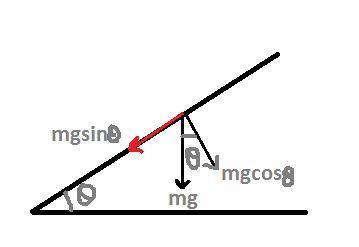
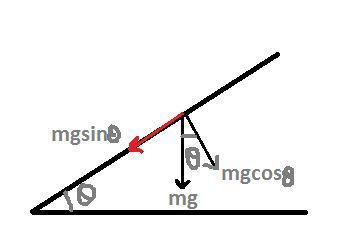
When cyclist is going up then there is two components of its weight , one is parallel to inclination and other is perpendicular to inclination

Weight of person is mg

it can be resolved in mg\cos \theta and  mg\sin \theta

mg\cos \theta is perpendicular to the inclination

and mg\sin \theta is parallel to inclination as shown in diagram

Parallel component =mg\sin \theta=85\times 9.8\times \sin 19=271.2\ N

Normal reaction N=mg\cos \theta =85\times 9.8\times \cos 19=787.61\ N

You might be interested in
The submarine sends out a sound wave that returns in 1.08 seconds. If this sound wave has a frequency of 2.50 × 10⁶ Hz and a wav
Shtirlitz [24]

Answer:

1620

Explanation:

....................

5 0
2 years ago
Electric field lines always begin at _______ charges (or at infinity) and end at _______ charges (or at infinity). One could als
lesantik [10]

Answer:

b)

Explanation:

By convention, the electric field lines (which are tangent to the direction of the electric field at a given point) always begin at positive charges, and finish at negative charges.

This is a consequence of the convention that states that the electric field has the direction of the trajectory of a positive test charge when released from rest in an electric field.

(As the positive charge would move away from positive charges and would  be attracted by negative ones).

So, the combination of answers that is true is b) (positive, negative, positive).

3 0
2 years ago
A certain fuse "blows" if the current in it exceeds 1.0 A, at which instant the fuse melts with a current density of What is the
Alborosie

Answer:

<em>0.45 mm</em>

Explanation:

The complete question is

a certain fuse "blows" if the current in it exceeds 1.0 A, at which instant the fuse melts with a current density of 620 A/ cm^2. What is the diameter of the wire in the fuse?

A) 0.45 mm

B) 0.63 mm

C.) 0.68 mm

D) 0.91 mm

Current in the fuse is 1.0 A

Current density of the fuse when it melts is 620 A/cm^2

Area of the wire in the fuse = I/ρ

Where I is the current through the fuse

ρ is the current density of the fuse

Area = 1/620 = 1.613 x 10^-3 cm^2

We know that 10000 cm^2 = 1 m^2, therefore,

1.613 x 10^-3 cm^2 = 1.613 x 10^-7 m^2

Recall that this area of this wire is gotten as

A = \frac{\pi d^{2} }{4}

where d is the diameter of the wire

1.613 x 10^-7 = \frac{3.142* d^{2} }{4}

6.448 x 10^-7 = 3.142 x d^{2}

d^{2} =\sqrt{ 2.05*10^-7}

d = 4.5 x 10^-4 m = <em>0.45 mm</em>

8 0
2 years ago
Now consider θc, the angle at which the blue refracted ray hits the bottom surface of the diamond. If θc is larger than the crit
Dennis_Churaev [7]

Complete Question:

A beam of white light is incident on the surface of a diamond at an angle \theta_{a},  since the index of refraction depends on the light's wavelength, the different colors that comprise white light will spread out as they pass through the diamond. For example, the indices of refraction in diamond are n_{red} = 2.410 for red light and n_{blue} = 2.450 for blue light. Thus, blue light and red light are refracted at different angles inside the diamond. The surrounding air has n_{air} = 1.000.

Now consider θc, the angle at which the blue refracted ray hits the bottom surface of the diamond. If θc is larger than the critical angle θcrit, the light will not be refracted out into the air, but instead it will be totally internally reflected back into the diamond. Find θcrit. Express your answer in degrees to four significant figures.

Answer:

\theta_{crit} = 24.09^{0}

Explanation:

Only the blue refracted ray is related to the critical angle in this question

n_{air} = 1.000

n_{blue} = 2.450

The relationship between the critical angle(\theta_{crit}), n_{air} and n_{blue} can be given as sin \theta_{crit} = \frac{n_{air} }{n_{blue} }

sin \theta_{crit} = \frac{1 }{2.450 }\\\theta_{crit} = sin^{-1} \frac{1 }{2.450 }\\\theta_{crit} = sin^{-1} 0.4082^{0}\\  \theta_{crit} = 24.09^{0}

6 0
2 years ago
You are driving on the highway, and you come to a steep downhill section. As you roll down the hill, you take your foot off the
Natasha2012 [34]

Answer:

air

Explanation:

The car is being slowed down by air.
5 0
2 years ago
Read 2 more answers
Other questions:
  • What common laboratory measuring device will we likely always use in experiments that measure enthalpy changes?
    13·1 answer
  • A satellite completes one revolution of a planet in almost exactly one hour. At the end of one hour, the satellite has traveled
    5·1 answer
  • The Pickering nuclear power plant has a power rating of 3100 MW.
    11·1 answer
  • A superman cyclist rode a bike uphill at 20 miles/hour for two hours. To sustain this constant speed the cyclist was exerting 50
    10·1 answer
  • Part F - Example: Finding Two Forces (Part I)
    5·1 answer
  • A series circuit has two 10-ohm bulb is added in a series. Technician A says that the three bulbs will be dimmer than when only
    14·1 answer
  • Enrico says that positive charge is created when you rub a glass rod with silk, and that negative charge is simply the absence o
    5·1 answer
  • Index of refraction
    15·1 answer
  • An astronaut working with many tools some distance away from a spacecraft is stranded when the "maneuvering unit" malfunctions.
    11·1 answer
  • An astronaut holds a rock 100m above the surface of Planet XX. The rock is then thrown upward with a speed of 15m/s, as shown in
    11·1 answer
Add answer
Login
Not registered? Fast signup
Signup
Login Signup
Ask question!