answer.
Ask question
Login Signup
Ask question
All categories
  • English
  • Mathematics
  • Social Studies
  • Business
  • History
  • Health
  • Geography
  • Biology
  • Physics
  • Chemistry
  • Computers and Technology
  • Arts
  • World Languages
  • Spanish
  • French
  • German
  • Advanced Placement (AP)
  • SAT
  • Medicine
  • Law
  • Engineering
jonny [76]
2 years ago
13

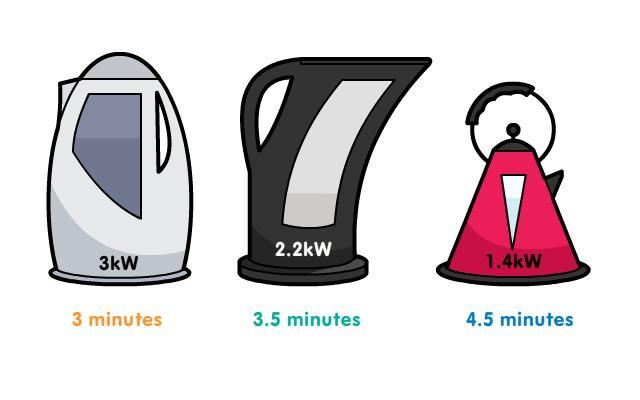
The image below shows three kettles with their power ratings and the time they take to boil 500cm3 of water. How many units (kWh

) does the 2.2kW kettle use to boil the water? Give your answer to 2 decimal places.

Physics
1 answer:
Irina-Kira [14]2 years ago
7 0

Answer:

0.13 KWh.

Explanation:

The following data were obtained from the question:

Power = 2.2KW

Time = 3.5 minutes

Next, we convert 3.5 minutes to hour. This is illustrated below:

60 mins = 1 hour

Therefore, 3.5 mins = 3.5/60 = 0.058 hour

Now, we can obtain the energy in KWh as follow:

Power = 2.2KW

Time = 0.058 hour

Energy =?

Power = Energy / time

Cross multiply

Energy = Power x time

Energy = 2.2 x 0.058

Energy = 0.13 KWh.

Therefore, it will take 0.13 KWh for the 2.2KW kettle to boil the water.

You might be interested in
A 15g bullet travelling at 100m/s strikes and is absorbed by a 75kg object. Find the speed at which the final object moves.
algol [13]
What i got was
speed of impact that is 44.27 m/s
     or 159.38 km/h
time until impact is 4.525
 and last is the Energy at impact which I calauated outcome was 73500.00 joules

4 0
2 years ago
A circular saw blade with radius 0.175 m starts from rest and turns in a vertical plane with a constant angular acceleration of
ANEK [815]

Answer:

The distance the piece travel in horizontally axis is

L=3.55m

Explanation:

a=2 \frac{rev}{s^{2}} \\h=0.820m\\r = 0.125 m
\\d=150rev

d= 155 rev = 155(2\pi ) = 310\pi rad

a= 2.0 \frac{rev}{s^{2} } = 2.0(2\pi )  = 4.0\pi \frac{rev}{s^{2} }

d=d_{i}+vo*t+\frac{1}{2}*a*t^{2} \\ di=0\\vo=0\\d=\frac{1}{2}*a*t^{2}\\t=\sqrt{\frac{2*d}{a}}\\t=\sqrt{\frac{2*310 rad}{4\frac{rad}{s^{2}}}} \\t=12.449

w=a*t\\w=4\frac{rad}{s^{2}}*12.449s\\ w=49.79 \frac{rad}{s}

Now the angular velocity is the blade speed so:

V=w*r\\V=49.79 \frac{rad}{s}*0.175m\\V=8.7 \frac{m}{s}

assuming no air friction effects affect blade piece:

time for blade piece to fall to floor

t=\sqrt{\frac{2*h}{g}}\\t=\sqrt{\frac{2*0.820m}{9.8\frac{m}{s^{2} } }}\\t=0.409s

Now is the same time the piece travel horizontally

L=t*V\\L=0.409s*8.7\frac{m}{s}\\L=3.55m

blade piece travels  HORIZONTALLY = (24.5)(0.397) = 9.73 m  ANS

6 0
2 years ago
Ugonna stands at the top of an incline and pushes a 100−kg crate to get it started sliding down the incline. The crate slows to
Anna [14]

Answer:(a)891.64 N

(b)0.7

Explanation:

Mass of crate m=100 kg

Crate slows down in s=1.5 m

initial speed u=1.77 m/s

inclination \theta =30^{\circ}

From Work-Energy Principle

Work done by all the Forces is equal to change in Kinetic Energy

W_{friction}+W_{gravity}=\frac{1}{2}mv_i^2-\frac{1}{2}mv_f^2

W_{gravity}=mg(0-h)=mgs\sin \theta

W_{gravity}=-mgs\sin \theta

W_{gravity}=-100\times 9.8\times 1.5\sin 30=-735 N

change in kinetic energy=\frac{1}{2}\times 100\times 1.77^2=156.64 J

W_{friction}=156.64+735=891.645

(b)Coefficient of sliding friction

f_r\cdot s=W_{friciton}

891.645=f_r\times 1.5

f_r=594.43 N

and f_r=\mu mg\cos \theta

\mu 100\times 9.8\times \cos 30=594.43

\mu =0.7

5 0
2 years ago
An amusement park ride raises people high into the air, suspends them for a moment, and then drops them at a rate of free-fall a
blsea [12.9K]

Answer: apparent weighlessness.


Explanation:


1) Balance of forces on a person falling:


i) To answer this question we will deal with the assumption of non-drag force (abscence of air).


ii) When a person is dropped, and there is not air resistance, the only force acting on the person's body is the Earth's gravitational attraction (downward), which is the responsible for the gravitational acceleration (around 9.8 m/s²).


iii) Under that sceneraio, there is not normal force acting on the person (the normal force is the force that the floor or a chair exerts on a body to balance the gravitational force when the body is on it).


2) This is, the person does not feel a pressure upward, which is he/she does not feel the weight: freefalling is a situation of apparent weigthlessness.


3) True weightlessness is when the object is in a place where there exists not grativational acceleration: for example a point between two planes where the grativational forces are equal in magnitude but opposing in direction and so they cancel each other.


Therefore, you conclude that, assuming no air resistance, a person in this ride experiencing apparent weightlessness.

3 0
2 years ago
Read 2 more answers
A small cylinder rests on a circular turntable that is rotating clockwise at a constant speed. Which set of vectors gives the di
I am Lyosha [343]

The question is missing the diagram. Also, the choices must have pictorial representation. So, I have attached the missing diagram and the pictorial representation of the vectors.

Answer:

The correct representation is attached below. Force and acceleration will be towards the center of rotation while the velocity will be along the tangent to the circular motion. <u>Option (D).</u>

Explanation:

From the figure, we can conclude the following points:

1. The cylinder is under a uniform circular motion as the circular table is moving at constant speed.

2. For a circular motion, velocity acts along the tangent to the circular path.

3. For a circular motion, centripetal force acts on the body that causes it move around a circular path.

4 The direction of the centripetal force is radially inward towards the center of rotation.

5. The centripetal force causes a centripetal acceleration acting on the body.

6. From Newton's second law, the net acceleration of a body is in the same direction as that of the net force acting on it. So, centripetal acceleration also acts in the radially inward direction.

Therefore, from the above conclusions, it is clear that velocity will act in the horizontal direction at the given instance of time and force and acceleration will act vertically down for the given instance.

This is shown in the picture below. The option (D).
4 0
2 years ago
Other questions:
  • One object has twice as much mass as another object. The first object also has twice as much a velocity. b gravitational acceler
    14·1 answer
  • postal worker on a bicycle travels at an average speed of 4m/s for 3 minutes. Work out how far she travelled.
    7·2 answers
  • The first law of thermodynamics states that ___. when a process converts energy from one form to another, some energy converted
    8·2 answers
  • In the winter sport of bobsledding, athletes push their sled along a horizontal ice surface and then hop on the sled as it start
    10·2 answers
  • A man runs at a velocity of 4.5 m/s for 15.0 min. When going up an increasingly steep hill, he slows down at a constant rate of
    11·1 answer
  • Calculate the true mass (in vacuum) of a piece of aluminum whose apparent mass is 4.5000 kg when weighed in air. The density of
    15·1 answer
  • On a day when the barometer reads 75.23 cm, a reaction vessel holds 250 mL of ideal gas at 20 celsius. An oil manometer ( rho= 8
    12·1 answer
  • Two forces, F⃗ 1F→1F_1_vec and F⃗ 2F→2F_2_vec, act at a point,F⃗ 1F→1F_1_vec has a magnitude of 8.80 NN and is directed at an an
    13·1 answer
  • . A magnetic field has a magnitude of 0.078 T and is uniform over a circular surface whose radius is 0.10 m. The field is orient
    15·1 answer
  • Calculate the work WC done by the gas during the isothermal expansion. Express WC in terms of p0, V0, and Rv.
    12·1 answer
Add answer
Login
Not registered? Fast signup
Signup
Login Signup
Ask question!
