answer.
Ask question
Login Signup
Ask question
All categories
  • English
  • Mathematics
  • Social Studies
  • Business
  • History
  • Health
  • Geography
  • Biology
  • Physics
  • Chemistry
  • Computers and Technology
  • Arts
  • World Languages
  • Spanish
  • French
  • German
  • Advanced Placement (AP)
  • SAT
  • Medicine
  • Law
  • Engineering
Tema [17]
2 years ago
5

Suppose that a charged particle of diameter 1.00 micrometer moves with constant speed in an electric field of magnitude 1.00×10⁵

newtons per coulomb while acted upon by a drag force of 7.25×10⁻¹¹ newtons. what is the charge q1 on the particle? ignore the effects of gravity.

Physics
2 answers:
OLga [1]2 years ago
6 0

The charge q₁ on the particle is about 7.25 × 10⁻¹⁶ C

<h3>Further explanation</h3>

Electric charge consists of two types i.e. positively electric charge and negatively electric charge.

There was a famous scientist who investigated about this charges. His name is Coulomb and succeeded in formulating the force of attraction or repulsion between two charges i.e. :

\large {\boxed {F = k \frac{Q_1Q_2}{R^2} } }

<em>F = electric force (N)</em>

<em>k = electric constant (N m² / C²)</em>

<em>q = electric charge (C)</em>

<em>r = distance between charges (m)</em>

<em>The value of k in a vacuum = 9 x 10⁹ (N m² / C²)</em>

Let's tackle the problem now !

<u>Given:</u>

diameter of charged particle = d = 1 μm

electric field strength = E = 1.00 × 10⁵ N/C

drag force = F = 7.25 × 10⁻¹¹ N

<u>Unknown:</u>

charge of particle = q₁ = ?

<u>Solution:</u>

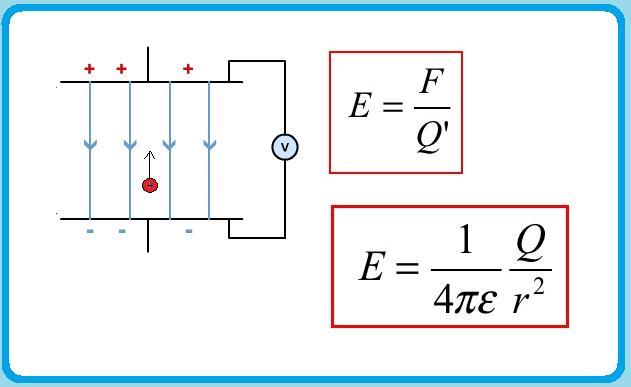
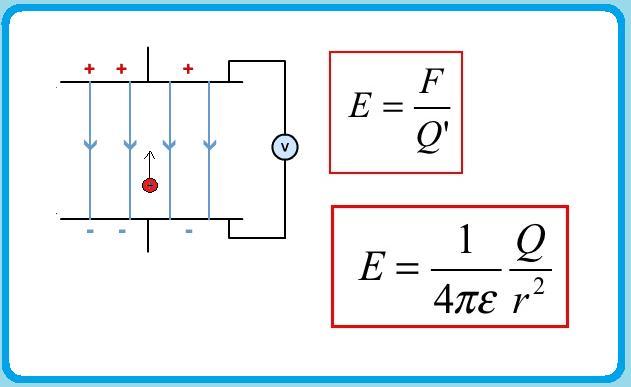
The drag forces is caused by the electric force acting on the charge particles.

F = q_1 \times E

7.25 \times 10^{-11} = q_1 \times 1.00 \times 10^5

q_1 = (7.25 \times 10^{-11}) \div (1.00 \times 10^5)

q_1 = 7.25 \times 10^{-16} ~ \text{Coulomb}

<h3>Learn more</h3>
  • The three resistors : brainly.com/question/9503202
  • A series circuit : brainly.com/question/1518810
  • Compare and contrast a series and parallel circuit : brainly.com/question/539204

<h3>Answer details</h3>

Grade: High School

Subject: Physics

Chapter: Static Electricity

Keywords: Series , Parallel , Measurement , Absolute , Error , Combination , Resistor , Resistance , Ohm , Charge , Small , Forces
Dovator [93]2 years ago
3 0
It's a bit of a trick question, had the same one on my homework. You're given an electric field strength (1*10^5 N/C for mine), a drag force (7.25*10^-11 N) and the critical info is that it's moving with constant velocity(the particle is in equilibrium/not accelerating). 
<span>All you need is F=(K*Q1*Q2)/r^2 </span>
<span>Just set F=the drag force and the electric field strength is (K*Q2)/r^2, plugging those values in gives you </span>
<span>(7.25*10^-11 N) = (1*10^5 N/C)*Q1 ---> Q1 = 7.25*10^-16 C </span>
You might be interested in
Rotational dynamics about a fixed axis: A person pushes on a small doorknob with a force of 5.00 N perpendicular to the surface
FrozenT [24]

Answer:

I = 2 kgm^2

Explanation:

In order to calculate the moment of inertia of the door, about the hinges, you use the following formula:

\tau=I\alpha     (1)

I: moment of inertia of the door

α: angular acceleration of the door = 2.00 rad/s^2

τ: torque exerted on the door

You can calculate the torque by using the information about the Force exerted on the door, and the distance to the hinges. You use the following formula:

\tau=Fd        (2)

F: force = 5.00 N

d: distance to the hinges = 0.800 m

You replace the equation (2) into the equation (1), and you solve for α:

Fd=I\alpha\\\\I=\frac{Fd}{\alpha}

Finally, you replace the values of all parameters in the previous equation for I:

I=\frac{(5.00N)(0.800m)}{2.00rad/s^2}=2kgm^2

The moment of inertia of the door around the hinges is 2 kgm^2

3 0
2 years ago
Two cyclists start on a race between points A and D on two different routes. Cyclist X takes the route passing through the equid
ollegr [7]
The displacement is the shortest distance between two points, which is 546.41. The displacement for both is 546.41 meters

Average velocity of X = (200 + 200 + 200) / 30
Average velocity of X = 20 m/s

Average velocity of Y = 546.41 / 30 = 18.2 m/s
8 0
2 years ago
Read 2 more answers
In the absence of air resistance, at what other angle will a thrown ball go the same distance as one thrown at an angle of 75 de
snow_tiger [21]

As we know that range of the projectile motion is given by

R = \frac{v^2 sin(2\theta)}{g}

here we know that range will be same for two different angles

so here we can say the two angle must be complementary angles

so the two angles must be

\theta, 90 - \theta

so it is given that one of the projection angle is 75 degree

so other angle for same range must be 90 - 75 = 15 degree

so other projection angle must be 15 degree

5 0
2 years ago
a fixed mass of a n ideal gas is heated from 50 to 80C at a constant pressure at 1 atm and again at a constant pressure of 3 atm
vitfil [10]

Answer:

The energy required is same for both cases since specific heat capacity (Cp) does not vary with pressure.

Explanation:

Given;

initial temperature, t₁ = 50 °C

final temperature, t₂ = 80 °C

Change in temperature, ΔT =80 °C - 50 °C = 30 °C

Pressure for case 1 = 1 atm

Pressure for case 2 = 3 atm

Energy required in both cases is given;

Q = M*C_p*\delta T

where;

Cp is specific heat capacity, which varies only with temperature and not with pressure.

Therefore, the energy required is same for both cases since specific heat capacity (Cp) does not vary with pressure.

8 0
2 years ago
When a 75.0-kg man slowly adds his weight to a vertical spring attached to the ceiling, he reaches equilibrium when the spring i
Sergio039 [100]

Answer:

1)k=11.319kN/m

2)displacement=13.02cm

3)k_{eq}=5.65kN/m

Explanation:

At equilibrium position the weight of the man should be balanced by force in the spring

thus we have at equilibrium

kx=mg\\\\k=\frac{mg}{x}

Applying values we get

k=\frac{75\times 9.81}{0.065}\\\\k=11.319kN/m

2)

When we add another identical spring we get an equivalent spring with spring constant as  

\frac{1}{k_{eq}}=\frac{1}{k_1}+\frac{1}{k_2}

Applying values we get

\frac{1}{k_{eq}}=\frac{1}{11.319}+\frac{1}{11.319}\\\\k_{eq}=5.65kN/m

Thus at equilibrium we have

x_{2}k_{eq}=mg\\\\x_{2}=\frac{mg}{k_{eq}}\\\\x_{2}=\frac{75\times 9.81}{5.65}\times 10^{-3}=13.02cm

3) Equivalent spring constant will be as calculated earlier k_{eq}=5.65kN/m

3 0
2 years ago
Other questions:
  • Which two pieces of data indicate that Uranus resides in the outer region of the solar system
    12·1 answer
  • Heat engines were first envisioned and built during the industrial revolution. Explain the thermodynamics of a heat engine comme
    6·2 answers
  • An OTR is removing electrodes from a client who has just received iontophoresis. Within several minutes of removing the electrod
    8·1 answer
  • A DJ starts up her phonograph player. The turntable accelerates uniformly from rest, and takes t1 = 11.9 seconds to get up to it
    12·1 answer
  • A and B, move toward one another. Object A has twice the mass and half the speed of object B. Which of the following describes t
    13·1 answer
  • A block moves at 5 m/s in the positive x direction and hits an identical block, initially at rest. A small amount of gunpowder h
    10·1 answer
  • Falling raindrops frequently develop electric charges. Does this create noticeable forces between the droplets? Suppose two 1.8
    6·2 answers
  • You use a slingshot to launch a potato horizontally from the edge of a cliff with speed v0. The acceleration due to gravity is g
    13·1 answer
  • Two parallel wires carry a current I in the same direction. Midway between these wires is a third wire, also parallel to the oth
    11·2 answers
  • A source of emf is connected by wires to a resistor and electrons flow in the circuit the wire diameter is teh same throughout t
    11·1 answer
Add answer
Login
Not registered? Fast signup
Signup
Login Signup
Ask question!
