answer.
Ask question
Login Signup
Ask question
All categories
  • English
  • Mathematics
  • Social Studies
  • Business
  • History
  • Health
  • Geography
  • Biology
  • Physics
  • Chemistry
  • Computers and Technology
  • Arts
  • World Languages
  • Spanish
  • French
  • German
  • Advanced Placement (AP)
  • SAT
  • Medicine
  • Law
  • Engineering
SpyIntel [72]
2 years ago
6

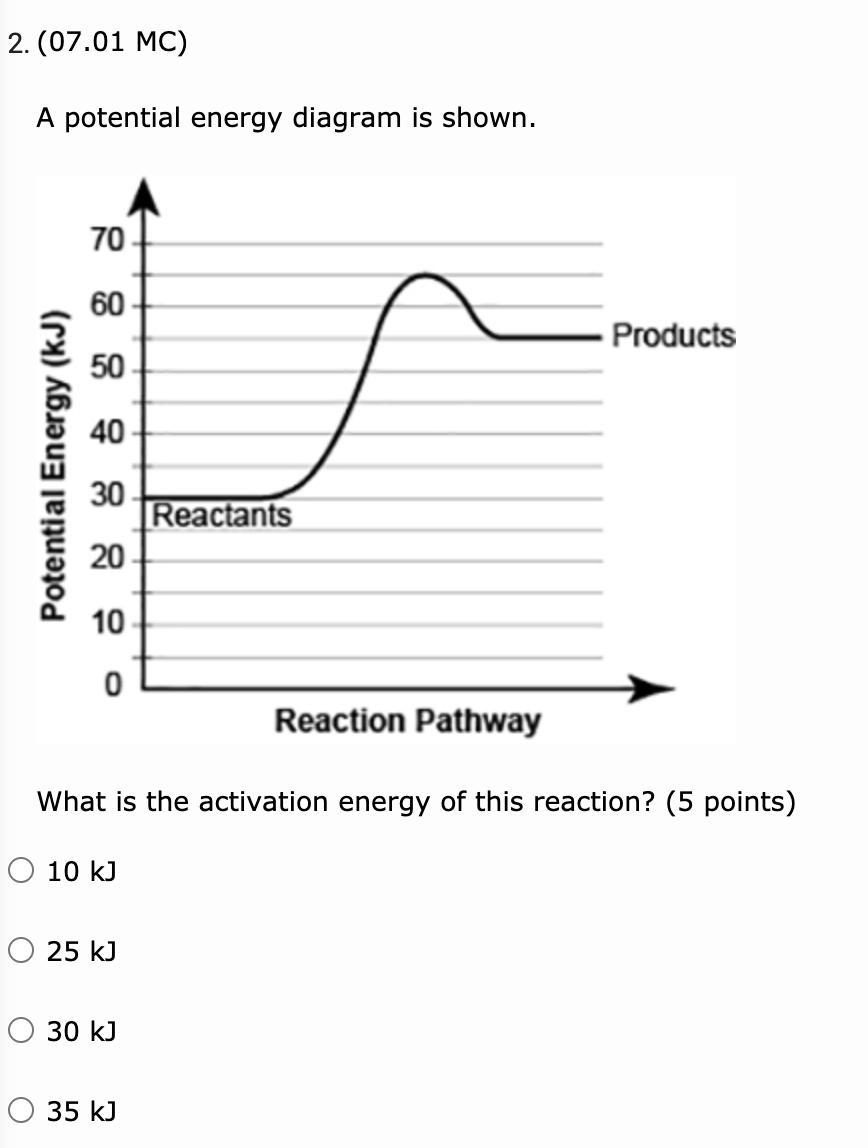
A potential energy diagram is shown. A graph is plotted with Potential Energy in KJ on the y axis and Reaction Pathway on the x

axis. The graph starts at 30 on the y axis and it is initially horizontal, labeled Reactants, and then rises up as a smooth curve and reaches its peak when y is 65 kilojoules. The curve comes down until y is 55 kilojoules where it becomes horizontal again, and it is labeled Products. What is the activation energy of this reaction? (5 points) 10 kJ 25 kJ 30 kJ 35 kJ

Chemistry
1 answer:
ahrayia [7]2 years ago
3 0

Answer:

35 KJ.

Explanation:

The activation energy is the minimum energy that must be overcome for a reaction to take place.

In the diagram given above, the activation energy lies between the energy of the reactants and that at the peak.

Thus we can calculate the activation energy as follow:

Energy of reactants = 30 KJ

Energy at the peak = 65 KJ

Activation energy =..?

Activation energy = Energy at the peak – Energy of reactants

Activation energy = 65 – 30

Activation energy = 35 KJ

Therefore, the activation energy of th reaction is 35 KJ

You might be interested in
Which statement accurately compares ionic and covalent bonding?
Travka [436]

Answer:

Conduct electricity when they are molten, while covalent compounds usually do not conduct electricity when they are molten.

5 0
2 years ago
Read 2 more answers
A 126-gram sample of titanium metal is heated from 20.0°C to 45.4°C while absorbing 1.68 kJ of heat. What is the specific heat o
Radda [10]

Answer:

The specific heat for the titanium metal is 0.524 J/g°C.

Explanation:

Given,

Q = 1.68 kJ   = 1680 Joules

mass = 126 grams

T₁ = 20°C

T₂ = 45.4°C

The specific heat for the metal can be calculated by using the formula

Q = (mass) (ΔT) (Cp)

Here, ΔT =  T₂ - T₁ = 45.4 - 20 = 25.4°C.

Substituting values,

1680 = (126)(25.4)(Cp)

By solving,

Cp = 0.524 J/g°C.

The specific heat for the titanium metal is 0.524 J/g°C.

3 0
2 years ago
With the help of balanced chemical equation explain what happens when:(1)Zinc is put in dilute hydrochloric acid (2)Zinc is put
UkoKoshka [18]
Find the attached document.

6 0
2 years ago
Read 2 more answers
Alka‑Seltzer is marketed as a remedy for stomach problems, such as heartburn or indigestion, and pain relief. It contains aspiri
Papessa [141]

Answer:

The equation for the reaction of one sodium bicarbonate ( NaHCO3 ) molecule with one citric acid (C6H8O7) molecule is the following:

Sodium Bicarbonate + Citric Acid ⇒ Water + Carbon Dioxide + Sodium Citrate

NaHCO3 + C6H8O7 ⇒ 3 CO2 + 3 H2O + Na3C6H5O7

Explanation:

The reaction is in balance, that is, the whole H2CO3 is not finished, but a little bit of this acid is left in the solution. Therefore, when sodium bicarbonate is added to the solution with citric acid, sodium citrate salt (C6H5O7Na3) and carbonic acid (H2CO3) are formed, which is rapidly broken down into water (H2O) and carbonic oxide (CO2).

C6H8O7 + NaHCO3 ⇒ C6H5O7Na3 + 3 H2CO3

C6H5O7Na3 + 3 H2CO3 ⇔ C6H5O7Na3 + 3 H2O + 3 CO2

5 0
2 years ago
To determine the concentration of ethanol in cognac a 5.00 mL sample of the cognac is diluted to 0.500 L. Analysis of the dilute
julia-pushkina [17]

Answer : The molar concentration of ethanol in the undiluted cognac is 8.44 M

Explanation :

Using neutralization law,

M_1V_1=M_2V_2

where,

M_1 = molar concentration of undiluted cognac = ?

M_2 = molar concentration of diluted cognac = 0.0844 M

V_1 =  volume of undiluted cognac = 5.00 mL = 0.005 L

V_2 = volume of diluted cognac = 0.500 L

Now put all the given values in the above law, we get molar concentration of ethanol in the undiluted cognac.

M_1\times 0.005L=0.0844M\times 0.500L

M_1=8.44M

Therefore, the molar concentration of ethanol in the undiluted cognac is 8.44 M

4 0
2 years ago
Other questions:
  • Rank the nonmetals in each set from most reactive (1) to least reactive (3). Neon: Selenium: Fluorine
    5·2 answers
  • You are writing a safety contract for your class. List 10 things you would include in the contract.
    8·2 answers
  • How many grams of h2 gas can be produced by the reaction of 63.0 grams of al(s) with an excess of dilute hydrochloric acid in th
    12·2 answers
  • if 20.g of a radioactive isotope are present at 1:00 pm and 5.0g remain at 2:00 pm, what is the half life of the isotope?
    9·1 answer
  • If, as a pioneer, you wished to warm your room by taking an object heated on top of a pot-bellied stove to it, which of the foll
    9·1 answer
  • Which of the following solutions is a buffer? Check all that apply. Check all that apply. a solution made by mixing 100 mL of 0.
    12·2 answers
  • The bond enthalpy of the C―N bond in the amide group of proteins can be treated as an average of C―N (276 kJ/mol) and C═N (615 k
    14·1 answer
  • Energy may not be created or destroyed, but it may be converted into different types. Categorize the examples below as either Po
    7·1 answer
  • A mixture containing 20 mole % butane, 35 mole % pentane and rest
    15·2 answers
  • In the synthesis of barium carbonate from an alkali metal carbonate (M2CO3 where M is one of the alkali metals) a student genera
    9·1 answer
Add answer
Login
Not registered? Fast signup
Signup
Login Signup
Ask question!