answer.
Ask question
Login Signup
Ask question
All categories
  • English
  • Mathematics
  • Social Studies
  • Business
  • History
  • Health
  • Geography
  • Biology
  • Physics
  • Chemistry
  • Computers and Technology
  • Arts
  • World Languages
  • Spanish
  • French
  • German
  • Advanced Placement (AP)
  • SAT
  • Medicine
  • Law
  • Engineering
Arada [10]
2 years ago
4

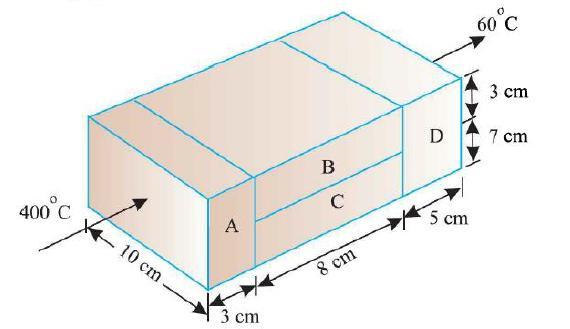
Find the heat flow from the composite wall as shown in figure. Assume one dimensional flow KA=150 W/m°C , KB=25 W/m°C, KC=60 W/m

°C , KD=60 W/m°C

Engineering
1 answer:
Svetradugi [14.3K]2 years ago
7 0

Answer:

The heat flow from the composite wall is 1283.263 watts.

Explanation:

The conductive heat flow through a material, measured in watts, is represented by the following expression:

\dot Q = \frac{\Delta T}{R_{T}}

Where:

R_{T} - Equivalent thermal resistance, measured in Celsius degrees per watt.

\Delta T - Temperature gradient, measured in Celsius degress.

First, the equivalent thermal resistance needs to be determined after considering the characteristics described below:

1) B and C are configurated in parallel and in series with A and D. (Section II)

2) A and D are configurated in series. (Sections I and III)

Section II

\frac{1}{R_{II}} = \frac{1}{R_{B}} + \frac{1}{R_{C}}

\frac{1}{R_{II}} = \frac{R_{B}+R_{C}}{R_{B}\cdot R_{C}}

R_{II} = \frac{R_{B}\cdot R_{C}}{R_{B}+R_{C}}

Section I

R_{I} = R_{A}

Section III

R_{III} = R_{D}

The equivalent thermal resistance is:

R_{T} = R_{I} + R_{II}+R_{III}

The thermal of each component is modelled by this:

R = \frac{L}{k\cdot A}

Where:

L - Thickness of the brick, measured in meters.

A - Cross-section area, measured in square meters.

k - Thermal conductivity, measured in watts per meter-Celsius degree.

If L_{A} = 0.03\,m, L_{B} = 0.08\,m, L_{C} = 0.08\,m, L_{D} = 0.05\,m, A_{A} = 0.01\,m^{2}, A_{B} = 3\times 10^{-3}\,m^{2}, A_{C} = 7\times 10^{-3}\,m^{2}, A_{D} = 0.01\,m^{2}, k_{A} = 150\,\frac{W}{m\cdot ^{\circ}C}, k_{B} = 25\,\frac{W}{m\cdot ^{\circ}C}, k_{C} = 60\,\frac{W}{m\cdot ^{\circ}C} and k_{D} = 60\,\frac{W}{m\cdot ^{\circ}C}, then:

R_{A} = \frac{0.03\,m}{\left(150\,\frac{W}{m\cdot ^{\circ}C} \right)\cdot (0.01\,m^{2})}

R_{A} = \frac{1}{50}\,\frac{^{\circ}C}{W}

R_{B} = \frac{0.08\,m}{\left(25\,\frac{W}{m\cdot ^{\circ}C} \right)\cdot (3\times 10^{-3}\,m^{2})}

R_{B} = \frac{16}{15}\,\frac{^{\circ}C}{W}

R_{C} = \frac{0.08\,m}{\left(60\,\frac{W}{m\cdot ^{\circ}C} \right)\cdot (7\times 10^{-3}\,m^{2})}

R_{C} = \frac{4}{21}\,\frac{^{\circ}C}{W}

R_{D} = \frac{0.05\,m}{\left(60\,\frac{W}{m\cdot ^{\circ}C} \right)\cdot (0.01\,m^{2})}

R_{D} = \frac{1}{12}\,\frac{^{\circ}C}{W}

R_{I} = \frac{1}{50} \,\frac{^{\circ}C}{W}

R_{III} = \frac{1}{12}\,\frac{^{\circ}C}{W}

R_{II} = \frac{\left(\frac{16}{15}\,\frac{^{\circ}C}{W} \right)\cdot \left(\frac{4}{21}\,\frac{^{\circ}C}{W}\right)}{\frac{16}{15}\,\frac{^{\circ}C}{W} + \frac{4}{21}\,\frac{^{\circ}C}{W}}

R_{II} = \frac{16}{99}\,\frac{^{\circ}C}{W}

R_{T} = \frac{1}{50}\,\frac{^{\circ}C}{W} + \frac{16}{99}\,\frac{^{\circ}C}{W}  + \frac{1}{12}\,\frac{^{\circ}C}{W}

R_{T} = \frac{2623}{9900}\,\frac{^{\circ}C}{W}

Now, if \Delta T = 400\,^{\circ}C - 60\,^{\circ}C = 340\,^{\circ}C and R_{T} = \frac{2623}{9900}\,\frac{^{\circ}C}{W}, the heat flow is:

\dot Q = \frac{340\,^{\circ}C}{\frac{2623}{9900}\,\frac{^{\circ}C}{W}  }

\dot Q = 1283.263\,W

The heat flow from the composite wall is 1283.263 watts.
 

You might be interested in
The hot water needs of an office are met by heating tab water by a heat pump from 16 C to 50 C at an average rate of 0.2 kg/min.
Alex777 [14]

Answer:

option B

Explanation:

given,

heating tap water from 16° C to 50° C

at the average rate of 0.2 kg/min

the COP of this heat pump is 2.8

power output = ?

COP = \dfrac{Q_H}{W_{in}}\\W_{in} = \dfrac{Q_H}{COP}\\W_{in} = \dfrac{\dfrac{0.2}{60}\times 4.18\times (50-16)}{2.8}\\W_{in} = 0.169

the required power input is 0.169 kW or 0.17 kW

hence, the correct answer is option B

7 0
2 years ago
Steam enters a turbine operating at steady state at 1 MPa, 200 °C and exits at 40 °C with a quality of 83%. Stray heat transfer
Andrei [34K]

Answer:

(a) Work out put=692.83\frac{KJ}{Kg}

(b) Change in specific entropy=0.0044\frac{KJ}{Kg-K}

Explanation:

Properties of steam at 1 MPa and 200°C

        h_1=2827.4\frac{KJ}{Kg},s_1=6.69\frac{KJ}{Kg-K}

We know that if we know only one property in side the dome then we will find the other property by using steam property table.

Given that dryness or quality of steam at the exit of turbine is 0.83 and temperature T=40°C.So from steam table we can find pressure corresponding to saturation temperature 40°C.

Properties of saturated steam at 40°C

      h_f= 167.5\frac{KJ}{Kg} ,h_g= 2537.4\frac{KJ}{Kg}

 s_f= 0.57\frac{KJ}{Kg-K} ,s_g= 8.25\frac{KJ}{Kg-K}

So the enthalpy of steam at the exit of turbine  

h_2=h_f+x(h_g-h_f)\frac{KJ}{Kg}

h_2=167.5+0.83(2537.4-167.5)\frac{KJ}{Kg}

h_2=2134.57\frac{KJ}{Kg}

s_2=s_f+x(s_g-s_f)\frac{KJ}{Kg-K}

s_2=0.57+0.83(8.25-0.57)\frac{KJ}{Kg-K}

s_2=6.6944\frac{KJ}{Kg-K}

(a)

Work out put =h_1-h_2

                      =2827.4-2134.57 \frac{KJ}{Kg}

Work out put =692.83 \frac{KJ}{Kg}

(b) Change in specific entropy

     s_2-s_1=6.6944-6.69\frac{KJ}{Kg-K}

Change in specific entropy =0.0044\frac{KJ}{Kg-K}

3 0
2 years ago
Let Deterministic Quicksort be the non-randomized Quicksort which takes the first element as a pivot, using the partition routin
juin [17]

Answer:

Answer for the question:

Let Deterministic Quicksort be the non-randomized Quicksort which takes the first element as a pivot, using the partition routine that we covered in class on the quicksort slides. Consider another almost-best case for quicksort, in which the pivot always splits the arrays 1/3: 2/3, i.e., one third is on the left, and two thirds are on the right, for all recursive calls of Deterministic Quicksort. (a) Give the runtime recurrence for this almost-best case. (b) Use the recursion tree to argue why the runtime recurrence solves to Theta (n log n). You do not need to do big-Oh induction. (c) Give a sequence of 4 distinct numbers and a sequence of 13 distinct numbers that cause this almost-best case behavior. (Assume that for 4 numbers the array is split into 1 element on the left side, the pivot, and two elements on the right side. Similarly, for 13 numbers it is split with 4 elements on the left, the pivot, and 8 elements on the right side.)

is given in the attachment.

Explanation:

Download pdf
3 0
2 years ago
Identify the four engineering economy symbols and their values from the following problem statement. Use a question mark with th
Vilka [71]

Answer:

The company will have $311,424 in its investment set-aside account.

Explanation:

To determine the amount of money that the company will have after 7 years with an interest rate of 11% per year, we must calculate the price to start with an increase of 11%, and then repeat the operation until reaching seven years:

Year 0: 150,000

Year 1: 150,000 x 1.11 = 166,500

Year 2: 166,000 x 1.11 = 184,815

Year 3: 184,815 x 1.11 = 205,144.65

Year 4: 205,144.65 x 1.11 = 227,710.56

Year 5: 227,710.56 x 1.11 = 252,758.72

Year 6: 252,758.72 x 1.11 = 280,562.18

Year 7: 280,562.18 x 1.11 = 311,424

3 0
2 years ago
As the porosity of a refractory ceramic brick increases:
ivolga24 [154]

Answer:

A) strength decreases, chemical resistance decreases, and thermal insulation increases

Explanation:

Strength always decreases, chemical resistence decreases, and thermal condictivity must be reduced therefore themal insulation must increase.

7 0
2 years ago
Other questions:
  • An exercise room has six weight-lifting machines that have no motors and seven treadmills, each equipped with a 2.5-hp (shaft ou
    13·1 answer
  • What can your employer do to protect you from overhead power lines?
    8·1 answer
  • The rigid bar CDE is attached to a pin support at E and rests on the 30 mm diameter brass cylinder BD. A 22 mm diameter steel ro
    8·1 answer
  • You want to determine whether the race of the defendant has an impact on jury verdicts. You assign participants to watch a trial
    9·1 answer
  • A fireboat is to fight fires at coastal areas by drawing seawater with a density of 1030 kg/m through a 20-cm-diameter pipe at a
    13·1 answer
  • The atomic radii of a divalent cation and a monovalent anion are 0.77 nm and 0.136 nm, respectively.1- Calculate the force of at
    11·1 answer
  • Define initial set and final set. Briefly discuss one method used to determine them. The following laboratory tests are performe
    12·1 answer
  • Two airstreams are mixed steadily and adiabatically. The first stream enters at 35°C and 30 percent relative humidity at a rate
    6·1 answer
  • A rectification column is fed 100 kg mol/h of a mixture of 50 mol % benzene and 50 mol % toluene at 101.32 kPa abs pressure. The
    5·1 answer
  • You are the scheduler for a large commercial building project. The schedule that you prepared (based on feedback from the projec
    7·1 answer
Add answer
Login
Not registered? Fast signup
Signup
Login Signup
Ask question!
