Answer:
C. 81 degrees Celsius
Explanation:
- To solve this problem, we can use the relation:
<em>Q = m.c.ΔT,</em>
where, Q is the amount of heat released from water (Q = - 1200 J).
m is the mass of the water (m = 20.0 g).
c is the specific heat capacity of water (c of water = 4.186 J/g.°C).
ΔT is the difference between the initial and final temperature (ΔT = final T - initial T = final T - 95.0°C).
<em>∵ Q = m.c.ΔT</em>
∴ (- 1200 J) = (20.0 g)(4.186 J/g.°C)(final T - 95.0°C ).
(- 1200 J) = 83.72 final T - 7953.
∴ final T = (- 1200 J + 7953)/83.72 = 80.67 °C ≅ 81.0 °C.
<em>So, the right choice is: C. 81 degrees Celsius
</em>
<em></em>
Complete Question is attached below,
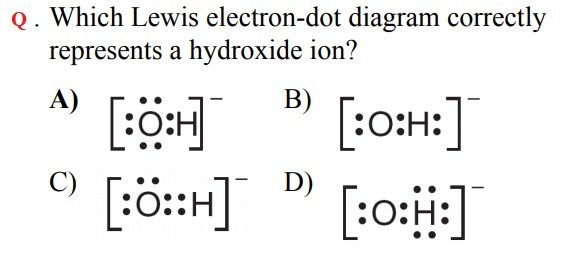
Answer: Option-A is the correct answer.
Explanation: As we know Hydroxide contains one hydrogen and one oxygen atom. Also one negative charge is being carried bu hydroxide ion as,,,
OH⁻
Now in order to draw its lewis structure we first of all calculate the total number of valence electrons of both elements i.e.
Valence electrons in Oxygen = 6
valence electrons in Hydrogen = 1
Number of negative charges = 1
------------
Total valence electrons 8
Now, we draw both elements and connect them via a single bond and subtract 2 electrons per single bond,
= 8 - 2
= 6
Now these six electrons are added to oxygen atom as it is more electronegative element. Hence, a structure shown in Option-A is formed, and the negative charge is in fact the -1 formal charge of oxygen atom.
<span> Zinc is a strong reducing agent. Copper will be oxidized first. </span>
Answer:
Explanation:
The correct statement is:
When 1 mol each of C₂H₅OH and CH₃CO₂H are allowed to react in 1 L of the solvent dioxane, equilibrium is established when 1/3 mol of each of the reactants remains. Calculate the equilibrium constant for the reaction. (Note: Water is a solute in this reaction.)
<u>1. Equilibrium equation</u>
- C₂H₅OH + CH₃CO₂H ⇄ CH₃CO₂C₂H₅ + H₂O
↑ ↑ ↑ ↑
ethanol acetic acid ethyl acetate water
<u>2. Equilibrium constant</u>
- Keq = [Products] / [Reactants], each raised to tis stoichiometrical coefficient.
Since water is also a solute in this reaction (the solvent is dioxane) its concentration will appear in the equilibrium constant.
<u>3. Equlibrium concentrations:</u>
Moles
C₂H₅OH + CH₃CO₂H ⇄ CH₃CO₂C₂H₅ + H₂O
Initial 1 1 0 0
Change -2/3 -2/3 +2/3 +2/3
End 1/3 1/3 2/3 2/3
Since the volume is 1 liter, the concentration is equal to the number of moles
<u>4. Calculations:</u>
![Keq=\frac{[CH_3CO_2C_2H_5]\cdot [H_2O]}{[C_2H_5OH]\cdot [CH_3CO_2H]}=\frac{2/3\cdot 2/3}{1/3\cdot 1/3}=4](https://tex.z-dn.net/?f=Keq%3D%5Cfrac%7B%5BCH_3CO_2C_2H_5%5D%5Ccdot%20%5BH_2O%5D%7D%7B%5BC_2H_5OH%5D%5Ccdot%20%5BCH_3CO_2H%5D%7D%3D%5Cfrac%7B2%2F3%5Ccdot%202%2F3%7D%7B1%2F3%5Ccdot%201%2F3%7D%3D4)