answer.
Ask question
Login Signup
Ask question
All categories
  • English
  • Mathematics
  • Social Studies
  • Business
  • History
  • Health
  • Geography
  • Biology
  • Physics
  • Chemistry
  • Computers and Technology
  • Arts
  • World Languages
  • Spanish
  • French
  • German
  • Advanced Placement (AP)
  • SAT
  • Medicine
  • Law
  • Engineering
Allushta [10]
2 years ago
15

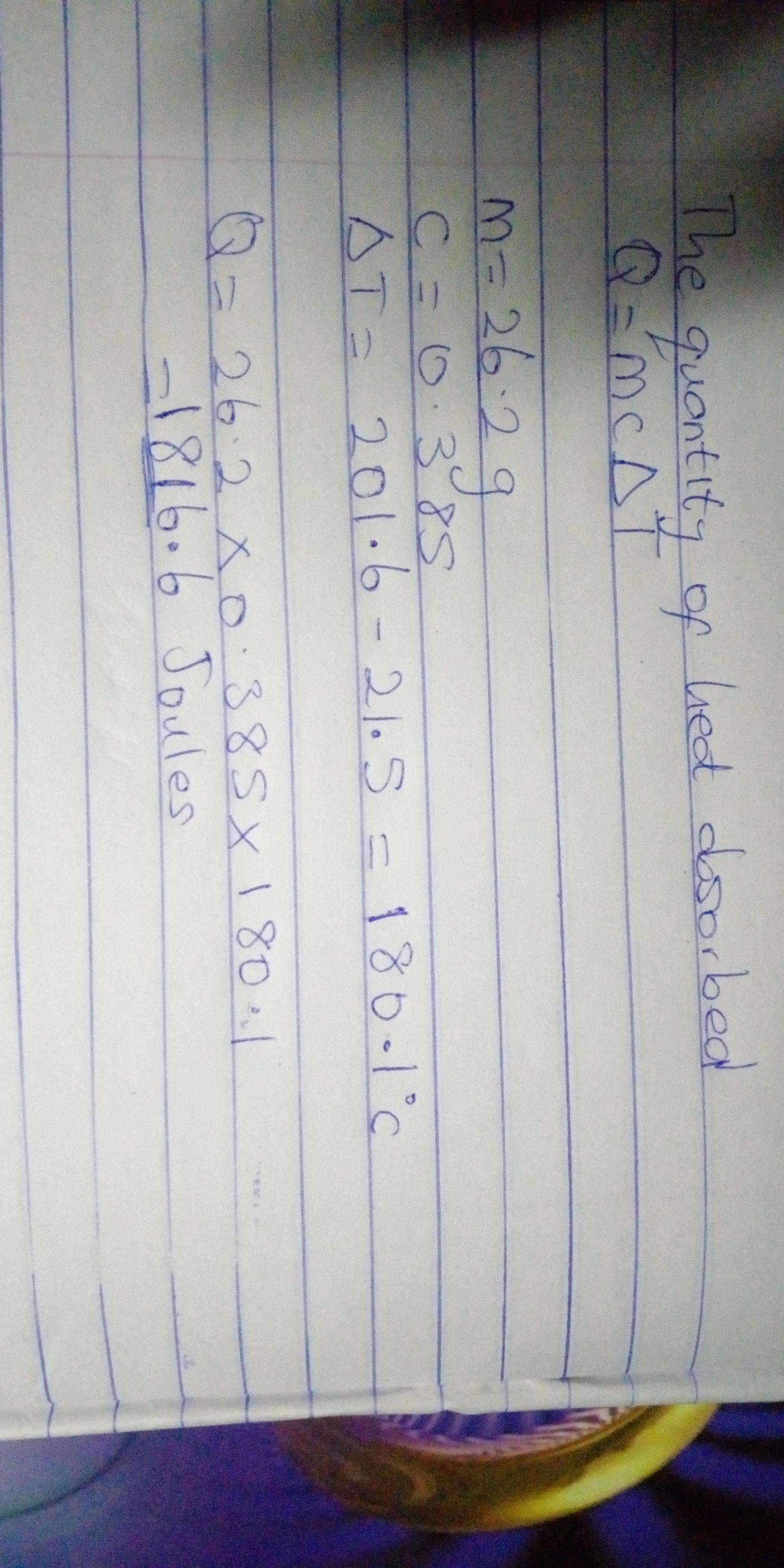
26.2 g piece of copper metal is heated from 21.5°C to 201.6°C. Calculate the amount of heat absorbed by the metal. The specific

heat of Cu is 0.385 /g "C.

Chemistry
1 answer:
Nuetrik [128]2 years ago
6 0

Answer:1816.6 joules

Explanation:see the attached photo

You might be interested in
What is the oxidation number for iodine in Mg(IO3)2 ?
navik [9.2K]
The oxidation number of iodine is 5 in Mg(IO3)2 which can be calculated as 
   Mg(IO3)2
   MgI2O6
As we know that
Mg has +2
O has -2
So,
   (+2) + 2I + 6 (-2)=0
   2 + 2I - 12 =0
   10+ 2I =0
    10 = 2I
     I =5

7 0
2 years ago
Read 2 more answers
Explain why the boiling point of water is a characteristic physical property, but the temperature and the volume of a glass of w
iren [92.7K]
Boiling and melting points are physical properties because they do not change the chemical nature of the substance whose properties you are measuring.
7 0
2 years ago
Salt solutions can be __________ to give solid salts. What word completes this sentence?
NikAS [45]

Answer:

evaporated

Explanation:

Once the solution is evaporated there will only be salt left, since the only other thing in the soulution is water.

7 0
2 years ago
Which of the following is consistent with a spontaneous process in the forward direction?
Kryger [21]

Answer:

A) ∆Suniv >0, ∆G<0, T∆Suniv >0.

Explanation:

The connection between entropy and the spontaneity of a reaction is expressed by the <u>second law of thermodynamics</u><u>: The entropy of the universe increases in a spontaneous process and remains unchanged in an equilibrium process</u>.

Mathematically, we can express the second law of thermodynamics as follows:

For a spontaneous process: ΔSuniv = ΔSsys + ΔSsurr > 0

Therefore, the second law of thermodynamics tells us that a spontaneous reaction increases the entropy of the universe; that is, ΔSuniv > 0.

If we want spontaneity expressed only in terms  of the properties of the system (ΔHsys and ΔSsys), we use the following equation:

-TΔSuniv = ΔHsys - TΔSsys < 0

That means that T∆Suniv >0.

This equation says that for a process carried out at constant pressure and temperature  T, if the changes in enthalpy and entropy of the system are such that <u>ΔHsys - TΔSsys  is less than zero, the process must be spontaneous.</u>

Finally, if the change in free energy is less than zero (ΔG<0), the reaction is spontaneous in the forward direction.

7 0
2 years ago
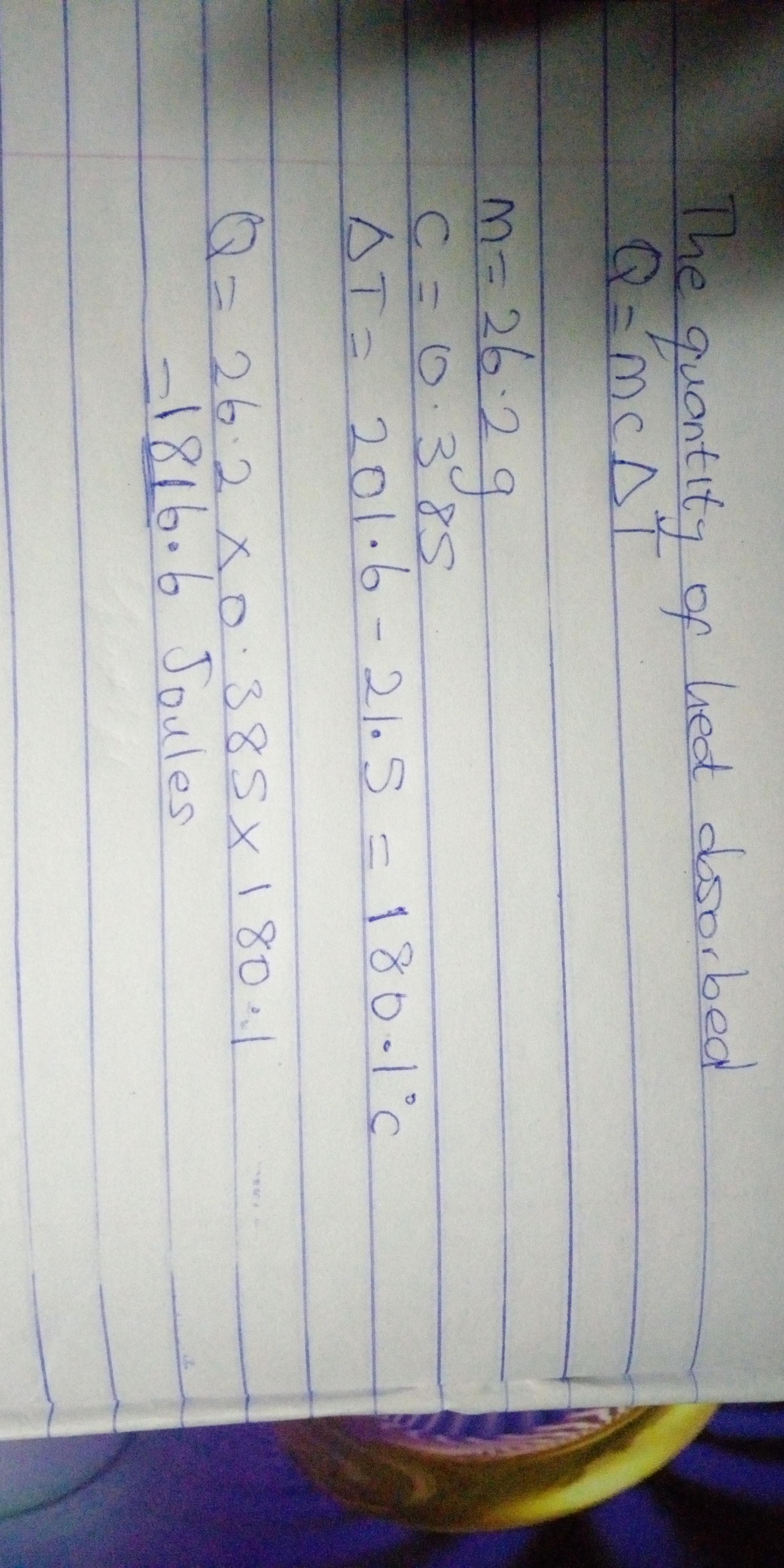
Consider the following voltaic cell. Identify the anode and cathode, and indicate the direction of Na ion and NO3- ion flow from
levacccp [35]

Answer:

Fe is the anode and Sn is the cathode; NO3- ions flow into half-cell compartment (A) and Na ions flow into half-cell compartment (B).

Explanation:

The purpose of a salt bridge in a voltaic cell is not to move electrons from the electrolyte, it's main function is the maintenance of charge balance between the half cells .The electrons flow from the anode to the cathode.

The iron half cell which has a higher reduction potential serves as anode. Iron atoms give up electrons to form positive ions according to the equation;

Fe(s)-----> Fe^2+(aq) + 2e

Hence there will be an excess of positive ions in the anode (compartment A). NO3^- ions from the salt bridge will migrate towards this compartment to ensure charge balance.

Similarly, in compartment B(cathode) Sn^2+ ions will accept two electrons according to the reaction;

Sn^2+(aq) + 2e ------> Sn(s)

This reaction causes a depletion of positive ions in compartment B, hence Na^+ from the salt bridge move towards this compartment to ensure charge balance.

4 0
2 years ago
Other questions:
  • Which conversion factor would you use to correctly calculate the number of moles in 25.0 g of the element titanium (ti) ?
    9·1 answer
  • What is the ratio of the concentration of potassium ions to the concentration of carbonate ions in a 0.015 m solution of potassi
    12·2 answers
  • Glucose generally exists in ring (cyclic) form. a haworth projection shows the orientations of the hydroxyl groups and hydrogen
    6·2 answers
  • Δs is negative for the reaction __________.
    6·1 answer
  • Combustion analysis of a 13.42-g sample of the unknown organic compound (which contains only carbon, hydrogen, and oxygen) produ
    7·1 answer
  • How many grams of Boron can be obtained from 234 grams of B2O3?
    8·1 answer
  • Based on the bond energies for the reaction below, what is the enthalpy of the reaction?HC≡CH (g) + 5/2 O₂ (g) → 2 CO₂ (g) + H₂O
    14·1 answer
  • Identify the true statements about surface tension. Molecules along the surface of a liquid behave differently than those in the
    10·1 answer
  • Three mixtures were prepared from three very narrow molar mass distribution polystyrene samples with molar masses of 10,000, 30,
    14·1 answer
  • HALPPPPPPPPPPPPPPPPPPPPPPPPPPPPPPPPPPPPPPPPPPPPPPPPPPPPPPPPPPPPPPPPPPPPPPPPPPPPPPPPPPPPPPPPPPPPPPPPPPPPPPPPPPPPPP!!!!!!!!!!!!!!!
    13·1 answer
Add answer
Login
Not registered? Fast signup
Signup
Login Signup
Ask question!