answer.
Ask question
Login Signup
Ask question
All categories
  • English
  • Mathematics
  • Social Studies
  • Business
  • History
  • Health
  • Geography
  • Biology
  • Physics
  • Chemistry
  • Computers and Technology
  • Arts
  • World Languages
  • Spanish
  • French
  • German
  • Advanced Placement (AP)
  • SAT
  • Medicine
  • Law
  • Engineering
Umnica [9.8K]
2 years ago
13

How many values of ml are allowed for an electron in a 5f subshell??

Chemistry
2 answers:
VladimirAG [237]2 years ago
8 0

There are 7 values ​​of ml are allowed for an electron in a 5f subshell namely: -3 -2, -1, 0, +1, +2, +3

<h3>Further explanation</h3>

In an atom, there are energy levels in the shell and subshell.This energy level is expressed in terms of electron configurations.

Writing the electron configuration starts from the lowest to the highest subshell's energy level. There are 4 sub-shells in an atom's shell, namely s, p, d, and f. The maximum number of electrons for each subshell is

  • s: 2 electrons
  • p: 6 electrons
  • d: 10 electrons and
  • f: 14 electrons

Electron filling in subshells using the following sequence:

1s², 2s², 2p⁶, 3s², 3p⁶, 4s², 3d¹⁰, 4p⁶, 5s², 4d¹⁰, 5p⁶, 6s², etc.

Each sub-shell also has orbitals drawn in the form of a square box in which there are electrons symbolized by half arrows.

Each orbital in an atom consists of 4 quantum numbers

  • n is the principal quantum number.
  • l is the angular momentum / azimuthal quantum number
  • ml, the magnetic quantum number
  • ms, the electron-spin quantum number

Value of n: positive integer

value of l: s = 0, p = 1, d = 2, f = 3

ml value: between -l to + l

ms value: +1/2 or -1/2

Determination of electron configurations based on principles:

  • 1. Aufbau: Electrons occupy orbitals of the lowest energy level
  • 2 Hund: electron fills orbitals with the same energy level
  • 3. Pauli: there are no electrons that have 4 equal quantum numbers

So for 5f orbitals, the value of a possible quantum number is

n = 5;

l = 3 (f = 3);

m = -3 -2, -1, 0, +1, +2, +3;

s = + - 1/2

<h3>Learn more</h3>

the locations and properties of two electrons

brainly.com/question/2292596

It's sublevel

brainly.com/question/4520082

a possible full set of quantum numbers

brainly.com/question/5389767

Keywords: orbitals, subshells, quantum numbers

CaHeK987 [17]2 years ago
7 0

The total number of   values for a given 5f subshell is \boxed{\mathbf{7}} .

Further Explanation:

The size, energy, shape, and orientation of an orbital depend upon four quantum numbers. These quantum numbers are,

1. Principal Quantum Number (n): It denotes the principle electron shell. The values of n are a positive integer (1, 2, 3,    ).

2. Angular Momentum Quantum Number (l): It represents the shape of an orbital. The value of l is an integer from 0 to \left( {n - 1}\right) .

3. Magnetic Quantum Number \left( {{m_l}}\right): This quantum number represents the orientation of the orbital in space. The value of {m_l} lie between  to  . The formula to calculate the value of {m_l}  is as follows:

{m_l} =  - l,( - l + 1),.....,0,1,2,.....,(l - 1),l

Therefore, the total number of {m_l}  values for a given value of l is 2l + 1 .

4. Electron Spin Quantum Number ({m_s}): It represents the direction of electron spin. Its value can be + \frac{1}{2} or- \frac{1}{2} .

The given subshell is 5f.

The value of the angular momentum quantum number (l) for f subshell is 3.(Refer to the table in the attached image)

Therefore, the total number of  {m_l} values for a given 5f subshell can be calculated as,

\begin{aligned}{\text{Total number of\; }}{{\text{m}}_l}{\text{ values}}&={\text{2}}\left( l \right){\text{ + 1}}\\&={\text{2}}\left( 3 \right){\text{ + 1}}\\&= {\mathbf{7}}\\\end{aligned}

These values of {m_l} lies between - l to + l , therefore the values of {m_l} for 5f are,

- {\mathbf{3}},-{\mathbf{2}},-{\mathbf{1}},{\mathbf{0}},+{\mathbf{1}},+{\mathbf{2}},+ {\mathbf{3}}

The total number of {m_l} values for 5f subshell is 7.

Learn more:

1. Classification of the solubility gases. brainly.com/question/2802008

2. Calculation of volume of gas: brainly.com/question/3636135

Answer details:

Grade: Senior School

Subject: Chemistry

Chapter: Structure of atom

Keywords: ml values, allowed, electrons in 5f subshell, angular momentum quantum number, principal quantum number, magnetic quantum number, electron spin quantum number.

You might be interested in
Predict the initial and isolated products for the reaction. The starting material is a 6 carbon chain where there is a triple bo
satela [25.4K]

Answer:

See explanation and image attached

Explanation:

This reaction is known as mercuric ion catalyzed hydration of alkynes.

The first step in the reaction is attack of the mercuric ion on the carbon-carbon triple bond, a bridged intermediate is formed. This bridged intermediate is attacked by water molecule to give an organomercury enol. This undergoes keto-enol tautomerism, proton transfer to the keto group yields an oxonium ion, loss of the mercuric ion now gives equilibrium keto and enol forms of the compound. The keto form is favoured over the enol form.

7 0
2 years ago
Match each term to a correct example from the chemical equation: 2A + B2 → 2AB.
kari74 [83]

Explanation:

The given equation is as follows.

       2A + B_{2} \rightarrow 2AB

Reactants are the species present on the left hand side of a chemical equation.

Products are the species present on the right hand side of a chemical equation.

Whereas coefficients are the number present in front of formulas.

Therefore, in the given reaction equation, matched terms are as follows.

  • Reactant is B_{2}
  • Product is AB.
  • Coefficient is 2.  
3 0
2 years ago
Calculate the pOH of a solution that contains 3.9 x 10⁻⁵ M H3O+ at 25°C.
exis [7]

Answer:

Option b. 9.59

Explanation:

First, let us calculate the pH. This is illustrated below:

[H3O+] = 3.9 x 10⁻⁵ M

pH = —Log [H3O+]

pH = —Log [3.9 x 10⁻⁵]

pH = 4.41

Recall: pH + pOH = 14

4.41 + pOH = 14

Collect like terms

pOH = 14 — 4.41

pOH = 9.59

6 0
2 years ago
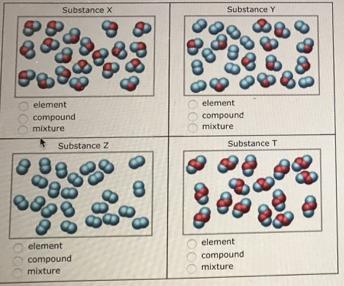
Question 2 Here are four sketches of pure substances. Each sketch is drawn as if a sample of the substance were under a microsco
Burka [1]

The image with the four sketches that accompany this question was obtained in internet and is attached.

Answer:

  • <u>Substance X: compound</u>
  • <u>Substance Y: mixture</u>
  • <u>Substance W: element</u>
  • <u>Substance Z: compound</u>

Explanation:

The first picture shows substance X as a matter composed by particles of one type. Every particle consists of two white balls bonded to one red ball, sketching a compound formed by two "white atoms" and one "red atom". So, this sketch shows a sample of a compound.

The second picture shows substance Y formed by two different kind of particles. One type of particles are two white balls bonded, sketching a molecule of two equal atoms, i.e. an element in the form of a diatomic molecules of a single element (likely a gas). The other type of particles are two white balls bonded to one red ball (just as in the first picture). This sketch, then, shows the mixture of one element and one compound. Thus, this is a mixture.

The third picture shows substance W formed by one type of particles: groups of two identical white balls. So, every pair of white ball sketchs a diatomic molecule, which means that this is an element (think, for example, in H₂ or O₂).

The fourth picture shows substance Z formed by groups of particles of the same type: two red balls bonded to two white balls. So, every group of these particles represents identical compounds, making this a compound and not a mixture.

6 0
2 years ago
A sample of krypton has a volume of 6.00 L, and the pressure is 0.960 atm. If the final temperature is 55.0°C, the final volume
MissTica

193.38 K was the initial temperature of the krypton.

Explanation:

Data given:

Initial volume of the krypton gas = 6 litres

initial pressure of the krypton gas = 0.960 atm

initial temperature of the krypton gas = ?

final volume of the krypton gas  = 7.70 litres

final pressure of the Krypton gas  = 1.25 atm

final temperature of the krypton gas = 55 degrees or 273.25+55 = 323.15 K

Applying the  Combined Gas Laws:

\frac{P1V1}{T1} = \frac{P2V2}{T2}

Rearranging the equation:

T1  = \frac{P1V1T2}{P2V2}

Putting the value in the equation:

T1 = \frac{0.960 X 6 X 323.15}{1.25 X 7.70}

T1 = 193.38 K

Initial temperature of the krypton gas is 193.78 K

5 0
2 years ago
Other questions:
  • After learning about climate change in her science class, Selena wants to make a few changes at home so she can affect climate c
    14·2 answers
  • The molar mass of copper(II) chloride (CuCl2) is 134.45 g/mol. How many formula units of CuCl2 are present in 17.6 g of CuCl2? 7
    9·2 answers
  • Write a balanced chemical equation for the reaction of copper(II) sulfate and concentrated ammonia to produce teramine copper(II
    5·1 answer
  • Using the periodic table, complete the table to describe each atom. Type in your answers.
    6·2 answers
  • Which image exclusively represents the principle of radiation? A) IV B) III C) II D) I
    8·2 answers
  • How much energy must be added to a bowl of 125popcorn kernels in order for them to reach a popping temperature of 175°C? Assume
    8·1 answer
  • The Michaelis‑Menten equation models the hyperbolic relationship between [S] and the initial reaction rate V 0 V0 for an enzyme‑
    15·1 answer
  • A compound A (C22H27NO) is insoluble in acid and base but reacts with concentrated aqueous HCl and heat to give a clear aqueous
    9·1 answer
  • 1. How many moles of tin are needed to react with 3.5 moles of hydrogen fluoride?
    15·1 answer
  • The pyruvate dehydrogenase complex catalyzes the oxidative decarboxylation of pyruvate to form acetyl‑CoA. E1 , E2 , and E3 are
    13·1 answer
Add answer
Login
Not registered? Fast signup
Signup
Login Signup
Ask question!