answer.
Ask question
Login Signup
Ask question
All categories
  • English
  • Mathematics
  • Social Studies
  • Business
  • History
  • Health
  • Geography
  • Biology
  • Physics
  • Chemistry
  • Computers and Technology
  • Arts
  • World Languages
  • Spanish
  • French
  • German
  • Advanced Placement (AP)
  • SAT
  • Medicine
  • Law
  • Engineering
ELEN [110]
2 years ago
3

What is the mass of a 1.75l sample of a liquid that has a density of 0.921 g/ml?

Chemistry
2 answers:
Stells [14]2 years ago
6 0

<u>Answer:</u> The mass of liquid sample is 1611.75 g

<u>Explanation:</u>

To calculate mass of a substance, we use the equation:

\text{Density of substance}=\frac{\text{Mass of substance}}{\text{Volume of substance}}

We are given:

Density of liquid = 0.921 g/mL

Volume of liquid = 1.75 L = 1750 mL     (Conversion factor: 1 L = 1000 mL)

Putting values in above equation, we get:

0.921g/mL=\frac{\text{Mass of liquid}}{1750mL}\\\\\text{Mass of liquid}=1611.75g

Hence, the mass of liquid sample is 1611.75 g

musickatia [10]2 years ago
5 0
Density =mass /volume
Mass=1750x0.921
=1611.75g
You might be interested in
Washing soda is a hydrate of sodium carbonate. Elemental analysis of a sample of washing soda gave 4.20% C and 7.05% H. What is
kozerog [31]

Answer:

Na₂CO₃ · 10H₂O

Explanation:

The formula for sodium carbonate hydrate is:

Na₂CO₃ · xH₂O

The unknown "x" is the number of water molecules contained in the hydrate.

To find "x" we have to use the hydrogen percentage in the sample, 7.05 % H.

First we calculate the molecular weight of Na₂CO₃ · xH₂O:

molecular weight of Na₂CO₃ · xH₂O = 23 × 2 + 12 + 16 × 3 + 18x

molecular weight of Na₂CO₃ · xH₂O = 106 + 18x  g/mole

Now we devise the fallowing reasoning tanking in account 1 mole of Na₂CO₃ · xH₂O:

if in        106 + 18x grams of Na₂CO₃ · xH₂O we have 2x grams of hydrogen

then in  100 grams of Na₂CO₃ · xH₂O we have 7.05 grams of hydrogen

106 + 18x = (100 × 2x) / 7.05

106 + 18x = 28.4x

106 = 28.4x - 18x

106 = 10.4x

x = 106 / 10.4

x = 10.2 ≈ 10

The formula for the washing soda is Na₂CO₃ · 10H₂O.

5 0
2 years ago
Using the following data table and graph, calculate the average k from the data. Amount CO2 (mL) Amount of White Solid (g) y x 1
UkoKoshka [18]
The k is the proportionality constant of the reaction. Graphically, this is the slope of the graph. Since the graph is linear, then there is only 1 value of k. To calculate this, choose two random points in the line. Suppose we use (0.15,10) and (0.30,20), calculate for the slope.

Slope = k = (10 - 20)/(0.15 - 0.30) = 66.67 mL CO₂/g CaCO₃
8 0
2 years ago
Read 2 more answers
In 200 g of a concentrated solution of 70.4 wt% nitric acid (r = 1.41 g/mL, FW(HNO3) = 63.01 g/mol), how many grams of water are
mars1129 [50]

Answer:

59.2 grams

Explanation:

We are given that 70.4% of the weight of the total 200 g of the concentration is made up of nitric acid, the remaining information is not required to solve the problem. Since water and nitric acid are the only components of the solution, the total weight of water is given by:

W = 200*(1-0.704)\\W=59.2\ g

There are 59.2 grams of water in this solution.

5 0
2 years ago
When the reaction CO2(g) + H2(g) ⇄ H2O(g) + CO(g) is at equilibrium at 1800◦C, the equilibrium concentrations are found to be [C
UNO [17]

Answer:

The new molar concentration of CO at equilibrium will be  :[CO]=1.16 M.

Explanation:

Equilibrium concentration of all reactant and product:

[CO_2] = 0.24 M, [H_2] = 0.24 M, [H_2O] = 0.48 M, [CO] = 0.48 M

Equilibrium constant of the reaction :

K=\frac{[H_2O][CO]}{[CO_2][H_2]}=\frac{0.48 M\times 0.48 M}{0.24 M\times 0.24 M}

K = 4

CO_2(g) + H_2(g) \rightleftharpoons H_2O(g) + CO(g)

Concentration at eq'm:

0.24 M          0.24 M                 0.48 M            0.48 M

After addition of 0.34 moles per liter of CO_2 and H_2 are added.

(0.24+0.34) M    (0.24+0.34) M  (0.48+x)M         (0.48+x)M

Equilibrium constant of the reaction after addition of more carbon dioxide and water:

K=4=\frac{(0.48+x)M\times (0.48+x)M}{(0.24+0.34)\times (0.24+0.34) M}

4=\frac{(0.48+x)^2}{(0.24+0.34)^2}

Solving for x: x = 0.68

The new molar concentration of CO at equilibrium will be:

[CO]= (0.48+x)M = (0.48+0.68 )M = 1.16 M

3 0
2 years ago
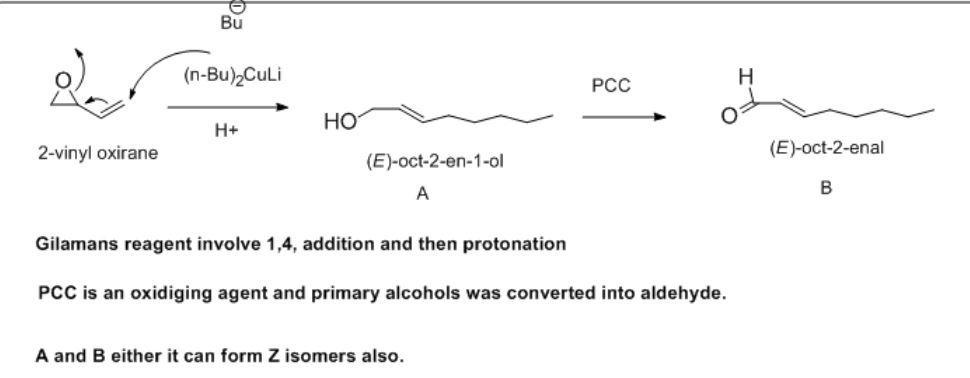
When the epoxide 2-vinyloxirane reacts with lithium dibutylcuprate, followed by protonolysis, a compound A is the major product
pshichka [43]

Answer:

A --- (E)-oct-2-en-1-o1

B ----(E)-oct-2-enal

Explanation:

See the attached file for the structure.

8 0
2 years ago
Other questions:
  • When a substance dissolves, it undergoes a _____.
    14·2 answers
  • Which statement is true? Nuclear power plants require more fuel than conventional power plants. There is a short supply of high
    13·2 answers
  • An impure sample of zinc (zn) is treated with an excess of sulfuric acid (h 2 so 4) to form zinc sulfate (znso4) and molecular h
    5·1 answer
  • It takes 330 j of energy to raise the temperature of 14.6 g of benzene from 21.0 °c to 28.7 °c at constant pressure. What is the
    9·1 answer
  • What is the driving force in the wittig reaction?
    5·1 answer
  • Industrial production of nitric acid, which is used in many products including fertilizers and explosives, approaches 10 billion
    9·1 answer
  • Combustion analysis of a 13.42-g sample of the unknown organic compound (which contains only carbon, hydrogen, and oxygen) produ
    7·1 answer
  • What is the main purpose of using NaOH in the saponification reaction . NaOH works as the catalyst b. NaOH solution is the solve
    14·1 answer
  • Which equation represents the total ionic equation for the reaction of HNO3 and NaOH? Upper H superscript plus, plus upper O upp
    13·2 answers
  • Determine the percent yield for the reaction
    5·1 answer
Add answer
Login
Not registered? Fast signup
Signup
Login Signup
Ask question!