answer.
Ask question
Login Signup
Ask question
All categories
  • English
  • Mathematics
  • Social Studies
  • Business
  • History
  • Health
  • Geography
  • Biology
  • Physics
  • Chemistry
  • Computers and Technology
  • Arts
  • World Languages
  • Spanish
  • French
  • German
  • Advanced Placement (AP)
  • SAT
  • Medicine
  • Law
  • Engineering
luda_lava [24]
2 years ago
13

Justify why the project in the following scenario would be a good fit for the engineers, and outline steps needed to complete it

.
Situation: A team of engineers is being hired to develop lawn furniture that is light enough to move around but also capable of being anchored to a patio or other hard surface so that strong winds will not blow the objects around.
Engineering
1 answer:
zavuch27 [327]2 years ago
6 0

Answer:

. This is because the injuries can takes place at the time of work.

While lifting heavy objects at the time of work One should divide the loads so that it does not feels burden.

Aids like pulley, handles and wheels can be used to divide the load and weight should be carried in a way that it can be easily carried.

Get manual help with way to heavy loads and the postures should also be maintained at the time of lifting the objects.

Explanation:

You might be interested in
Radioactive wastes are temporarily stored in a spherical container, the center of which is buried a distance of 10 m below the e
puteri [66]

Given:

outer radius, R' = 10 m

inner diameter, d = 2 m

inner radius, R = \frac{d}{2} = 1 m

surface temperature, T' = 20^{\circ}C

Thermal conductivity of soil, K = 0.52 W/mK

Solution:

To calculate the thermal temperature of conductor, T, we know amount of heat, Q is given by :

Q =  \frac{T - T'}{\frac{R' - R}{4\pi KRR'}}

500 =  (T - 20)\frac{4\pi \times0.52\times 1\times 10}{10 - 1}

T = 68.86 +20 = 88.865^{\circ}C  

Therefore, outside surface temperature is 88.865^{\circ}C  

4 0
2 years ago
A platinum resistance temperature sensor has a resistance of 120 Ω at 0℃ and forms one arm of a Wheatstone bridge. At this tempe
oksian1 [2.3K]

Answer : 9.36ohms/ temperature

Explanation:

Expression for the variation of resistance of platinum with temperature

Rt= Ro(1+*t)

Rt= resistance @ t°C

Ro= resistance @ 0°C

*= temperature coefficient of resistance

Calculate the change in resistance by putting 120ohms for Ro,

0.0039/K for *

20°C for t

Using this formula:

Rt = Ro(1+*t)

Rt- Ro = Ro*t

= (120ohms)(0.0039/K)(20°C)

= 9.36ohms/K

8 0
2 years ago
At an impaired driver checkpoint, the time required to conduct the impairment test varies (according to an exponential distribut
professor190 [17]

Answer:

Option (d) 2 min/veh

Explanation:

Data provided in the question:

Average time required = 60 seconds

Therefore,

The maximum capacity that can be accommodated on the system, μ = 60 veh/hr

Average Arrival rate, λ = 30 vehicles per hour

Now,

The average time spent by the vehicle is given as

⇒ \frac{1}{\mu(1-\frac{\lambda}{\mu})}

thus,

on substituting the respective values, we get

Average time spent by the vehicle = \frac{1}{60(1-\frac{30}{60})}

or

Average time spent by the vehicle = \frac{1}{60(1-0.5)}

or

Average time spent by the vehicle = \frac{1}{60(0.5)}

or

Average time spent by the vehicle = \frac{1}{30} hr/veh

or

Average time spent by the vehicle = \frac{1}{30}\times60 min/veh

[ 1 hour = 60 minutes]

thus,

Average time spent by the vehicle = 2 min/veh

Hence,

Option (d) 2 min/veh

7 0
2 years ago
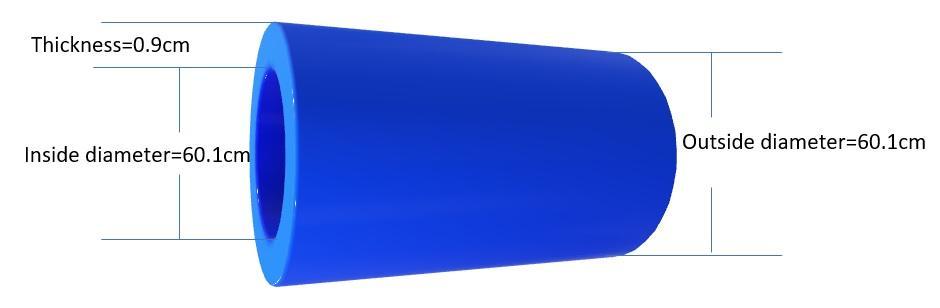
Water is flowing in a metal pipe. The pipe OD (outside diameter) is 61 cm. The pipe length is 120 m. The pipe wall thickness is
Yuki888 [10]

Answer:

1113kN

Explanation:

The ouside diameter OD of the pipe is 61cm and the thickness T is 0.9cm, so the inside diameter ID will be:

Inside Diameter = Outside Diameter - Thickness

Inside Diameter = 61cm - 0.9cm = 60.1cm

Converting this diameter to meters, we have:

60.1cm*\frac{1m}{100cm}=0.601m

This inside diameter is useful to calculate the volume V of water inside the pipe, that is the volume of a cylinder:

V_{water}=\pi  r^{2}h

V_{water}=\pi (\frac{0.601m}{2})^{2}*120m

V_{water}=113.28m^{3}

The problem gives you the water density d as 1.0kg/L, but we need to convert it to proper units, so:

d_{water}=1.0\frac{Kg}{L}*\frac{1L}{1000cm^{3}}*(\frac{100cm}{1m})^{3}

d_{water}=1000\frac{Kg}{m^{3}}

Now, water density is given by the equation d=\frac{m}{V}, where m is the water mass and V is the water volume. Solving the equation for water mass and replacing the values we have:

m_{water}=d_{water}.V_{water}

m_{water}=1000\frac{Kg}{mx^{3}}*113.28m^{3}

m_{water}=113280Kg

With the water mass we can find the weight of water:

w_{water}=m_{water} *g

w_{water}=113280kg*9.8\frac{m}{s^{2}}

w_{water}=1110144N

Finally we find the total weight add up the weight of the water and the weight of the pipe,so:

w_{total}=w_{water}+w_{pipe}

w_{total}=1110144N+2500N

w_{total}=1112644N

Converting this total weight to kN, we have:

1112644N*\frac{0.001kN}{1N}=1113kN

7 0
2 years ago
Laminar flow normally persists on a smooth flat plate until a critical Reynolds number value is reached. However, the flow can b
grandymaker [24]

Answer:

At L = 0.1 m

h⁻_lam = 11.004K   W/m^1.5

h⁻_turb = 7.8848K   W/m^1.8

At L = 1 m

h⁻_lam = 3.48K   W/m^1.5

h⁻_turb = 4.975K   W/m^1.8

Explanation:

Given that;

h_lam(x)= 1.74 W/m^1.5. Kx^-0.5

h_turb(x)= 3.98 W/m^1.8 Kx^-0.2

conditions for plates of length L = 0.1 m and 1 m

Now

Average heat transfer coefficient is expressed as;

h⁻ = 1/L ₀∫^L hxdx

so for Laminar flow

h_lam(x)= 1.74 . Kx^-0.5  W/m^1.5

from the expression

h⁻_lam = 1/L ₀∫^L 1.74 . Kx^-0.5   dx

= 1.74k / L { [x^(-0.5+1)] / [-0.5 + 1 ]}₀^L

= 1.74k/L = [ (x^0.5)/0.5)]⁰^L

= 1.74K × L^0.5 / L × 0.5

h⁻_lam= 3.48KL^-0.5

For turbulent flow

h_turb(x)= 3.98. Kx^-0.2 W/m^1.8

form the expression

1/L ₀∫^L 3.98 . Kx^-0.2   dx

= 3.98k / L { [x^(-0.2+1)] / [-0.2 + 1 ]}₀^L

= (3.98K/L) × (L^0.8 / 0.8)

h⁻_turb = 4.975KL^-0.2

Now at L = 0.1 m

h⁻_lam = 3.48KL^-0.5  =  3.48K(0.1)^-0.5  W/m^1.5

h⁻_lam = 11.004K   W/m^1.5

h⁻_turb = 4.975KL^-0.2 = 4.975K(0.1)^-0.2

h⁻_turb = 7.8848K   W/m^1.8

At L = 1 m

h⁻_lam = 3.48KL^-0.5  =  3.48K(1)^-0.5  W/m^1.5

h⁻_lam = 3.48K   W/m^1.5

h⁻_turb = 4.975KL^-0.2 = 4.975K(1)^-0.2

h⁻_turb = 4.975K   W/m^1.8

Therefore

At L = 0.1 m

h⁻_lam = 11.004K   W/m^1.5

h⁻_turb = 7.8848K   W/m^1.8

At L = 1 m

h⁻_lam = 3.48K   W/m^1.5

h⁻_turb = 4.975K   W/m^1.8

3 0
2 years ago
Other questions:
  • Steam enters a turbine operating at steady state at 1 MPa, 200 °C and exits at 40 °C with a quality of 83%. Stray heat transfer
    9·1 answer
  • A pitfall cited in Section 1.10 is expecting to improve the overall performance of a computer by improving only one aspect of th
    6·1 answer
  • A steam power plant operates on an ideal reheat- regenerative Rankine cycle and has a net power output of 80 MW. Steam enters th
    10·1 answer
  • The 2-Mg concrete pipe has a center of mass at point G. If it is suspended from cables AB and AC, determine the diameter of cabl
    12·1 answer
  • A fireboat is to fight fires at coastal areas by drawing seawater with a density of 1030 kg/m through a 20-cm-diameter pipe at a
    13·1 answer
  • What is the PW (at i 5%) of SuperTool's new test equipment? The development cost is $1.2M. Net revenues will begin at $300,000 f
    9·1 answer
  • Air whose density is 0.082 lbm/ft3 enters the duct of an air-conditioning system at a volume flow rate of 450 ft3/min. If the di
    8·2 answers
  • a. (24 points) Describe the microstructure present in a 10110 steel after each step in each of the following heat treatments (no
    10·1 answer
  • Determine the design angle ϕ (0∘≤ϕ≤90 ∘) between struts AB and AC so that the 400 lb horizontal force has a component of 600 lb
    10·1 answer
  • What is the linear distance traveled in one revolution of a 36-inch wheel
    6·1 answer
Add answer
Login
Not registered? Fast signup
Signup
Login Signup
Ask question!