answer.
Ask question
Login Signup
Ask question
All categories
  • English
  • Mathematics
  • Social Studies
  • Business
  • History
  • Health
  • Geography
  • Biology
  • Physics
  • Chemistry
  • Computers and Technology
  • Arts
  • World Languages
  • Spanish
  • French
  • German
  • Advanced Placement (AP)
  • SAT
  • Medicine
  • Law
  • Engineering
mezya [45]
2 years ago
5

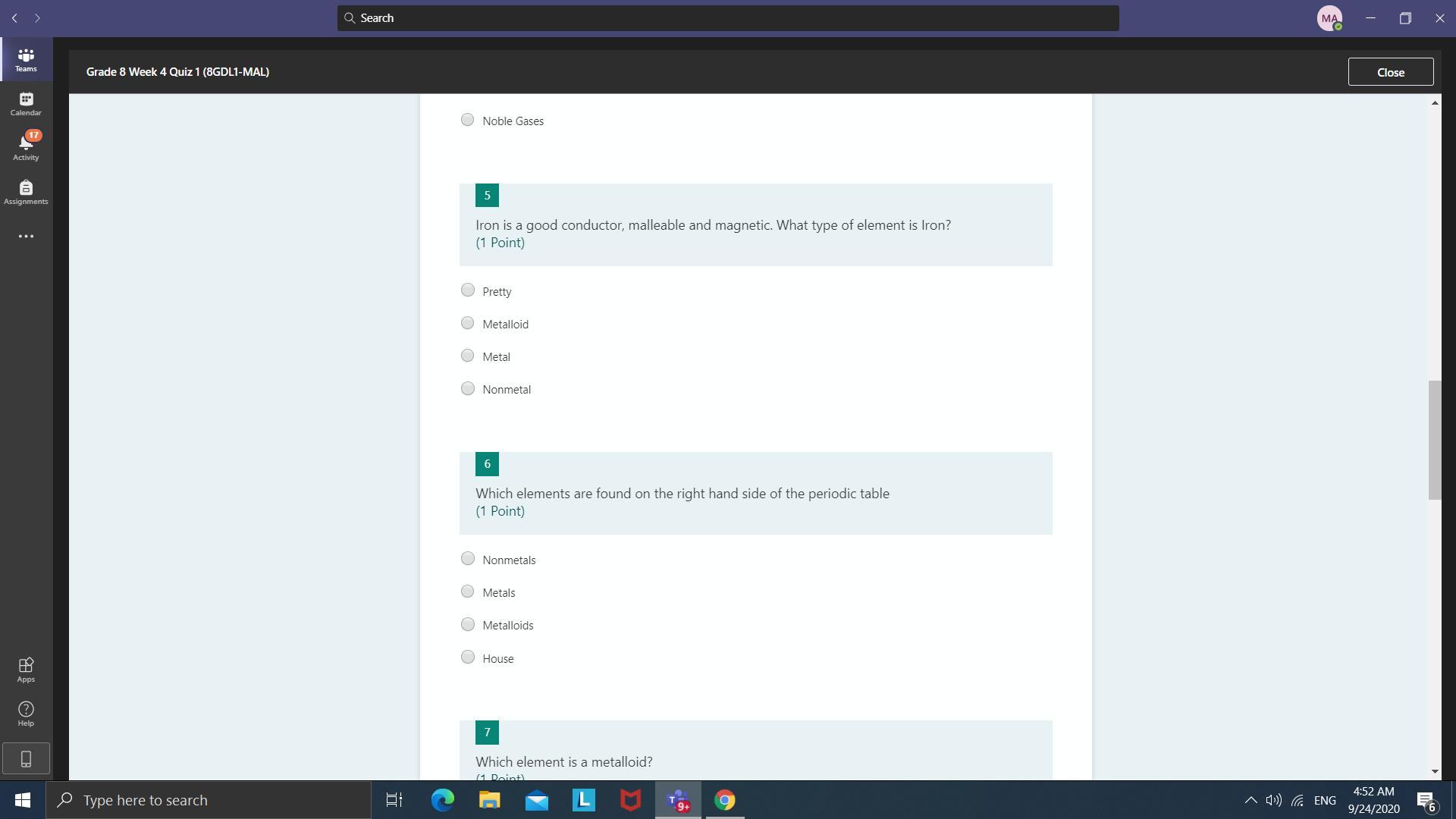
PLEASEEE ANSWERRR FASTT

Chemistry
1 answer:
Aneli [31]2 years ago
5 0

Number 5 is metal & number 6 is nonmetals

Explanation:

You might be interested in
You mix 500.0 mL of 0.250 M iron(III) chloride solution with 425.0 mL of 0.350 M barium chloride solution. Assuming the volumes
12345 [234]

Answer:

M=0.727M

Explanation:

Hello,

In this case, since iron (III) chloride (FeCl3) and barium chloride (BaCl2) are both chloride-containing compounds, we can compute the moles of chloride from each salt, considering the concentration and volume of the given solutions, and using the mole ratio that is 1:3 and 1:2 for the compound to chlorine:

n_{Cl^-}=0.50L*0.250\frac{molFeCl_3}{L}*\frac{3molCl^-}{1molFeCl_3}=0.375molCl^-  \\\\n_{Cl^-}=0.425L*0.350\frac{molBaCl_2}{L}*\frac{2molCl^-}{1molBaCl_2}=0.2975molCl^-

So the total mole of chloride ions:

N_{Cl^-}=0.2975mol+0.375mol=0.6725molCl^-

And the total volume by adding the volume of each solution in L:

V=0.500L+0.425L=0.925L

Finally, the molarity turns out:

M=\frac{0.6725molCl^-}{0.925L}\\ \\M=0.727M

Best regards.

5 0
2 years ago
Which statement best describes the oxidation numbers of the atoms found in magnesium chloride?
Natalka [10]

Answer- The correct choice of answer out of all would be option C.

Explanation

The given substance magnesium chloride made out of combination of chlorine and magnesium is a compound. Where magnesium has two positive ions and chlorine has two negative ions which trigger the reaction.

Hence the oxidation of the 2 positive ions of Magnesium takes place  and reduction of the Negative Ion chlorine has to offer attract and stabilize each other by forming the compound .

5 0
2 years ago
Interpret the following Arterial Blood Gases 1. pH 7.33 PaCO2 60 HCO3 34 A. Normal ABG values B. Respiratory acidosis without co
kicyunya [14]

Answer: 1) C; 2)D; 3)B; 4)B; 5) A

Explanation:Interpreting the following Arterial Blood gases, we have

1. pH 7.33 PaCO2 60 HCO3  34----Respiratory acidosis with partial compensation----C

2. pH 7.48 PaCO2 42 HCO3 30------. Metabolic alkalosis without compensation----D

3. pH 7.38 PaCO2 38 HCO3 24 ----- Normal---B

4. pH 7.21 PaCO2 60 HCO3 24------ Respiratory acidosis without compensation-----B

5. pH 7.48 PaCO2 28 HCO3 20 ----Respiratory alkalosis with partial compensation

The Arterial blood gas interpretation  from analysis shows  the pH and the partial pressures of oxygen and carbon dioxide in the arterial blood of an individual which can detect how well the lungs are functioning thereby making a physician make a diagnosis, estimate  the severity of a condition and profer treatment.

4 0
2 years ago
The amount of energy that must be absorbed or lost to raise or lower the temperature of 1 g of liquid water by 1°C _____.
MatroZZZ [7]

Answer:

c

Explanation:

1 calorie = 4.184J/g×°C

This also happens to be the specific heat capacity of water, which is the amount of energy it takes to raise the temperature of 1mL of water by 1°C

6 0
2 years ago
How many grams of K2CO3 would you need to put on the spill to neutralize the acid according to the following equation? 2HBr(aq)+
Mkey [24]

Full Question:

A flask containing 420 Ml of 0.450 M HBr was accidentally knocked to the floor.?

How many grams of K2CO3 would you need to put on the spill to neutralize the acid according to the following equation?

2HBr(aq)+K2CO3(aq) ---> 2KBr(aq) + CO1(g) + H2O(l)

Answer:

13.1 g K2CO3 required to neutralize spill

Explanation:

2HBr(aq) + K2CO3(aq) → 2KBr(aq) + CO2(g) + H2O(l)

Number of moles = Volume * Molar Concentration

moles HBr= 0.42L x .45 M= 0.189 moles HBr

From the stoichiometry of the reaction;

1 mole of K2CO3 reacts  with 2 moles of HBr

1 mole = 2 mole

x mole = 0.189

x = 0.189 / 2 = 0.0945 moles

Mass = Number of moles * Molar mass

Mass = 0.0945 * 138.21  = 13.1 g
3 0
2 years ago
Other questions:
  • Ozone is made of oxygen. What is the formula of ozone if 36g occupies 16.8L at STP?
    8·1 answer
  • The fuel used in many disposable lighters is liquid butane, C4H10. Butane has a molecular weight of 58.1 grams in one mole. How
    13·2 answers
  • What is the mass in grams of 6.022×10²³ atoms of mass 16.00 amu?
    10·1 answer
  • Here is a sketch of a 2px orbital: This sketch is about 800pm wide. The coordinate ( x , y , and z ) axes are also shown. You ca
    15·1 answer
  • A mixture of ethyl alcohol (molecular mass = 46.1 u) and water (molecular mass = 18.0 u) contains one mole of molecules. The mix
    11·1 answer
  • The student made observations related to the contents of the Erlenmeyer flask during the titration. Identify an observation that
    10·1 answer
  • Which equation represents a reduction half-reaction?
    12·1 answer
  • Bromine has two isotopes, Br79 and Br81. The isotopes occur in a 50:50 (1:1) ratio. Given that the mass spectrum of bromine cont
    12·1 answer
  • Pluto's average distance from the Sun is about 3,666,000,000 miles. What is this in inches?​
    15·1 answer
  • It take 38.70cm³ of 1.90m NaoH to neutralize 10.30cm³ of H2so4 in a battery, calculate the molar concentration of H2so4
    7·1 answer
Add answer
Login
Not registered? Fast signup
Signup
Login Signup
Ask question!
