answer.
Ask question
Login Signup
Ask question
All categories
  • English
  • Mathematics
  • Social Studies
  • Business
  • History
  • Health
  • Geography
  • Biology
  • Physics
  • Chemistry
  • Computers and Technology
  • Arts
  • World Languages
  • Spanish
  • French
  • German
  • Advanced Placement (AP)
  • SAT
  • Medicine
  • Law
  • Engineering
fenix001 [56]
2 years ago
9

a certain atom has a green spectrum line of about 540 nm. what is the difference in energy between the two energy levels respons

ible for producing the line?
Chemistry
1 answer:
Rufina [12.5K]2 years ago
4 0

Answer:

\Delat E=3.7\times 10^{-19}\ J

Explanation:

The difference in energy between the two energy levels is given by :

\Delta E=\dfrac{hc}{\lambda}

Where,

h is Planck's constant

c is speed of light

\lambda is wavelength

So,

\Delta E=\dfrac{6.67\times 10^{-34}\times 3\times 10^8}{540\times 10^{-9}}\\\\\Delta E=3.7\times 10^{-19}\ J

So, the energy difference is 3.7\times 10^{-19}\ J.

You might be interested in
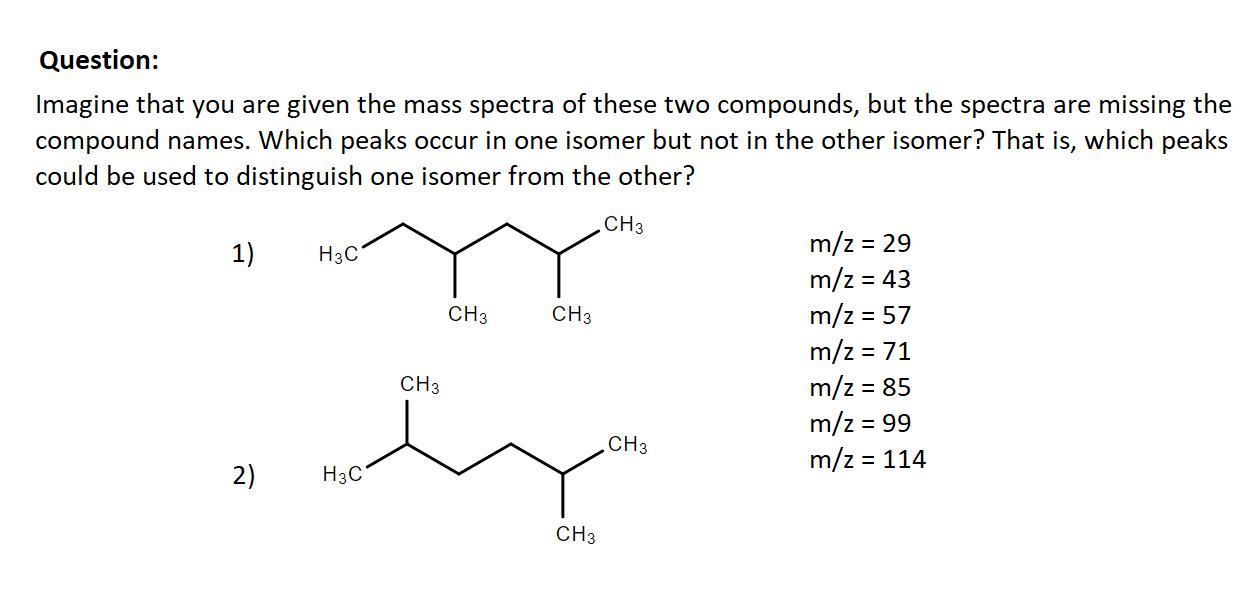
Imagine that you are given the mass spectra of these two compounds, but the spectra are missing the compound names.
12345 [234]

The structures of the isomers and the m/z values of their peaks are not given in the question. The complete question is provided in the attachment

Answer:

Compound 2 (2,5-dimethylhexane) will not have the peaks at 29 and 85 m/z

Explanation:

The fragmentation of molecules by electron ionization of mass spectrometer occurs according to Stevenson's Rule, which states that "The most probable fragmentation is the one that leaves the positive charge on the fragment with the lowest ionization energy". This is much like the Markovnikov's Rule in organic chemistry which has predicted the formation of most stable carbocation and the addition of hydrogen halide to it.

The mass spectra of compound 1 (2,4-dimethylhexane) will contain all the m/z values mentioned in the question. Each peak indicate towards homologous series of fragmentation product of the compound 1. The first peak can be attributed to ethyl carbocation (m/z = 29), with the increase of 14 units the next peak indicates towards propyl carbocation (m/z = 43) and onwards until molecular ion peak of 114 m/z.

Compound 2 (2,5-dimethylhexane) structure shows that the cleavage  of C-C bond will not yield a stable ethyl and hexyl carbocation. Hence, no peaks will be observed at 29 and 85 m/z. The absence of these two peaks can be used to distinguish one isomer from the other.

5 0
2 years ago
A solution of 20.0 g of which hydrated salt dissolved in 200 g H2O will have the lowest freezing point? (A) CuSO4 • 5 H2O (M = 2
Andrews [41]

Answer:

(D) Na₂SO₄•10H₂O (M = 286).

Explanation:

  • The depression in freezing point of water by adding a solute is determined using the relation:

ΔTf = i.Kf.m,

Where, <em>ΔTf </em>is the depression in freezing point of water.

<em>i</em> is van't Hoff factor.

<em>Kf </em>is the molal depression constant.

<em>m</em> is the molality of the solute.

  • Since, Kf and m is constant for all the mentioned salts. So, the depression in freezing point depends strongly on the van't Hoff factor (i).
  • van't Hoff factor is the ratio between the actual concentration of particles produced when the substance is dissolved and the concentration of a substance as calculated from its mass.

(A) CuSO₄•5H₂O:

CuSO₄ is dissociated to Cu⁺² and SO₄²⁻.

So, i = dissociated ions/no. of particles = 2/1 = 2.

(B) NiSO₄•6H₂O:

NiSO₄ is dissociated to Ni⁺² and SO₄²⁻.

So, i = dissociated ions/no. of particles = 2/1 = 2.

(C) MgSO₄•7H₂O:

MgSO₄ is dissociated to Mg⁺² and SO₄²⁻.

So, i = dissociated ions/no. of particles = 2/1 = 2.

(D) Na₂SO₄•10H₂O:

Na₂SO₄ is dissociated to 2 Na⁺ and SO₄²⁻.

So, i = dissociated ions/no. of particles = 3/1 = 3.

∴ The salt with the high (i) value is Na₂SO₄•10H₂O.

So, the highest ΔTf resulted by adding Na₂SO₄•10H₂O salt.

4 0
2 years ago
Two electrons in an atom are separated by 1.5 ✕ 10-10 m, the typical size of an atom. what is the electric force between them?
densk [106]
Given two electrons with charge of 1.5x10^-10 m 

The electostatic force between them is determined by this formula: 

F = kq1q2/r^2
   
where 

k = 9x10^9
q1 = q2 = 1.5x10^-10
r = 2.82x10^-15

F = 9x10^9 * (1.5x10^-10)^2 / 2.82x10^-15
   = 71808.51
4 0
2 years ago
Read 2 more answers
1. A student sees tiny bubbles clinging to the inside of an unopened plastic bottle full of carbonated soft drinks. The student
Lina20 [59]

Answer:

1) The bubbles will grow, and more may appear.

2)Can A will make a louder and stronger fizz than can B.

Explanation:

When you squeeze the sides of the bottle you increase the pressure pushing on the bubble, making it compress into a smaller space. This decrease in volume causes the bubble to increase in density. When the bubble increases in density, the bubble will grow and more bubbles will appear. Therefore, Changing the pressure (by squeezing the bottle) changes the volume of the bubbles. The number of bubbles doesn't change, just their size increases.

Carbonated drinks tend to lose their fizz at higher temperatures because the loss of carbon dioxide in liquids is increased as temperature is raised. This can be explained by the fact that when carbonated liquids are exposed to high temperatures, the solubility of gases in them is decreased. Hence the solubility of CO2 gas in can A at 32°C is less than the solubility of CO2 in can B at 8°C. Thus can A will tend to make a louder fizz more than can B.

3 0
2 years ago
93.2 mL of a 2.03 M potassium fluoride (KF) solution
Marrrta [24]

Answer:

1.98 M

Explanation:

Given data

  • Initial volume (V₁): 93.2 mL
  • Initial concentration (C₁): 2.03 M
  • Volume of water added: 3.92 L

Step 1: Convert V₁ to liters

We will use the relationship 1 L = 1000 mL.

93.2mL \times \frac{1L}{1000mL} = 0.0932 L

Step 2: Calculate the final volume (V₂)

The final volume is the sum of the initial volume and the volume of water.

V_2 = 0.0932L + 3.92 L = 4.01L

Step 3: Calculate the final concentration (C₂)

We will use the dilution rule.

C_1 \times V_1 = C_2 \times V_2\\C_2 = \frac{C_1 \times V_1}{V_2} = \frac{2.03 M \times 3.92L}{4.01L} = 1.98 M

3 0
2 years ago
Read 2 more answers
Other questions:
  • The reaction below has an equilibrium constant kp=2.2×10⁶ at 298 k. 2cof2(g)⇌co2(g)+cf4(g) calculate kp for the reaction below.
    15·2 answers
  • At 1 atm, how many moles of co2 are released by raising the temperature of 1 liter of water from 20∘c to 25∘c? express your answ
    11·2 answers
  • How many atoms of hydrogen are in 210 g of hydrogen peroxide (h2o2)?
    8·2 answers
  • Consider isotopes ions protons and electrons. how many of these did dalton not discuss in his atomic theory?
    12·1 answer
  • In an experiment a student mixes a 50.0 mL sample of 0.100 M AgNO₃(aq) with a 50.0 mL sample of 0.100 M NaCl(aq) at 20.0°C in a
    6·1 answer
  • Given the following data, determine the rate constant of the reaction 2NO(g) +Cl2(g) --&gt; 2NOCl(g) Experiment [NO] (M) [Cl2] (
    12·1 answer
  • Draw the molecule by placing atoms on the grid and connecting them with bonds. Include all lone pairs of electrons. Show the for
    12·1 answer
  • What is the pH of a solution made by mixing 15.00 mL of 0.100 M HCl with 50.00 mL of 0.100 M KOH? Assume that the volumes of the
    5·1 answer
  • A scientist wants to determine the best light wavelength for growing plants. He grows plants in four test groups as shown in the
    12·2 answers
  • What geologic processes helped to form gold ore, oil, and aquifers?
    12·1 answer
Add answer
Login
Not registered? Fast signup
Signup
Login Signup
Ask question!