answer.
Ask question
Login Signup
Ask question
All categories
  • English
  • Mathematics
  • Social Studies
  • Business
  • History
  • Health
  • Geography
  • Biology
  • Physics
  • Chemistry
  • Computers and Technology
  • Arts
  • World Languages
  • Spanish
  • French
  • German
  • Advanced Placement (AP)
  • SAT
  • Medicine
  • Law
  • Engineering
deff fn [24]
2 years ago
9

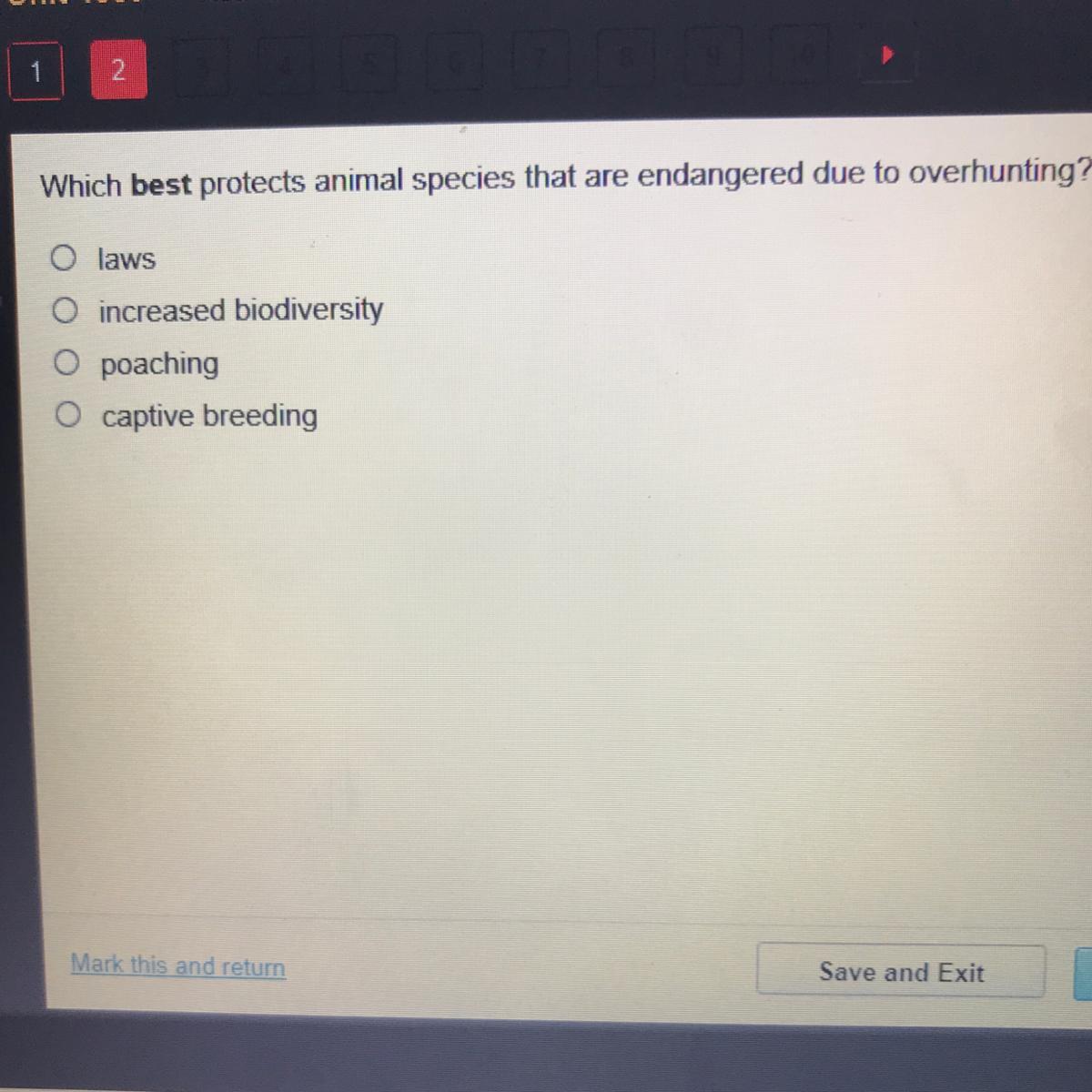
Which best protects animal species that are endangered due to overhunting?

Chemistry
2 answers:
a_sh-v [17]2 years ago
7 0

Answer:

captive breeding

Explanation:

jekas [21]2 years ago
3 0

Answer:

Captive breeding

Explanation:

Endangered species, such as the Black Rhino, Saola, Cross River Gorrillas, the Blue Whale, and a host of others, are species that are critically under the verge of extinction either as a result of the destruction of their habitat or poaching/overhunting, which has really led to steep decline in their population.

Several attempts have been made and ate being made to ensure the preserve and protect these endangered species form going extinct.

However, the best of such measures or practices is arguably referred to as Captive Breeding.

Captive breeding involves the capturing of some of these endangered species and transporting them to enclosed and monitored facilities such as zoos in other to promote the increase preservation and survival of these species and ensuring they don't go extinct.

In most cases, when a considerable increase in population in these facilities is established through breeding, some of them are later on reintroduced to their natural habitat in the wild. This do not only ensure biodiversity, it also ensures the population of the endangered species to grow and avoid such species from going extinct.

You might be interested in
The idea that an emotion-arousing stimulus is simultaneously routed to the cortex and to the sympathetic nervous system is centr
pshichka [43]
<h3><u>Answer;</u></h3>

Cannon-Bard theory

<h3><u>Explanation</u>;</h3>
  • <em><u>The idea that an emotion-arousing stimulus is simultaneously routed to the cortex and to the sympathetic nervous system is central to the Cannon-Band theory.</u></em>
  • Cannon-Bard theory states that we feel emotions and experience physiological reactions such as sweating, trembling, and muscle tension simultaneously.
  • The theory argues that we experience physiological arousal and emotion at the same time. The theory gives more attention to the role of thought or outward behavior as compared to James-Lange.
7 0
2 years ago
Read 2 more answers
When the elements in Group 1 are considered in order from top to bottom, each successive element at standard pressure has
kvasek [131]
When the element in group 1 are considered in order from top to bottom, each successive Elmer at standard pressure has a lower melting point and a lower boiling point.
7 0
2 years ago
What kind of decoration did artists use on Tutankhamen's throne?
Temka [501]

If there are options, they are b, c, and d. I've done this question in class before :)

5 0
2 years ago
Read 2 more answers
For the Bradford assay, the instructor will make a Bradford reagent dye by mixing 50 ml of 95% v/v ethanol with 100 mg of Coomas
jolli1 [7]

Answer:

4,25% v/v H3PO4

Explanation:

The concentration of phosphoric acid (H3PO4) is expressed as a volume / volume percentage, which means:

%v/v H3PO4 = (mL of pure H3PO4/mL of solution)*100%

In other words, <u>we are only interested in the final volume of the solution to which the phosphoric acid was diluted, regardless of its composition</u>. Which in this case is 1 L (1000 mL).

We can then apply the following equation, commonly used to calculate the initial or final concentration (or volume) of a substance when it is diluted:

Ci*Vi=Cf*Vf

<u>Where</u>:

Ci, is the initial concentration of the substance.

Vi, the initial volume of the substance

Cf, the final concentration reached after dilution

Vf, the final volume of the solution at which the substance was diluted

In this case, the incognite would be the final concentration of H3PO4 reached after dilution, that is, Cf. Therefore, we proceed to clear Cf from the previous equation and replace our data:

Cf = (Ci*Vi)/Vf = (85% v/v * 50 mL)/1000 mL = 4,25 % v/v

Note that being up and down in the division, the mL unit is canceled to result in% v / v.
7 0
2 years ago
A group of students are wandering around a room. when their teacher claps, the students sit down wherever they are. this situati
Oksi-84 [34.3K]

an amorphous solid because the particles do not have a regular structure is the answer

8 0
2 years ago
Read 2 more answers
Other questions:
  • A flexible container is put in a deep freeze. Its original volume is 3.00 m3 at 25.0°C. After the container cools, it has shrunk
    12·1 answer
  • How many moles of hydrogen gas are produced when 0.066 mole of sodium is completely reacted?
    14·2 answers
  • What mass of ZnCO3 contains 3.11×10²² O atoms
    10·2 answers
  • How many moles of MgCl2 are there in 319 g of the compound?
    5·1 answer
  • What pressure would a gas mixture in a 10.0 l tank exert if it were composed of 48.5 g he and 94.6 g co2 at 398 k?
    5·2 answers
  • For the chemical equation SO2(g)+NO2(g)↽−−⇀SO3(g)+NO(g) the equilibrium constant at a certain temperature is 3.80. At this tempe
    7·1 answer
  • what would the total pressure of a mixture of fluorine, chlorine, and bromine gases be if the partial pressure are 2.20 atm, 6.7
    11·1 answer
  • A 1.000 kg sample of nitroglycerine, C3H5N3O9, explodes and releases gases with a temperature of 1985°C at 1.100 atm. What is th
    9·1 answer
  • Determine whether each phrase describes carboxylic acids or esters.a. Do not form hydrogen bonds amongst themselves and have hig
    12·2 answers
  • 9 The Haber process is a reversible reaction. N2(g) + 3H2(g) 2NH3(g) The reaction has a 30% yield of ammonia. Which volume of am
    12·1 answer
Add answer
Login
Not registered? Fast signup
Signup
Login Signup
Ask question!
