answer.
Ask question
Login Signup
Ask question
All categories
  • English
  • Mathematics
  • Social Studies
  • Business
  • History
  • Health
  • Geography
  • Biology
  • Physics
  • Chemistry
  • Computers and Technology
  • Arts
  • World Languages
  • Spanish
  • French
  • German
  • Advanced Placement (AP)
  • SAT
  • Medicine
  • Law
  • Engineering
lianna [129]
2 years ago
9

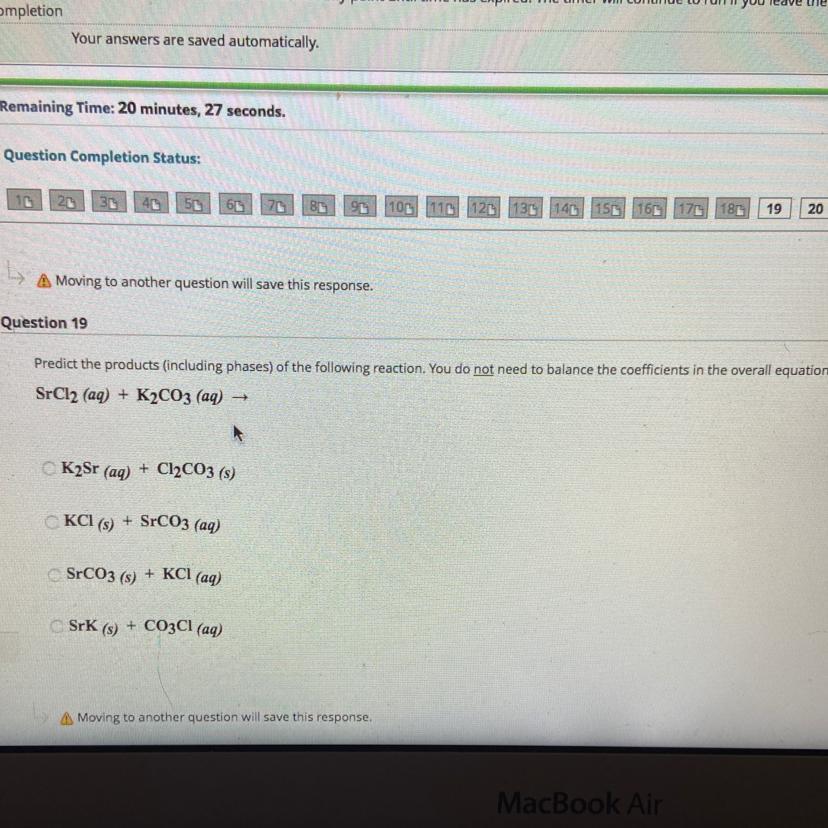
SrCl2 (aq) + K2CO3 (aq) —>

Chemistry
1 answer:
Wewaii [24]2 years ago
8 0

Answer: SrCl_2(aq)+K_2CO_3(aq)\rightarrow 2KCl(aq)+SrCO_3(s)

Explanation:

A double displacement reaction is one in which exchange of ions take place. The salts which are soluble in water are designated by symbol (aq) and those which are insoluble in water and remain in solid form are represented by (s) after their chemical formulas.

A double displacement reaction in which one of the product is formed as a solid is called as precipitation reaction.

The balanced chemical equation is:

SrCl_2(aq)+K_2CO_3(aq)\rightarrow 2KCl(aq)+SrCO_3(s)

You might be interested in
How many valence electrons are in chlorodifluoromethane
Elis [28]
<span>Well... first, let's recognize that the chemical formula for chlorodifluoromethane is CHClF2. Count out how many valence electrons there are. C = 4, H = 1, Cl = 7, F (X2) = 14. Total is 26. Let's put C as the central atom, and put the other elements surrounding it. Draw a pair of electrons beach each element and the central atom. Then fill the halogen elements with 3 pairs of electrons each to fill their octets. Count out how many dots you have. There should be 26, making this the correct lewis structure! Remember, hydrogen doesn't have a full octet, only a maximum of two electrons.</span>
7 0
2 years ago
What are the answers to these questions
Virty [35]

Answer:

Explanation:

So basically it just asking you question about that surtain subject .

5 0
2 years ago
Consider the solutions, 0.04 m urea [(NH2)2C=O)], 0.04 m AgNO3 and 0.04 m CaCl2. Which has (i) the highest osmotic pressure, (ii
Lana71 [14]

Answer:

i) Highest osmotic pressure: CaCl2

ii) lower vapor pressure : CaCl2

iii) highest boiling point : CaCl2

Explanation:

The colligative properties depend upon the number of solute particles in a solution.

The following four are the colligative properties:

a) osmotic pressure : more the concentration of the solute, more the osmotic pressure

b) vapor pressure: more the concentration of the solute, lesser the vapor pressure.

c) elevation in boiling point: more the concentration of the solute, more the boiling point.

d) depression in freezing point: more the concentration of the solute, lesser the freezing point.

the number of particle produced by urea = 1

the number of particle produced by AgNO3 = 2

the number of particle produced by CaCl2 = 3

As concentrations are same, CaCl2 will have more number of solute particles and urea will have least

i) Highest osmotic pressure: CaCl2

ii) lower vapor pressure : CaCl2

iii) highest boiling point : CaCl2
5 0
2 years ago
In the human body hydrochloric acid is responsible for the low ph of the contents of the
natulia [17]
The wording makes this question difficult, but HCl is found in stomach acid. Hope this helps!
4 0
2 years ago
A state property X has a value 89.6 units. It undergoes the following changes, first increase by
yanalaym [24]

Answer:

B) -4.1 units

Explanation:

According to this question, a state property X has a value 89.6 units. It undergoes the certain changes as follows:

- first increase by 3.6 units

- then increase by another 18.7 units

- then decrease by 12.2 units

- and finally attains a value of 85.5 units

This can be mathematically represented by 89.6 - {3.6 + 18.7 - 12.2 - x) = 85.5

To get x, we say;

89.6 + 3.6 = 93.2

93.2 + 18.7 = 111.9

111.9 - 12.2 = 99.7

99.7 - 85.5 = 14.2units.

The changes that occured is represented as follows:

= (3.6 + 18.7) - (12.2 + 14.2)

= 22.3 - 26.4

= -4.1 units

7 0
2 years ago
Other questions:
  • In what situation do we use a volumetric flask, conical flask, pipette and graduated cylinder? Explain your answer from accuracy
    9·1 answer
  • The four rows of data below show the boiling points for a solution with no solute, sucrose (C12H22O11), sodium chloride (NaCl),
    14·2 answers
  • **PLATO QUESTION, PLEASE ANSWER CORRECTLY, THANK YOU**
    5·1 answer
  • Hafnium has six naturally occurring isotopes: 0.16% of 174Hf, with an atomic weight of 173.940 amu; 5.26% of 176Hf, with an atom
    7·1 answer
  • A compound with the molecular formula C10H10O4 produces a 1H NMR spectrum that exhibits only two signals, both singlets. One sig
    15·1 answer
  • How many moles are equal to 47.2 g of K2O
    15·2 answers
  • A gas balloon has a volume of 80.0 mL at 300K , and a pressure of 50.0 kPa. if the pressure changes to 80.0 kPa and the temperat
    14·1 answer
  • what is the new pressure acting on a 2.5 l balloon if its original volume was 5.8 l at 3.7 ATM of pressure
    5·1 answer
  • Determine whether each description applies to electrophilic aromatic substitution or nucleophilic aromatic substitution.
    12·1 answer
  • How many moles of BCl3 are needed to produce 10.0 g of HCl(aq) in the following reaction? (HCl molar mass is 36.46 g/mol).
    14·1 answer
Add answer
Login
Not registered? Fast signup
Signup
Login Signup
Ask question!