answer.
Ask question
Login Signup
Ask question
All categories
  • English
  • Mathematics
  • Social Studies
  • Business
  • History
  • Health
  • Geography
  • Biology
  • Physics
  • Chemistry
  • Computers and Technology
  • Arts
  • World Languages
  • Spanish
  • French
  • German
  • Advanced Placement (AP)
  • SAT
  • Medicine
  • Law
  • Engineering
aleksandr82 [10.1K]
2 years ago
13

Two common forms of phosphorus are red and white. Red phosphorus is fairly stable at room temperature in air, but white phosphor

us can ignite easily when exposed to air. Is this difference in properties due to the existence of different isotopes of phosphorus or different allotropes? Explain.
Chemistry
1 answer:
kodGreya [7K]2 years ago
6 0

Answer:

I believe it to be a difference in isotopes.

Explanation:

This is because since both are the same element it cannot be allotropes which are on a molecular level so it must be isotopes.

You might be interested in
The structure of haloacetic acids, XCH,COOH (where X is either F.CI, Br, or I), is shown above. The dissociation constants and m
lana [24]

Answer:

A student titrates 20.0mL of 1.0M NaOH with 2.0M formic acid, HCO2H (Ka=1.8x10⁻⁴). Formic ... How much formic acid is necessary to reach the equivalence point? a. ... At the equivalence point, is the solution acidic, basic or neutral? ... By adding a small amount of water to the beaker but not dissolving all of the solid. 11.

Explanation:

8 0
2 years ago
\al(s) + 3agno3(aq) → al(no3)3(aq) + 3ag(s) this equation represents which type of chemical reaction?
Savatey [412]
 Al(s)  + 2AgNO3(aq) = Al(NO3)3(aq) + 3 Ag (s) 


is a  single  replacement reaction

 A  single  replacement  reaction  is a type  of chemical reaction were element react with a compound  and  the element take  place  of another element in that  compound.  In the reaction above Aluminium  (Al) take the place of  silver (Ag)  from it compound.that is AgNO3. single  replacement reaction is possible because  aluminium   is  in high in reactivity   series    as compared to silver.
3 0
2 years ago
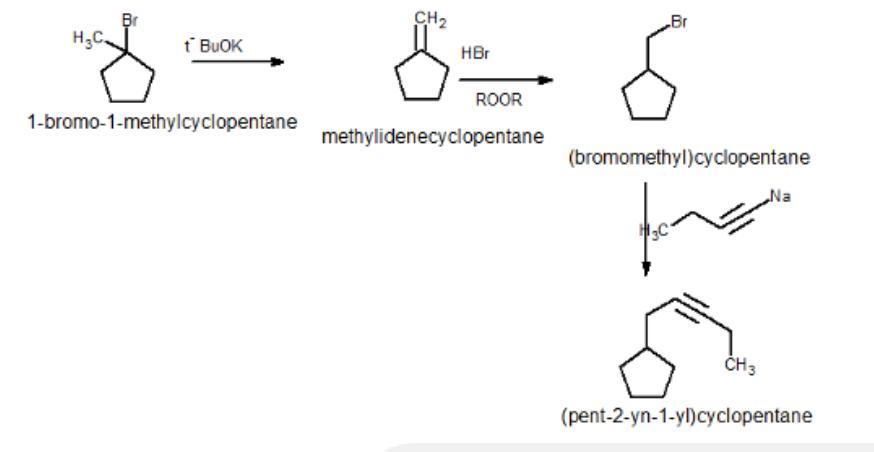
Question 096 Propose a three-step synthetic sequence to accomplish the transformation below. 1) HBr, ROOR; 2) t-BuOK; 3) CH3CH2C
salantis [7]

Complete Question

Question 096 Propose a three-step synthetic sequence to accomplish the transformation below.

Option 1 =>  1) HBr, ROOR; 2) t-BuOK; 3) CH3CH2CCNa

Option 2 => 1) NaOEt; 2) HBr, ROOR; 3) CH3CH2CCNa

Option 3 => 1) t-BuOK; 2) NaNH2; 3) CH3CH2CCNa

Option 4 => 1) CH3CH2CH2CH2Br; 2) NaOEt; 3) HBr, ROOR

Option 5 => 1) t-BuOK; 2) HBr, ROOR; 3) CH3CH2CCNa

Option 6 => 1) NaOEt; 2) NBS, hν; 3) NaSBu

Answer:

The correct option is option 5

Explanation:

   The mechanism of the reaction is shown on the first uploaded image

8 0
2 years ago
The reaction between sulfur dioxide and oxygen is reversible.
RUDIKE [14]

Explanation:

the correct answer is

D) 0.636 mol/dm³

3 0
2 years ago
Copper(II) sulfide, CuS, is used in the development of aniline black dye in textile printing. What is the maximum mass of CuS wh
Naya [18.7K]

Answer:

1.82 g   is the maximum mass of CuS.

Explanation:

Considering:

Molarity=\frac{Moles\ of\ solute}{Volume\ of\ the\ solution}

Or,

Moles =Molarity \times {Volume\ of\ the\ solution}

Given :

<u>For CuCl_2 : </u>

Molarity = 0.500 M

Volume = 38.0 mL

The conversion of mL to L is shown below:

1 mL = 10⁻³ L

Thus, volume = 38.0×10⁻³ L

Thus, moles of CuCl_2 :

Moles=0.500 \times {38.0\times 10^{-3}}\ moles

<u>Moles of CuCl_2  = 0.019 moles </u>

<u>For (NH_4)_2S : </u>

Molarity = 0.600 M

Volume = 42.0 mL

The conversion of mL to L is shown below:

1 mL = 10⁻³ L

Thus, volume = 42.0×10⁻³ L

Thus, moles of (NH_4)_2S :

Moles=0.600 \times {42.0\times 10^{-3}}\ moles

<u>Moles of (NH_4)_2S  = 0.0252 moles </u>

According to the given reaction:

CuCl_2_{(aq)}+(NH_4)_2S_{(aq)}\rightarrow CuS_{(s)}+2NH_4Cl_{(aq)}

1 mole of CuCl_2 reacts with 1 mole of (NH_4)_2S

So,  

0.019 mole of CuCl_2 reacts with 0.019 mole of (NH_4)_2S

Moles of (NH_4)_2S = 0.019 mole

Available moles of (NH_4)_2S = 0.0252 mole

<u>Limiting reagent is the one which is present in small amount. Thus, CuCl_2 is limiting reagent.</u>

The formation of the product is governed by the limiting reagent. So,

1 mole of CuCl_2 gives 1 mole of CuS

0.019 mole of CuCl_2 gives 0.019 mole of CuS

Moles of CuS formed = 0.019 moles

Molar mass of CuS = 95.611 g/mol

Mass of CuS = Moles × Molar mass = 0.019 × 95.611 g = 1.82 g

<u>1.82 g   is the maximum mass of CuS.</u>

5 0
2 years ago
Other questions:
  • A pot of water is heated over a fire, and then frozen peas are added to the hot water. What happens to the energy in this situat
    9·2 answers
  • Suppose a layer of oil is on the top of a beaker of water. Water in many oils is slightly soluble, so its concentration is so lo
    8·1 answer
  • How many molecules of CO2 are contained in a 10.0 L tank at 7.53 atm and 485 K?
    14·2 answers
  • Adelyn cut herself on broken glass in the classroom she started bleeding and needed assistance from her teacher which should the
    9·2 answers
  • Identify and calculate the number of representative particles in 2.15 moles of gold.<br>​
    13·1 answer
  • Weak noncovalent interactions:__________ a. do not include ionic interactions b. always involve water. c. can have a large cumul
    13·1 answer
  • What is the IUPAC name of the following compound?
    13·1 answer
  • By mistake, a quart of oil was dumped into a swimming pool that measures 25.0 m by 30.0 m. The density of the oil was 0.750 g/cm
    13·1 answer
  • Put the following elements into five pairs of elements that have similar chemical reactivity: F, Sr, P, Ca, O, Br, Rb, Sb, Li, S
    6·1 answer
  • Copper atoms are heavier than magnesium atoms. So, although each atom of magnesium can produce one atom of copper, the masses wo
    13·1 answer
Add answer
Login
Not registered? Fast signup
Signup
Login Signup
Ask question!