answer.
Ask question
Login Signup
Ask question
All categories
  • English
  • Mathematics
  • Social Studies
  • Business
  • History
  • Health
  • Geography
  • Biology
  • Physics
  • Chemistry
  • Computers and Technology
  • Arts
  • World Languages
  • Spanish
  • French
  • German
  • Advanced Placement (AP)
  • SAT
  • Medicine
  • Law
  • Engineering
Inga [223]
2 years ago
8

Global Precipitation Measurement (GPM) is a tool scientists use to forecast weather. Which statements describe GPM? Select three

options.
It is a computer model used to predict weather.
It is a satellite that collects data about rain and snow.
Its orbit covers 90 percent of Earth’s surface.
Its orbit covers 70 percent of Earth’s surface.
The sensors measure visible light.
The sensors measure microwaves.
ANSWER FOR MY COUSIN
Chemistry
2 answers:
Simora [160]2 years ago
4 0

Answer:

It is a satellite that collects data about rain and snow.

• Its orbit covers 90 percent of Earth's surface.

• The sensors measure microwaves.

Explanation:

Correct on edge

zavuch27 [327]2 years ago
4 0

Answer:

B,C, and F

Explanation:

Got it right on edge

You might be interested in
Which choice below correctly completes the sentence? _______ reaches the Earth's surface through _______, then turns into ______
blondinia [14]

Answer:

d , before the molten rock becomes lava, it is first magma, and most people know that lava is ejected from volcanoes

4 0
2 years ago
A 600.0 mL sample of 0.20 MHF is titrated with 0.10 MNaOH. Determine the pH of the solution after the addition of 600.0 mL of Na
Leona [35]

Answer: pH=12.69

Explanation:

{\text{Moles of HF}=Molarity\times {\text{Volume of solution in liters}}

{\text{Moles of HF}=0.20M\times 0.6L=0.12 moles

HF\rightarrow H^++F^-

Initial 0.12               0       0

Eqm   0.12-x           x        x

K_a=\frac{[H^+][F^-]}{[HF]}

3.5\times 10^{-4}=\frac{x^2}{0.12-x}  

(neglecting small value of x in comparison to 0.12)

x=4.2\times 10^{-5}

Moles of H^+=4.2\times 10^{-5}

NaOH\rightarrow Na^++OH^-

{\text{Molesof NaOH}}=Molarity\times {\text{Volume of solution in liters}}

{\text{Moles of NaOH}}=0.10M\times 0.6L=0.06 moles

0.06 moles of NaOH will give 0.06 moles of [OH^-]

Now 4.2\times 10^{-5} moles of OH^- will be neutralized by 4.2\times 10^{-5} moles of H^+ and (0.06-4.2\times 10^{-5})=0.059 moles of OH^- will be left.

Molarity of OH^-=\frac{0.059moles}{1.2L}=0.049M

pOH=-\log[OH^-]=-\log[0.049]=1.31

pH = 14 - pOH= 14 - 1.31 = 12.69

5 0
2 years ago
ethylene glycol used in automobile antifreeze and in the production of polyester. The name glycol stems from the sweet taste of
Luden [163]

<u>Answer:</u> The empirical and molecular formula for the given organic compound is CH_3O and C_4H_{12}O_4

<u>Explanation:</u>

The chemical equation for the combustion of hydrocarbon having carbon, hydrogen and oxygen follows:

C_xH_yO_z+O_2\rightarrow CO_2+H_2O

where, 'x', 'y' and 'z' are the subscripts of Carbon, hydrogen and oxygen respectively.

We are given:

Mass of CO_2=9.06g

Mass of H_2O=5.58g

We know that:

Molar mass of carbon dioxide = 44 g/mol

Molar mass of water = 18 g/mol

  • <u>For calculating the mass of carbon:</u>

In 44g of carbon dioxide, 12 g of carbon is contained.

So, in 9.06 g of carbon dioxide, \frac{12}{44}\times 9.06=2.47g of carbon will be contained.

  • <u>For calculating the mass of hydrogen:</u>

In 18g of water, 2 g of hydrogen is contained.

So, in 5.58 g of water, \frac{2}{18}\times 5.58=0.62g of hydrogen will be contained.

  • Mass of oxygen in the compound = (6.38) - (2.47 + 0.62) = 3.29 g

To formulate the empirical formula, we need to follow some steps:

  • <u>Step 1:</u> Converting the given masses into moles.

Moles of Carbon =\frac{\text{Given mass of Carbon}}{\text{Molar mass of Carbon}}=\frac{2.47g}{12g/mole}=0.206moles

Moles of Hydrogen = \frac{\text{Given mass of Hydrogen}}{\text{Molar mass of Hydrogen}}=\frac{0.62g}{1g/mole}=0.62moles

Moles of Oxygen = \frac{\text{Given mass of oxygen}}{\text{Molar mass of oxygen}}=\frac{3.29g}{16g/mole}=0.206moles

  • <u>Step 2:</u> Calculating the mole ratio of the given elements.

For the mole ratio, we divide each value of the moles by the smallest number of moles calculated which is 0.206 moles.

For Carbon = \frac{0.206}{0.206}=1

For Hydrogen  = \frac{0.62}{0.206}=3

For Oxygen  = \frac{0.206}{0.206}=1

  • <u>Step 3:</u> Taking the mole ratio as their subscripts.

The ratio of C : H : O = 1 : 3 : 1

Hence, the empirical formula for the given compound is C_1H_{3}O_1=CH_3O

For determining the molecular formula, we need to determine the valency which is multiplied by each element to get the molecular formula.

The equation used to calculate the valency is:

n=\frac{\text{molecular mass}}{\text{empirical mass}}

We are given:

Mass of molecular formula = 124 amu = 124 g/mol

Mass of empirical formula = 31 g/mol

Putting values in above equation, we get:

n=\frac{124g/mol}{31g/mol}=4

Multiplying this valency by the subscript of every element of empirical formula, we get:

C_{(1\times 4)}H_{(3\times 4)}O_{(1\times 4)}=C_4H_{12}O_4

Thus, the empirical and molecular formula for the given organic compound is CH_3O and C_4H_{12}O_4

3 0
2 years ago
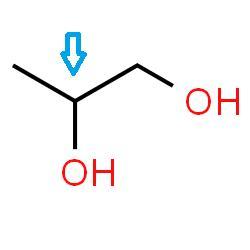
How many possible stereoisomers are there of propylene glycol, an organic compound found in clearasil acne cream, caladryl, colg
vova2212 [387]

Answer:

2

Explanation:

Isomers are molecules with the same molecular formula, but with some difference. If that difference is in the manner the atoms are distributed in the molecule, they are called structural isomers; if the difference is the way the molecule is in space, they're called space isomers (cis/trans); and there are the stereoisomers, which the molecules are images that can be overlapping.

The stereoisomers have the property to deviate the polarized light, and, when a molecule has a chiral carbon, it means that it has stereoisomers. The number of stereoisomers is 2ⁿ, where n is the number of chiral carbons.

Chiral carbon is a carbon that bonds with four different structures. So, below is represented the molecule of propylene glycol, and it has only one chiral carbon (see the blue arrow), so, it has only 2 stereoisomers.

6 0
2 years ago
`suppose you were tasked with producing some nitrogen monoxide (a.k.a. nitric oxide). i'm sure this is often requested of you. y
Umnica [9.8K]
N(H₂O):n(NO)=6:4(3:2), n(NO)=2·3,5mol÷3=2,33mol
So it is a).
7 0
2 years ago
Read 2 more answers
Other questions:
  • A chemist mixes 75.0 g of an unknown substance at 96.5C w/ 1,150 g of water at 25.0C . if the final temperature of the system is
    12·1 answer
  • An air bubble with a volume of 5.0 mL is released at the bottom of a lake where the pressure is 3.0 atm. When it reaches the sur
    15·2 answers
  • Phosphine, ph3(g), combusts in oxygen gas to form water vapor and solid tetraphosphorus decaoxide. express your answer as a bala
    10·1 answer
  • Justin is growing a garden and has many different types of liquids with which he could water his plants. He has water, coffee, m
    11·2 answers
  • For the following pair, indicate which element has the lower first ionization energy: Match the words in the left column to the
    6·1 answer
  • If you add a chunk of zinc to a beaker of acid and zinc shavings to another beaker of acid, the sample with the zinc shavings wi
    13·1 answer
  • For which of these processes is the value of ΔH expected to be negative?I. The temperature (of water) increases when calcium chl
    15·1 answer
  • If a reaction occurs, what will be the products of the unbalanced reaction below?Cu(s) + Ni(NO3)2(aq) 
    8·1 answer
  • What is the pH of a solution made by mixing 15.00 mL of 0.100 M HCl with 50.00 mL of 0.100 M KOH? Assume that the volumes of the
    5·1 answer
  • A compound containing Na, C, and O is found to have 1.06 mol Na, 0.528 mol C, and 1.59 mol O. What is the empirical formula of t
    8·1 answer
Add answer
Login
Not registered? Fast signup
Signup
Login Signup
Ask question!