answer.
Ask question
Login Signup
Ask question
All categories
  • English
  • Mathematics
  • Social Studies
  • Business
  • History
  • Health
  • Geography
  • Biology
  • Physics
  • Chemistry
  • Computers and Technology
  • Arts
  • World Languages
  • Spanish
  • French
  • German
  • Advanced Placement (AP)
  • SAT
  • Medicine
  • Law
  • Engineering
Leona [35]
2 years ago
7

Salt is poured from a container at 10 cm³ s-¹ and it formed a conical pile whose height at any time is 1/5 the radius of the abo

ve. At what rate is the height of the cone increasing when the height is 2 cm form the base of the cone?​
Chemistry
1 answer:
Romashka-Z-Leto [24]2 years ago
7 0

Answer:

\displaystyle \frac{dh}{dt} = \frac{1}{10 \pi}

Explanation:

Volume of a cone:

  • \displaystyle V=\frac{1}{3} \pi r^2 h

We have \displaystyle \frac{dV}{dt} = \frac{10 \ cm^3}{sec} and we want to find \displaystyle \frac{dh}{dt} \Biggr | _{h\ =\ 6}= \ ? when the height is 2 cm.

We can see in our equation for the volume of a cone that we have three variables: V, r, and h.

Since we only have dV/dt and dh/dt, we can rewrite the equation in terms of h only.

We are given that the height of the cone is 1/5 the radius at any given time, 1/5r, so we can write this as r = 5h.

Plug this value for r into the volume formula:

  • \displaystyle V =\frac{1}{3} \pi (5h)^2 h  
  • \displaystyle V =\frac{1}{3} \pi \ 25h^3

Differentiate this equation with respect to time t.

  • \displaystyle \frac{dV}{dt}  =\frac{25}{3} \pi \ 3h^2 \ \frac{dh}{dt}
  • \displaystyle \frac{dV}{dt}  =25 \pi h^2 \ \frac{dh}{dt}

Plug known values into the equation and solve for dh/dt.

  • \displaystyle 10 = 25 \pi (2)^2  \ \frac{dh}{dt}
  • \displaystyle 10 = 100 \pi  \ \frac{dh}{dt}  

Divide both sides by 100π to solve for dh/dt.

  • \displaystyle \frac{10}{100 \pi} = \frac{dh}{dt}
  • \displaystyle \frac{dh}{dt} = \frac{1}{10 \pi}

The height of the cone is increasing at a rate of 1/10π cm per second.

You might be interested in
You see a structural formula in which the symbols for elements are connected by a long dash. You can assume that the chemical bo
Shkiper50 [21]
<span>You see a structural formula in which the symbols for elements are connected by a long dash. I can assume that the chemical bonds in the compound are covalent.</span>
4 0
2 years ago
Read 2 more answers
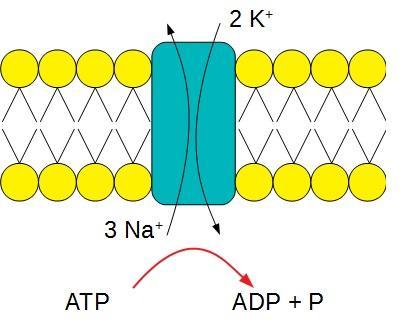
One ATP molecule's hydrolysis releases 7.3 kcal/mol of energy (∆G = −7.3 kcal/mol of energy). If it takes 2.1 kcal/mol of energy
Oxana [17]

Answer:

One ATP molecule's hydrolysis can move 3 ions of Sodium (Na+) across the menbrane.

Explanation:

As you can see, the energy provided by ATP is enough for moving 3 ions of Na+. Each ion needs +2.1 kcal/mol of energy.

If we multiply by 3 the energy for moving across the membrane= +6.3 kcal/mol

By adding the energy from ATP:

ΔGTotal=6.3-7.3= -1 kcal/mol

7 0
2 years ago
Assuming ideal solution behavior, what is the freezing point of a solution of 9.04 g of I2 in 75.5 g of benzene?
cluponka [151]

Answer:

3.1°C

Explanation:

Using freezing point depression expression:

ΔT = Kf×m×i

<em>Where ΔT is change in freezing point, Kf is freezing point depression constant (5.12°c×m⁻¹), m is molality of the solution and i is Van't Hoff factor constant (1 For I₂ because doesn't dissociate in benzene).</em>

Molality of 9.04g I₂ (Molar mass: 253.8g/mol) in 75.5g of benzene (0.0755kg) is:

9.04g ₓ (1mol / 253.8g) = 0.0356mol I₂ / 0.0755kg = 0.472m

Replacing in freezing point depression formula:

ΔT = 5.12°cm⁻¹×0.472m×1

ΔT = 2.4°C

As freezing point of benzene is 5.5°C, the new freezing point of the solution is:

5.5°C - 2.4°C =

<h3>3.1°C</h3>

<em />

3 0
2 years ago
1. Which class of compounds contains at least one element from Group 17 of the Periodic Table ? A) aldehyde B ) amine C) ester D
blondinia [14]

Halide

hope it helps

4 0
2 years ago
Carbon monoxide and molecular oxygen react to form carbon dioxide. A 50.0 L reactor at 25.0 oC is charged with 1.00 bar of CO. T
Umnica [9.8K]

Answer:

CO = zero

CO2 =1 bar

O2  = 2.02 bar

Explanation:

We are given

initial pressure of CO = 1bar

total pressure = 3.52 bar

so initial pressure of O2 = 3.52 - 1 = 2.52 bar

the reaction is

2CO + O2 →  2CO2

using the unitary method

2 moles of CO2 → 1 mole of O2

1  bar of CO → \frac{1}{2} * 1= 0.5 bar (required)

but we have more oxygen present , that means CO is the limiting reagent

  • Final pressure of CO will be zero as it is the limiting reagent so it will be consumed completely
  • 1 bar of CO → \frac{2mol CO2}{2mol CO} * 1= 1 bar of CO2
  • 2.52 bar O2 (initially) - 0.5 bar (reacted) = 2.02bar O2
6 0
2 years ago
Other questions:
  • Which reactants would lead to a spontaneous reaction?
    13·1 answer
  • From the options provided for each element below, choose the properties that it may have based on its location in the periodic t
    10·2 answers
  • Be sure to answer all parts. one of the most important industrial sources of ethanol is the reaction of steam with ethene derive
    8·1 answer
  • Which of the following reactions will not occur as written? Which of the following reactions will not occur as written? Sn (s) +
    8·2 answers
  • Acetylene burns in air according to the following equation: C2H2(g) + 5 2 O2(g) → 2 CO2(g) + H2O(g) ΔH o rxn = −1255.8 kJ Given
    5·1 answer
  • A student weighs an empty flask and stopper and finds the mass to be 53.256 g. She then adds about 5 mL of an unknown liquid and
    9·1 answer
  • A student placed 11.5 g of glucose (C6H12O6) in a volumetric flask, added enough water to dissolve the glucose by swirling, then
    12·2 answers
  • Write two chemical formulae showing the steps involved when a metal combined with a radical
    9·1 answer
  • How much energy is required to vaporize 1.5 KG of aluminum
    8·1 answer
  • Nicole has 2 glasses on the counter: one of water and one of sugar. She is baking a cake and needs to use the sugar-water for th
    11·2 answers
Add answer
Login
Not registered? Fast signup
Signup
Login Signup
Ask question!