answer.
Ask question
Login Signup
Ask question
All categories
  • English
  • Mathematics
  • Social Studies
  • Business
  • History
  • Health
  • Geography
  • Biology
  • Physics
  • Chemistry
  • Computers and Technology
  • Arts
  • World Languages
  • Spanish
  • French
  • German
  • Advanced Placement (AP)
  • SAT
  • Medicine
  • Law
  • Engineering
Alexxx [7]
2 years ago
14

Planet 1 orbits Star 1 and Planet 2 orbits Star 2 in circular orbits of the same radius. However, the orbital period of Planet 1

is longer than the orbital period of Planet 2. What could explain this
Physics
1 answer:
hichkok12 [17]2 years ago
6 0

Answer:

The mass of Star 2 is Greater than the mass of Start 1. (This, if we suppose the masses of the planets are much smaller than the masses of the stars)

Explanation:

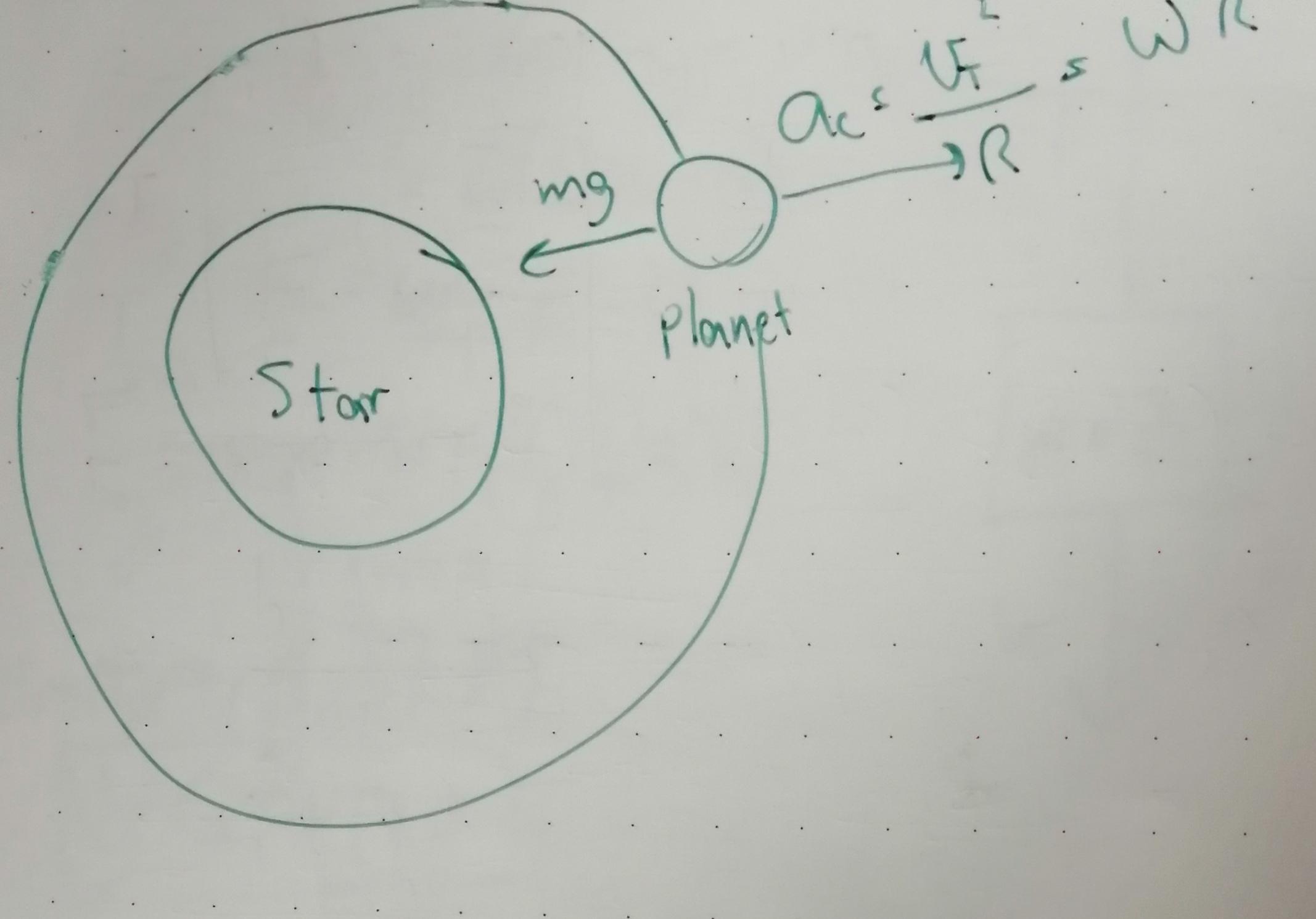
First of all, let's draw a free body diagram of a planet orbiting a star. (See attached picture).

From the free body diagram we can build an equation with the sum of forces between the start and the planet.

\sum F=ma

We know that the force between two bodies due to gravity is given by the following equation:

F_{g} = G\frac{m_{1}m_{2}}{r^{2}}

in this case we will call:

M= mass of the star

m= mass of the planet

r = distance between the star and the planet

G= constant of gravitation.

so:

F_{g} =G\frac{Mm}{r^{2}}

Also, if the planet describes a circular orbit, the centripetal force is given by the following equation:

F_{c}=ma_{c}

where the centripetal acceleration is given by:

a_{c}=\omega ^{2}r

where

\omega = \frac{2\pi}{T}

Where T is the period, and \omega is the angular speed of the planet, so:

a_{c} = ( \frac{2\pi}{T})^{2}r

or:

a_{c}=\frac{4\pi^{2}r}{T^{2}}

so:

F_{c}=m(\frac{4\pi^{2}r}{T^{2}})

so now we can do the sum of forces:

\sum F=ma

F_{g}=ma_{c}

G\frac{Mm}{r^{2}}=m(\frac{4\pi^{2}r}{T^{2}})

in this case we can get rid of the mass of the planet, so we get:

G\frac{M}{r^{2}}=(\frac{4\pi^{2}r}{T^{2}})

we can now solve this for T^{2} so we get:

T^{2} = \frac{4\pi ^{2}r^{3}}{GM}

We could take the square root to both sides of the equation but that would not be necessary. Now, the problem tells us that the period of planet 1 is longer than the period of planet 2, so we can build the following inequality:

T_{1}^{2}>T_{2}^{2}

So let's see what's going on there, we'll call:

M_{1}= mass of Star 1

M_{2}= mass of Star 2

So:

\frac{4\pi^{2}r^{3}}{GM_{1}}>\frac{4\pi^{2}r^{3}}{GM_{2}}

we can get rid of all the constants so we end up with:

\frac{1}{M_{1}}>\frac{1}{M_{2}}

and let's flip the inequality, so we get:

M_{2}>M_{1}

This means that for the period of planet 1 to be longer than the period of planet 2, we need the mass of star 2 to be greater than the mass of star 1. This makes sense because the greater the mass of the star is, the greater the force it applies on the planet is. The greater the force, the faster the planet should go so it stays in orbit. The faster the planet moves, the smaller the period is. In this case, planet 2 is moving faster, therefore it's period is shorter.
You might be interested in
A skydiver finds that she speeds up when she holds her arms close to her body. What does this do?
ArbitrLikvidat [17]

D. Reduces the force of air resistance

7 0
2 years ago
Read 2 more answers
A runner has a momentum of 720 kg m/s and is traveling at a velocity of 5 m/s. What is his mass?
antiseptic1488 [7]
I could be wrong, but I'm pretty sure it's 144kg.
8 0
2 years ago
Read 2 more answers
Suppose you wanted to hold up an electron against the force of gravity by the attraction of a fixed proton some distance above i
SCORPION-xisa [38]

Answer:

The value is  r =  5.077 \  m

Explanation:

From the question we are told that

   The  Coulomb constant is  k =  9.0 *10^{9} \  N\cdot  m^2  /C^2

   The  charge on the electron/proton  is  e =  1.6*10^{-19} \  C

    The  mass of proton m_{proton} =  1.67*10^{-27} \  kg

    The  mass of  electron is  m_{electron } =  9.11 *10^{-31} \ kg

Generally for the electron to be held up by the force gravity

   Then    

       Electric force on the electron  =  The  gravitational Force

i.e  

            m_{electron} *  g  = \frac{ k *  e^2  }{r^2 }

         \frac{9*10^9 *  (1.60 *10^{-19})^2  }{r^2 }  =     9.11 *10^{-31 }  *  9.81

         r =  \sqrt{25.78}

         r =  5.077  \  m

7 0
2 years ago
Monochromatic light is incident on a grating that is 75 mm wide and ruled with 50,000 lines. the second-order maximum is seen at
DIA [1.3K]

Answer:

The wavelength of the incident light is \lambda = 400 nm

Explanation:

Given data

Distance between the sits

d = \frac{0.075}{50000}

d = 1.5 × 10^{-6} m

\theta = 32.5°

m = 2

We know that the wavelength of the incident light is given by

\lambda = \frac{d\sin \theta}{m}

Put all the value in above formula we get

\lambda = \frac{1.5 (\sin 32.5)}{2}×10^{-6}

\lambda = 4 × 10^{-7} m

\lambda = 400 nm

Therefore the wavelength of the incident light is \lambda = 400 nm

4 0
2 years ago
Which is the goal of science?
Irina-Kira [14]
The goal of Science is to expand knowledge.
8 0
2 years ago
Read 2 more answers
Other questions:
  • Why did the acorn fall to earth instead of rising up to the moon?
    8·2 answers
  • what velocity must a 1340kg car have in order to havw the same momentum as a 2680 kg truck traveling at a velocity of 15m/s to t
    12·1 answer
  • What is the direction of the current in the loop as the loop rotates clockwise through the magnetic field from as viewed from th
    14·2 answers
  • A person kicks a ball, giving it an initial velocity of 20.0 m/s up a wooden ramp. When the ball reaches the top, it becomes air
    12·1 answer
  • An object starts from rest and slides with negligible friction down an air track tipped at an angle theta from the horizontal. A
    6·1 answer
  • Which of the following is NOT a good way to reduce fuel consumption?
    15·2 answers
  • What affects the way a projectile performs when it is shot from a firearm?
    10·2 answers
  • Consider a bird that flies at an average speed of 10.7 m/sm/s and releases energy from its body fat reserves at an average rate
    5·2 answers
  • A horizontal spring with spring constant 750 N/m is attached to a wall. An athlete presses against the free end of the spring, c
    6·2 answers
  • The net force acting on a Cessna 172 airplane has a magnitude of 1900 N and points in the positive x direction. If the plane has
    14·1 answer
Add answer
Login
Not registered? Fast signup
Signup
Login Signup
Ask question!
