answer.
Ask question
Login Signup
Ask question
All categories
  • English
  • Mathematics
  • Social Studies
  • Business
  • History
  • Health
  • Geography
  • Biology
  • Physics
  • Chemistry
  • Computers and Technology
  • Arts
  • World Languages
  • Spanish
  • French
  • German
  • Advanced Placement (AP)
  • SAT
  • Medicine
  • Law
  • Engineering
kupik [55]
1 year ago
11

Ricardo and Jane are standing under a tree in the middle of a pasture. An argument ensues, and they walk away in different direc

tions. Ricardo walks 28.0 m in a direction 60.0∘ west of north. Jane walks 12.0 m in a direction 30.0∘ south of west. They then stop and turn to face each oth
Physics
1 answer:
tankabanditka [31]1 year ago
8 0

Answer:

a) 24.33 m of distance.

b) 34.55° east of the south.

Explanation:

The question is incomplete. The whole exercise is the following:

<em>"Ricardo and Jane are standing under a tree in the middle of a pasture. An argument ensues, and they walk away in different directions. Ricardo walks 28.0 m in a direction 60.0° west of north. Jane walks 12.0 m in a direction 30.0° south of west. They then stop and turn to face each other. </em>

<em>(a) What is the distance between them? </em>

<em>(b) In what direction should Ricardo walk to go directly toward Jane?</em><em>"</em>

Now that we know what we need to do in this question, let's head for every part of the problem.

<u>a) Distance between Ricardo and Jane</u>

In this case, we need to analyze the given data:

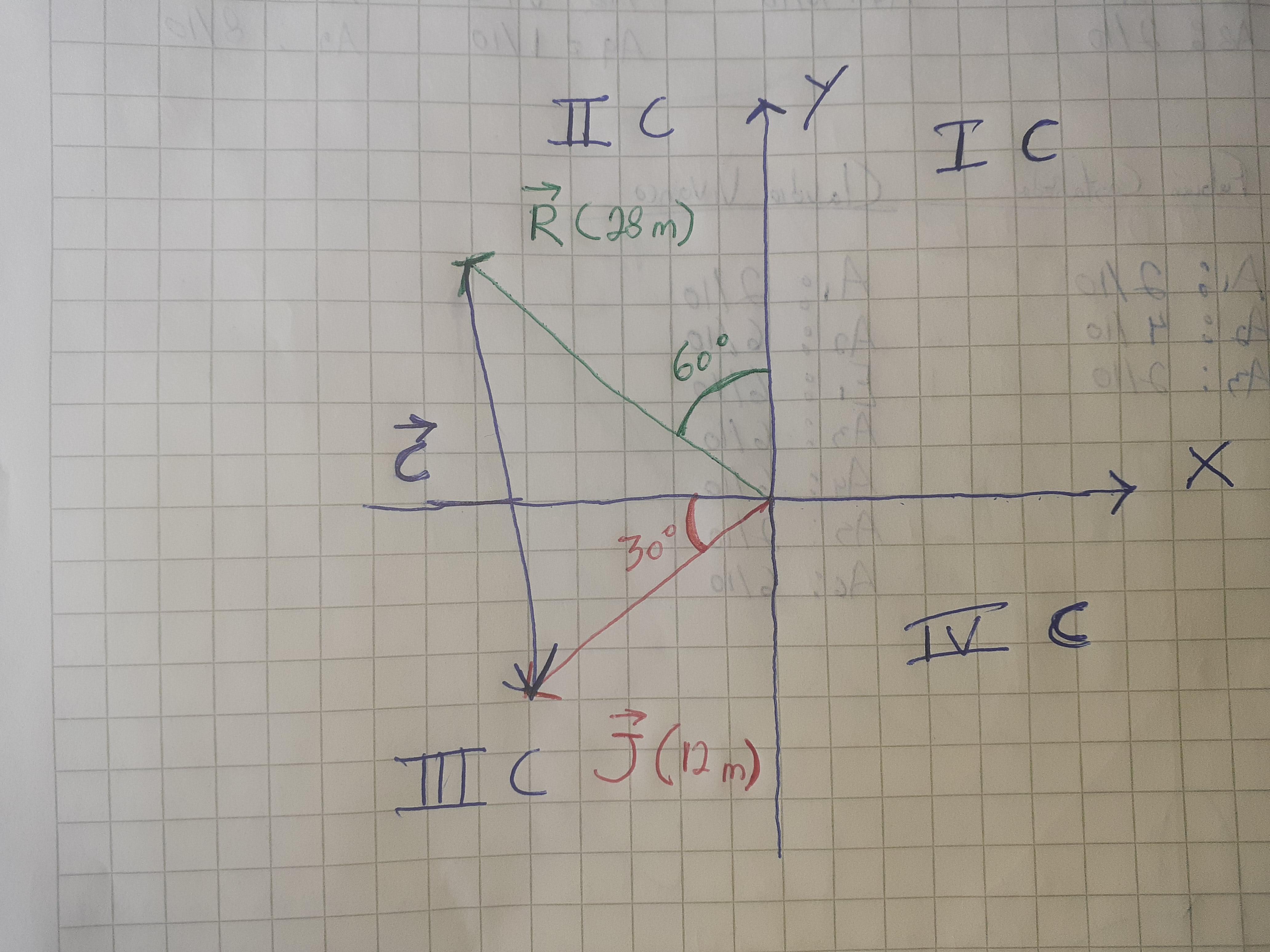
Ricardo (which we will call R) is 28 m from the starting point at 60° west of north, and Jane (J) is 12 m at 30° south of west. So the distance between them, will be the point where they both stop and face each other. This point can be seen in the image attached (See picture).

Let's call the distance between them as "D", to get the distance of D, according to the picture will be:

D = J - R   (1)

However, as they are facing in different angles and directions, we cannot do the difference of their values distance just like that. In order to do that, we need to calculate the components in the "x" and "y" axis of each vector. In that way, we can get the components of x and y of the Distance D, and then, the whole distance between them will be:

D = √Dx² + Dy²     (2)

So, let's get the components of x and y of R and J.

For Ricardo (R):

Rx = R sin60° = 28 sin60° = -24.25 m

Ry = R cos60° = 28 cos60° = 14 m

The sign "-" it's because R it's on the second quadrant, therefore in x, we'll have to add the negative.

For Jane (J):

Jx = J cos30° = 12 cos30° = -10.39 m

Jy = J sin30° = 12 sin30° = -6 m

Again, the negative is added because J is on the third quadrant.

Now that we have the components, let's calculate vector D using expression (1):

Dx = -10.39 - (-24.25) = 13.86 m

Dy = -6 - 14 = -20 m

Now, using expression (2) we can finally know the distance between Jane And Ricardo:

D = √(-20)² + (13.86)²

<h2>D = 24.33 m</h2>

This is the distance between Jane and Ricardo.

b) Direction of Ricardo walking to Jane

In this case, we already have the components of x and y of the distance between them, so, to know the direction:

Tanα = Dy/Dx

α = tan⁻¹ (Dy/Dx)

Replacing the values we have:

α = tan⁻¹ (-20/13.86)

α = 55.45°

Which should south of east or:

β = 90 - 55.45

<h2>β = 34.55°</h2>

Ricardo should walk 34.55° east of south

Hope this helps
You might be interested in
James Cameron piloted a submersible craft to the bottom of the Challenger Deep, the deepest point on the ocean's floor, 11,000 m
Over [174]

Answer:

4.1\cdot 10^8 N

Explanation:

First of all, we need to find the pressure exerted on the sphere, which is given by:

p=p_0 + \rho g h

where

p_0 =1.01\cdot 10^5 Pa is the atmospheric pressure

\rho = 1000 kg/m^3 is the water density

g=9.8 m/s^2 is the gravitational acceleration

h=11,000 m is the depth

Substituting,

p=1.01\cdot 10^5 Pa + (1000 kg/m^3)(9.8 m/s^2)(11,000 m)=1.08\cdot 10^8 Pa

The radius of the sphere is r = d/2= 1.1 m/2= 0.55 m

So the total area of the sphere is

A=4 \pi r^2 = 4 \pi (0.55 m)^2=3.8 m^2

And so, the inward force exerted on it is

F=pA=(1.08\cdot 10^8 Pa)(3.8 m^2)=4.1\cdot 10^8 N

8 0
2 years ago
Read 2 more answers
A sample of an unknown volatile liquid was injected into a Dumas flask (mflask = 27.0928 g, Vflask = 0.1040 L) and heated until
NNADVOKAT [17]

Answer:

The gas was Hexane

Explanation:

taking the diference between the mass of the flask and the final mass qe can calculate the mass of liquid injected (assuming none escaped the flask):

m_{l}  = 27.4593g - 27.0928g = 0.3665g

with the volume of the flask we can get the density of the gas at the indicated pressure and temperature:

d_{g}  = \frac{0.3665 g}{0.1040L} = 3.524 g/L

From the ideal gases law we have that the density can be calculated as:

d_{g}  = \frac{P*M}{R*T}

Where R is the ideal gases constant = , and M the molecular weight of the fluid. Solving for M:

M=\frac{d_{g}*R*T}{P}=\frac{3.524g/L*0,082atmL/molK*291K}{0.976atm}

M=86.16 g/mol

Note that the temperature is computed in Kelvin T= 18+273=291K

The gas with the closer molar mass is Hexane

4 0
2 years ago
For what value m of the clockwise couple will the horizontal component ax of the pin reaction at a be zero? if a couple of that
sergejj [24]
Thank you for posting your question here at brainly. Below is the answer:

sum of Mc = 0 = -Ay(4.2 + 3cos(59)) + (275)(2.1 + 3cos(59)) + M 
<span>- Ay = (M + (275*(2.1 + 3cos(59)))/(4.2 + 3cos(59)) </span>

<span>sum of Ma = 0 = (-275)(2.1) - Cy(4.2 + 3cos(59)) + M </span>
<span>- Cy = (M - (275*2.1))/(4.2 + 3cos(59)) </span>

<span>Ay + Cy = 275 = ((M+1002.41)+(M-577.5))/(5.745) </span>
<span>= (2M + 424.91)/(5.745) </span>

<span>M = ((275*5.745) - 424.91)/2 </span>
<span>= 577.483 which rounds off to 577 </span>

<span>Is it maybe supposed to be Ay - Cy = 275</span>
8 0
2 years ago
A 5kg bucket hangs from a ceiling on a rope. A student attaches a spring scale to the buckets handle and pulls horizontally on t
7nadin3 [17]
I don’t know what the angle is in your diagram so I used the angle from the vertical.

6 0
2 years ago
Which statement describes one way in which global winds affect weather and climate? A. Polar easterlies move warm air to the mid
Genrish500 [490]

The answer your looking for is "D".

4 0
2 years ago
Read 2 more answers
Other questions:
  • In the lab activity, you will examine sound waves as they are emitted from a moving source. Predict what will happen to the soun
    10·2 answers
  • A catcher stops a 0.15-kg ball traveling at 40 m/s in a distance of 20 cm. what is the magnitude of the average force that the b
    10·2 answers
  • A 60 kg student in a rowboat on a still lake decides to dive off the back of the boat. The studen'ts horizontal aceleration is 2
    9·1 answer
  • Assume you are driving 20 mph on a straight road. Also, assume that at a speed of 20 miles per hour, it takes 100 feet to stop.
    11·2 answers
  • A ray of light is incident on a plane surface separating two sheets of glass with refractive indexes 1.70 and 1.58. The angel of
    7·2 answers
  • A rifle, which has a mass of 5.50 kg., is used to fire a bullet, which has a massof m = 65.0 grams., at a "ballistics pendulum".
    6·1 answer
  • A 2-kg cart, traveling on a horizontal air track with a speed of 3 m/s, collides with a stationary 4-kg cart. The carts stick to
    5·1 answer
  • A barge is 10.0 m wide and 60.0 m long and has vertical sides. The bottom of the hull is 12.0 m below the water surface. What ar
    8·1 answer
  • A box is sliding with a speed of 4.50 m/s on a horizontal surface when, at point P, it encounters a rough section. The coefficie
    7·2 answers
  • An x-ray tube is an evacuated glass tube that produces electrons at one end and then accelerates them to very high speeds by the
    13·1 answer
Add answer
Login
Not registered? Fast signup
Signup
Login Signup
Ask question!
