answer.
Ask question
Login Signup
Ask question
All categories
  • English
  • Mathematics
  • Social Studies
  • Business
  • History
  • Health
  • Geography
  • Biology
  • Physics
  • Chemistry
  • Computers and Technology
  • Arts
  • World Languages
  • Spanish
  • French
  • German
  • Advanced Placement (AP)
  • SAT
  • Medicine
  • Law
  • Engineering
goldfiish [28.3K]
2 years ago
4

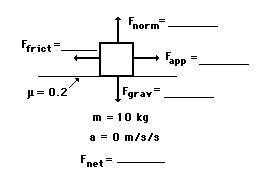
A rightward force is applied to a 10-kg object to move it across a rough surface at constant velocity. The coefficient of fricti

on between the object and the surface is 0.2. Use the diagram to determine the (A) gravitational force, (B) normal force, (C) applied force, (D) frictional force, and (E) net force. (Neglect air resistance.)

Physics
1 answer:
Alinara [238K]2 years ago
8 0

Answer:

Explanation:

Gravitational force = normal force which are both the same thing as the weight of the object which is found in w = mg. Therefore,

w = 10(9.8) = 98 N.

If the object is being pulled at a constant velocity, then the acceleration of said object is 0. Thus,

F - f = ma and

F - f = 0 so

F = f.  So we just need to solve for f, which is found in the equation

f = μF_n so

f = .2(98) and

f = 19.6 = F

The net force is 0 if F = f

You might be interested in
Consider the waveform expression. y (x, t) = ym sin (0.333x + 5.36 + 585t) The transverse displacement (y) of a wave is given as
Sonja [21]

Explanation:

The waveform expression is given by :

y(x,t)=y_m\ sin(0.333x+5.36+585t)...........(1)

Where

y is the position

t is the time in seconds

The general waveform equation is given by :

y(x,t)=y_m\ sin(kx+\phi+\omega t)..........(2)

Where

k=\dfrac{2\pi}{\lambda}

\omega=2\pi f

On comparing equation (1) and (2) we get :

0.333=\dfrac{2\pi}{\lambda}

\lambda=18.86\ m

585=2\pi f

f = 93.10 Hz

Time period, T=\dfrac{1}{f}

T=\dfrac{1}{0.010}

T = 0.010 s

Phase constant, \phi=5.36\ radian

Hence, this is the required solution.

8 0
2 years ago
What makes the subject of star formation so difficult and complex? Star formation is too expensive to study in detail. Stars liv
marta [7]

Answer:

Stars live to long to be observed from birth to death

Explanation:

The life expectancy of a star are millions of years compared to that of human thereby making it difficult to study the life path and activities of the stars till the point of extinction. This brought about scientist studying different star with different ages in order to answer their burning question on formation of stars which is called the figuring out process(stellar activity) and this makes it difficult and tedious.

5 0
2 years ago
A 0.110 kg cube of ice (frozen water) is floating in glycerine. The glycerine is in a tall cylinder that has inside radius 3.70
Sonbull [250]

Answer:

the distance by which the height of the  liquid in the cylinder change after the ice gets melted = 0.528 cm

Explanation:

The change in volume of glycerin when the ice cube is placed on the surface of the glycerin can be represented as:

V = \frac{m}{ \rho}

Given that ;

the mass of the ice cube (m) = 0.11 kg = 0.110 × 10³ g

density of the glycerine (\rho) = 1.260 kg/L = 1.260 g/cm³

Then:

V = \frac{0.110*10^3 \ g}{1.260 \ g/cm^3}

V = 0.0873*10^3 \ cm^3 (\frac{1L}{10^3 cm^3})

V = 0.0873 L

Now;Initially the volume of the glycerin before the ice cube starts to melt is:

V_1 = V_i + V\\\\V_1 = V_i+ 0.0873 \ L

However; the volume of the water produced by the 0.11 kg ice cube = 0.11*10^3 \ cm^3

The expression for change in the volume of glycerin after the ice cube starts to melt is as follows:

V_2 = V_i + V"

replacing V" with 0.11*10^3 \ cm^3 ; we have:

V_2 = V_i (0.11*10^3 \ cm^3 )(\frac{1 \ L }{10^3 \ cm^3})

V_2 = V_i + 0.11 \ L

The overall total change in the volume of the glycerin is illustrated as:

V_f = V_2 - V_1

Now; from the foregoing ; lets replace the respective value of V_2 and V_1 in the above equation ; we have;

V_f = (V_i + 0.11 \ L) - (V_i + \ 00873 \ L)\\ \\V_f = 0.11 L - 0.0873 \ L\\\\V_f = 0.0227 \ L

The formula usually known to be the volume of a cylinder is :

V = \pi r ^2 h

For the question ; we will have:

V_f = \pi r ^2 h

making h the subject of the  formula ; we have:

h = \frac{V_f}{\pi r^2}

replacing 0.0227 L for V_fand the given value of radius which is = 3.70 cm; we have:

h = \frac{0.0227 \ L ( \frac{10^3 \ cm^3}{1\ L})}{\pi * (3.70 cm)^2}

h = \frac{22.7 \ cm^3}{\pi * (3.70 cm)^2}\\\\h = 0.528 \ \ cm

Thus ; the distance by which the height of the  liquid in the cylinder change after the ice gets melted = 0.528 cm
8 0
2 years ago
Assume you are driving 20 mph on a straight road. Also, assume that at a speed of 20 miles per hour, it takes 100 feet to stop.
Viefleur [7K]

Answer:900  feet

Explanation:

Given

Velocity \left ( V_1\right )=20 mph\approx 29.334 ft/s

it take 100 feet to stop

Using Equation of motion

v^2-u^2=2as

where

v,u=Final and initial velocity

a=acceleration

s=distance moved

0-\left ( 29.334\right )^2=2\left (-a\right )\left ( 100\right )

a=\frac{29.334^2}{2\times 100}=4.302 ft/s^2

When velocity is 60 mph\approx 88.002 ft/s

v^2-u^2=2as

0-\left ( 88.002\right )^2=2\left ( -4.302\right )\left ( s\right )

s=900.08 feet

8 0
2 years ago
Read 2 more answers
If a train is 100 kilometers away, how much sooner would you hear the train coming by listening to the rails (iron) as opposed t
Whitepunk [10]
From tables, the speed of sound at 0°C is approximately
V₁ = 331 m/s (in air)
V₃ = 5130 m/s (in iron)

Distance traveled is
d = 100 km = 10⁵ m

Time required to travel in air is
t₁ = d/V₁ = 10⁵/331 = 302.12 s

Time required to travel in iron is
t₂ = d/V₂ = 10⁵/5130 = 19.49 s

The difference in time is
302.12 - 19.49 = 282.63 s

Answer:  283 s (nearest second)


6 0
2 years ago
Other questions:
  • a field hockey ball is launched from the ground at an angle to the horizontal. what are the ball's horizontal and vertical accel
    11·1 answer
  • Water is projected from two rubber pipes at the same speed from one at an angle of 30°and from the other at 60°.why are the rang
    6·1 answer
  • A cliff diver on an alien planet dives off of a 32 meter tall cliff and lands in a sea of hydrochloric acid 1.20 seconds later.
    11·1 answer
  • A spaceship is travelling at 20,000.0 m/s. After 5.0 seconds, the rocket thrusters are turned on. At the 55.0 second mark, the s
    9·1 answer
  • Two 7.0cm×7.0cm metal electrodes are spaced 1.0 mm apart and connected by wires to the terminals of a 9.0 v battery.
    9·1 answer
  • According to the Revere and Black (2003) article, processes that result in an error probability of 0.000070 should be recognized
    8·1 answer
  • Suppose we were to attempt to use a similar machine to measure the charge-to-mass ratio of protons, instead. Suppose, for simpli
    9·1 answer
  • Four kilograms of carbon monoxide (CO) is contained in a rigid tank with a volume of 1 m^3. The tank is fitted with a paddle whe
    11·1 answer
  • Which of these has the most kinetic energy
    5·2 answers
  • Two very small +3.00-μC charges are at the ends of a meter stick. Find the electric potential (relative to infinity) at the cent
    6·1 answer
Add answer
Login
Not registered? Fast signup
Signup
Login Signup
Ask question!
