answer.
Ask question
Login Signup
Ask question
All categories
  • English
  • Mathematics
  • Social Studies
  • Business
  • History
  • Health
  • Geography
  • Biology
  • Physics
  • Chemistry
  • Computers and Technology
  • Arts
  • World Languages
  • Spanish
  • French
  • German
  • Advanced Placement (AP)
  • SAT
  • Medicine
  • Law
  • Engineering
PolarNik [594]
1 year ago
10

Why is the first jar of hydrogen gas collected during preparation discarded

Chemistry
2 answers:
valentina_108 [34]1 year ago
7 0

Answer:

Hydrogen is collected by downward displacement of water as it is less denser than water. Hence it comes out at the surface of water . It is insoluble in water so it does not dissolve in water

nekit [7.7K]1 year ago
6 0

Answer:

Hydrogen gas is almost insoluble in water,it can be collected by displacement of water using an inverted apparatus. Hydrogen is highly explosive when mixed with air. Hydrogen is explosive when mixed with air so burns with explosion near the mouth of gas jar but burns out inside the jar because the burning requires the presence of oxygen which in not present inside the jar

You might be interested in
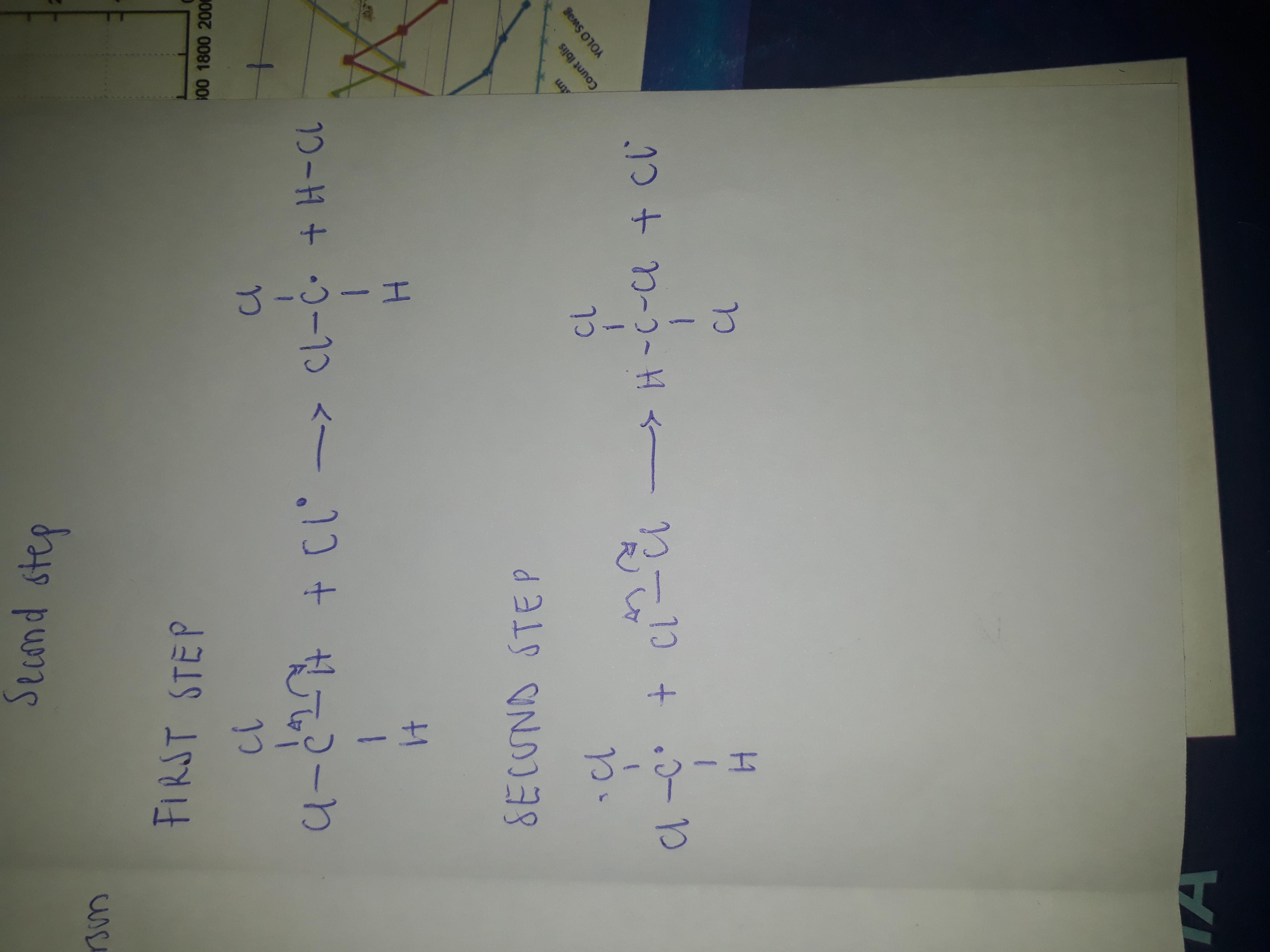
Which of the following represents a propagation step in the monochlorination of methylene chloride (CH2Cl2)?a. CHCl3 + Cl. Right
svetlana [45]

Answer:

B = CHCl2 + Cl2 --> CHCl3 + Cl

Explanation:

Free radical halogenation is a chlorination reaction on Alkane hydrocarbons. This involves the splitting of molecules into radicals/ unstable molecules in the presence of sunlight/ U.V light which ensures bonding of the molecules.

Free radical chlorination is divided into 3 steps which are:

The initiation step

The propagation step

The termination step

So in reference to the question, propagation step involves two steps.

The first step is where the molecule in this case the methylene chloride(CH2Cl2) loses a hydrogen atom and then bond with a chlorine atom radical to give a nethylwnw chloride radical and HCl.

The second step involves the reaction of this methylene chloride got in the first step with chlorine molecule to form trichloride methane and a chlorine radical.

You would find in the attachment the 2 step mechanism.

3 0
2 years ago
14) The central iodine atom in the ICl4- ion has __________ nonbonded electron pairs and __________ bonded electron pairs in its
masha68 [24]

Answer:

Two non bonded electron pairs and four bonded electron pairs

Explanation:

An image of the compound as obtained from chemlibretext is attached to this answer.

The ion ICl4- ion, is an AX4E2 ion. This implies that there are four bond pairs and two lone pairs of electrons. As expected, the shape of the ion is square planar since the lone pairs are found above and below the plane of the square. This is clear from the image attached.

7 0
2 years ago
An unknown element X has the following isotopes: ⁵²X (89.00% abundant), ⁴⁹X (8.00% abundant), ⁵⁰X (3.00% abundant). What is the
Vlad [161]

Answer:

52 amu

Explanation:

To get the relative atomic mass of the element, we need to take into consideration, the atomic masses of the different isotopes and their relative abundances. We simply multiply the percentages with the masses. This can be obtained as follows:

[89/100 * 52] + [8/100 * 49] + [3/100 * 50]

46.28 + 3.92 + 1.5 =51.7 amu

The approximate atomic mass of element x is 52 amu

6 0
2 years ago
What is the name of Pb(NO3)2? Explain how you determined the bond type and the steps you used to determine the naming convention
Elena L [17]

Answer: Lead(II) nitrate but idk the rest

Explanation:

5 0
2 years ago
Write the formulas for the following ionic compounds: (a) copper bromide (containing the Cu+ ion), (b) manganese oxide (containi
ivann1987 [24]

Answer:The formulas of ionic compounds are:

a)CuBr

b)Mn_2O_3

c)Hg_2I_2

d)Mg_3(PO_4)_2

Explanation:

Formulas for the an ionic compounds is determine by:

Criss-cross method, the oxidation state of the ions gets exchanged and they form the subscripts of the other ions. This results in the formation of a neutral compound.

(a) Copper bromide :Given that it contains Cu^+ ion.

Cu^++Br^-\rightarrow CuBr

(b) Manganese oxide : Given that it contains Mn^{3+} ion.

Mn^{3+}+O^{2-}\rightarrow Mn_2O_3

(c)Mercury iodide :Given that it contains Hg_2^{2+}

Hg_2^{2+}+I^-\rightarrow Hg_2I_2

(d) Magnesium phosphate :Given that it contains PO_4^{3-}

Mg^{2+}+PO_4^{3-}\rightarrow Mg_3(PO_4)_2

4 0
2 years ago
Other questions:
  • Hydrogen has three isotopes with mass numbers of 1, 2, and 3 and has an average atomic mass of 1.00794 amu. This information ind
    10·2 answers
  • Radioactive isotopes are used as contrast dyes to study soft tissues such as the gastrointestinal tract. The radiocontrast dyes
    7·2 answers
  • Part a write an equation for the formation of nh3(g) from its elements in its standard states. express your answer as a chemical
    11·2 answers
  • Among these processes, which is the slowest chemical reaction?
    13·2 answers
  • A chemist pours 1 mol of zinc granules into one beaker and 1 mol of zinc chloride powder into another beaker. What do the two sa
    14·2 answers
  • When the pressure that a gas exerts on a sealed container changes from 22.5 psi to psi the temperature changes from 110 c to 65.
    14·1 answer
  • The coinage metals (Group 1B) copper, silver, and gold have specific heats of 0.385, 0.233, and 0.129 J/g-K, respectively. Among
    13·2 answers
  • How much energy must be removed from a 125 g sample of benzene (molar mass= 78.11 g/mol) at 425.0 K to liquify the sample and lo
    9·1 answer
  • A student weighs an empty flask and stopper and finds the mass to be 53.256 g. She then adds about 5 mL of an unknown liquid and
    9·1 answer
  • Interpret the following Arterial Blood Gases 1. pH 7.33 PaCO2 60 HCO3 34 A. Normal ABG values B. Respiratory acidosis without co
    15·1 answer
Add answer
Login
Not registered? Fast signup
Signup
Login Signup
Ask question!