answer.
Ask question
Login Signup
Ask question
All categories
  • English
  • Mathematics
  • Social Studies
  • Business
  • History
  • Health
  • Geography
  • Biology
  • Physics
  • Chemistry
  • Computers and Technology
  • Arts
  • World Languages
  • Spanish
  • French
  • German
  • Advanced Placement (AP)
  • SAT
  • Medicine
  • Law
  • Engineering
kicyunya [14]
1 year ago
13

A student builds a model of a race car. The scale is 1:15. In the scale model, the car is 8 cm tall.How tall is the actual car?

Chemistry
1 answer:
Xelga [282]1 year ago
5 0

let the actual height of car be x

now, according to question,

  • \dfrac{1}{15}  =  \dfrac{8}{x}

  • x = 15 \times 8

  • x = 120 \:  \: cm

  • height \:  \: of \:  \: car   =   120 \:   cm \:  \: or \:  \: 1.2 \:  \: m
You might be interested in
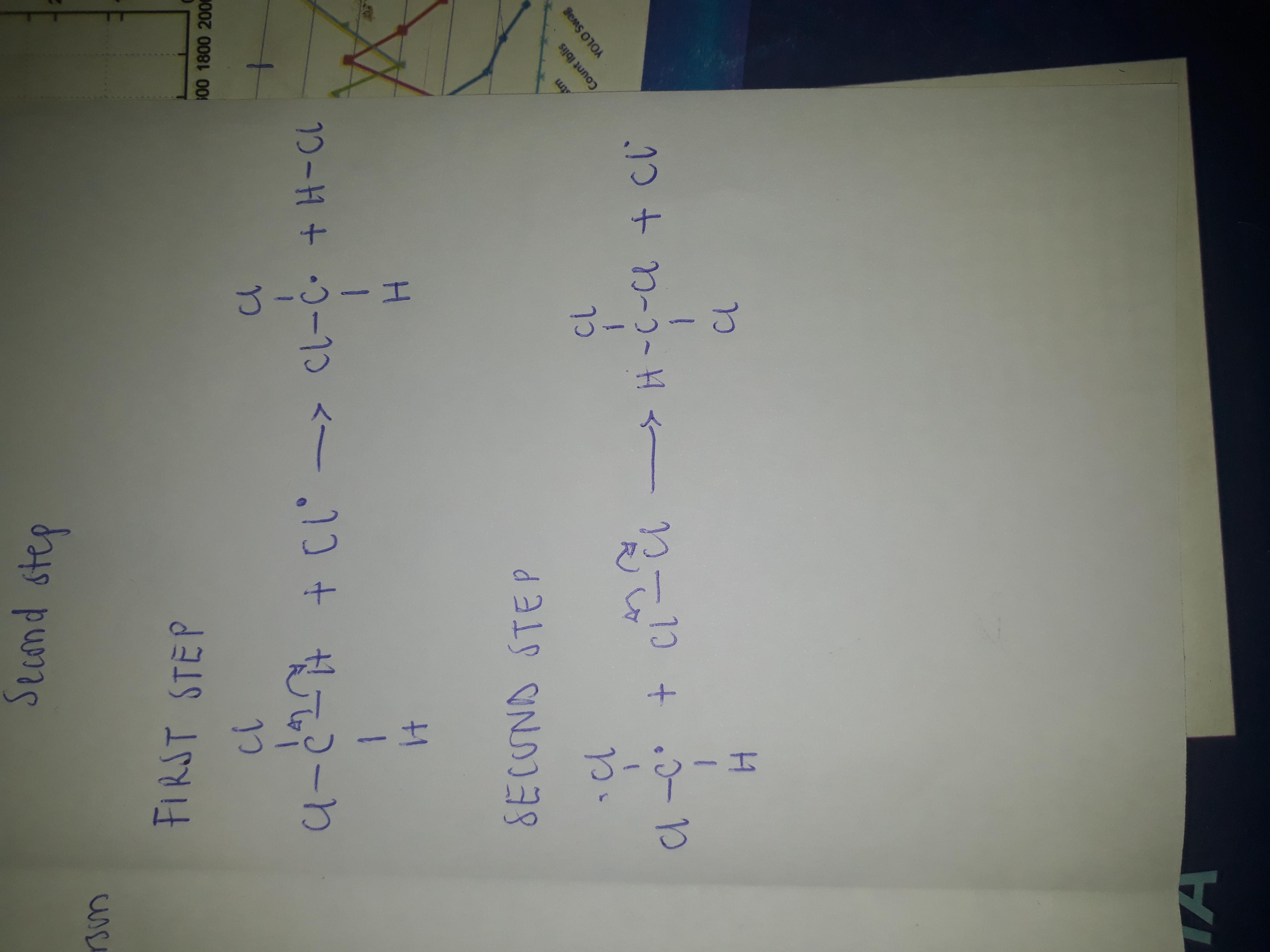
Which of the following represents a propagation step in the monochlorination of methylene chloride (CH2Cl2)?a. CHCl3 + Cl. Right
svetlana [45]

Answer:

B = CHCl2 + Cl2 --> CHCl3 + Cl

Explanation:

Free radical halogenation is a chlorination reaction on Alkane hydrocarbons. This involves the splitting of molecules into radicals/ unstable molecules in the presence of sunlight/ U.V light which ensures bonding of the molecules.

Free radical chlorination is divided into 3 steps which are:

The initiation step

The propagation step

The termination step

So in reference to the question, propagation step involves two steps.

The first step is where the molecule in this case the methylene chloride(CH2Cl2) loses a hydrogen atom and then bond with a chlorine atom radical to give a nethylwnw chloride radical and HCl.

The second step involves the reaction of this methylene chloride got in the first step with chlorine molecule to form trichloride methane and a chlorine radical.

You would find in the attachment the 2 step mechanism.

3 0
2 years ago
How many g i2 should be added to 750g ccl4 to prepare a 0.200m solution?
vesna_86 [32]
<span>There are a number of ways to express concentration of a solution. This includes molality. Molality is expressed as the number of moles of solute per mass of the solvent. We calculate as follows:

0.200 mol I2 / kg CCl4 ( .750 kg CCl4 ) ( 253.809 g I2 / mol I2) = 38.07 g I2 needed

Hope this helps.

 </span>
6 0
2 years ago
Read 2 more answers
Explain the effects of nh3 and hcl on the cuso4 solution in terms of le chatelier's principle
Fittoniya [83]

The Principle of Le Chatelier states that if a system in equilibrium is subjected to a disturbance, the system will react in such a way that it will diminish the effect of that disturbance. Thus, when the concentration of one of the substances in an equilibrium system is changed, the equilibrium varies in such a way that it can compensate for this change.

For example, if the concentration of one of the reactants is increased, the equilibrium shifts to the right or to the side of the products. Also, if you add more reagents, the reaction will move even more to the right until the balance is re-established again, increasing the quantity of products.

In this way, adding HCl to a solution of CuSO4 will produce the following reaction:

CuSO4 (aq) + 2HCl (aq) ⇔ CuCl2 (aq) + H2SO4 (aq)

Initially the solution of CuSO4 in water will be blue, but when adding HCl the solution will change color to green, since the aqueous solutions of CuCl2 are green. By adding more HCl this color will intensify as the balance shifts to the right, producing more CuCl2 and H2SO4.

On the other hand, adding NH3 to a solution of CuSO4 will produce the following reaction

CuSO4 (aq) + 4NH3 (aq) ⇔ [Cu(NH3)4] SO4 (s)

Thus, by adding NH3 to the CuSO4 solution we will observe the formation of a precipitate corresponding to [Cu(NH3) 4] SO4. <u>When adding more NH3, the formation of more precipitate will be observed as the equilibrium moves to the right, producing a greater quantity of [Cu (NH3) 4] SO4.</u>


6 0
2 years ago
A gas occupies 72.1 at stp. At what temperature would the gas occupy 85.9 L at a pressure of 93.6 kPa?
Alika [10]

Answer:

328.1 K.

Explanation:

  • To calculate the no. of moles of a gas, we can use the general law of ideal gas: <em>PV = nRT</em>.

where, P is the pressure of the gas in atm.

V is the volume of the gas in L.

n is the no. of moles of the gas in mol.

R is the general gas constant,

T is the temperature of the gas in.

  • If n is constant, and have two different values of (P, V and T):

<em>P₁V₁T₂ = P₂V₂T₁</em>

<em></em>

P₁ = 1.0 atm (standard P), V₁ = 72.1 L, T₁ = 25°C + 273 = 298 K (standard T).

P₂ = 93.6 kPa = 0.924 atm, V₂ = 85.9 L, T₂ = ??? K.

<em>T₂ = P₂V₂T₁/P₁V₁ = </em>(0.924 atm)(85.9 L)(298 K)/(1.0 atm)(72.1 L) <em>= 328.1 K.</em>

<em></em>

4 0
2 years ago
What is the mass of 2.5 moles of hydrogen fluoride gas HF
Nady [450]

Answer:

You will get 5.0 g of hydrogen.

Explanation:

As with any stoichiometry problem, we start with the balanced equation.

Sn

l

+

2HF

→

SnF

2

+

H

2

Moles of H

2

=

2.5

mol Sn

×

1 mol H

2

1

mol Sn

=

2.5 mol H

2

Mass of H

2

=

2.5

mol H

2

×

2.016 g H

2

1

mol H

2

=

5.0 g H

2

7 0
2 years ago
Other questions:
  • jan is holding an ice cube. what causes the ice to melt? thermal energy from the ice is transferred to the air. thermal energy f
    12·2 answers
  • Write one scientific question about the organism in the photo
    8·2 answers
  • The empirical formula for a compound is CH2. If n is a whole number, which shows a correct relationship between the molecular fo
    15·2 answers
  • At elevated temperatures, methylisonitrile (CH3NC) isomerizes to acetonitrile (CH3CN): CH3NC (g) → CH3CN (g) At the start of the
    10·1 answer
  • Explain how the lines seen in the spectroscope relate to the position of electrons in the metal atom?
    15·1 answer
  • Platinum, which is widely used as a catalyst, has a work function φ(the minimum energy needed to eject an electron from the meta
    8·1 answer
  • A solution is prepared by adding 100 mL of 1.0 M HC2H3O2 (aq) to 100 mL of 1.0 M NaC2H3O2 (aq). The solution is stirred and its
    8·1 answer
  • Please help me please
    14·2 answers
  • What is the general formula for the homologous series that includes ethene?
    13·1 answer
  • Imagine you are volunteering in a 1st grade classroom. The students recently learned about the water cycle. One student raises h
    10·1 answer
Add answer
Login
Not registered? Fast signup
Signup
Login Signup
Ask question!