answer.
Ask question
Login Signup
Ask question
All categories
  • English
  • Mathematics
  • Social Studies
  • Business
  • History
  • Health
  • Geography
  • Biology
  • Physics
  • Chemistry
  • Computers and Technology
  • Arts
  • World Languages
  • Spanish
  • French
  • German
  • Advanced Placement (AP)
  • SAT
  • Medicine
  • Law
  • Engineering
Lunna [17]
2 years ago
3

what rule can you state about the relationship between phase changes and temperature?Between phase changes and heat energy

Chemistry
1 answer:
erastova [34]2 years ago
5 0
The phase does not change until the substance is at the same temperature. Hope this helps! By the way, this was the answer for the question "What rule can you state about the relationship between phase changes and temperature"
You might be interested in
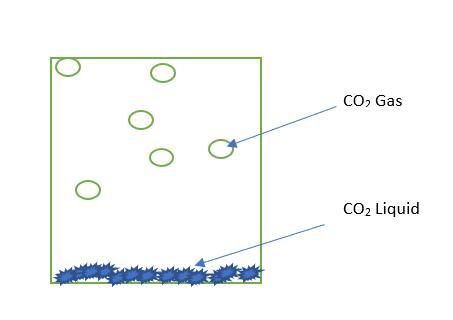
Paintball is a popular recreational activity that uses a metal tank of compressed carbon
Dovator [93]

Answer:

Explanation:

Here we have the mass of CO₂ added = 340 g

From

Number \, of \, moles = \frac{Mass}{Molar \, mass}

We have, where the molar mass of CO₂ is 44.01 g/mol

Therefore,

Number \, of \, moles = \frac{340}{44.01} = 7.73 \, \, \, moles

71. Included drawing attached

72. Here we have the pressure of the gas given by Charles law which can be resented as follows;

\frac{P_1}{P_2} =\frac{T_1}{T_2}

Where:

P₁ = Initial pressure = 6.1 atmospheres

P₂ = Final pressure

T₁ = Initial Temperature = 293 K

T₂ = Initial Temperature = 313 K

Therefore,

P_2= T_2 \times \frac{P_1}{T_1} = 313 \times \frac{6.1}{293} = 3.312 \, \, \, atmospheres


5 0
2 years ago
In the synthesis of barium carbonate from an alkali metal carbonate (M2CO3 where M is one of the alkali metals) a student genera
Paraphin [41]

Answer:

0.019 moles of M2CO3

Explanation:

M2CO3(aq) + BaCl2 (aq) --> 2MCl (aq) + BaCO3(s)

From the equation above;

1 mol of  M2CO3 reacts to produce 1 mol of BaCO3

Mass of BaCO3 formed = 3.7g

Molar mass of BaCO3 = 197.34g/mol

Number of moles = Mass / Molar mass = 3.7 / 197.34 = 0.0187  ≈ 0.019mol

Since 1 mol of M2CO3 reacts with 1 mol of BaCO3,

1 = 1

x = 0.019

x = 0.019 moles of M2CO3

3 0
2 years ago
Stu Dent has finished his titration, and he comes to you for help with the calculations. He tells you that 20.00 mL of unknown c
Alexus [3.1K]

Answer:

0.3229 M HBr(aq)

0.08436M H₂SO₄(aq)

Explanation:

<em>Stu Dent has finished his titration, and he comes to you for help with the calculations. He tells you that 20.00 mL of unknown concentration HBr(aq) required 18.45 mL of 0.3500 M NaOH(aq) to neutralize it, to the point where thymol blue indicator changed from pale yellow to very pale blue. Calculate the concentration (molarity) of Stu's HBr(aq) sample.</em>

<em />

Let's consider the balanced equation for the reaction between HBr(aq) and NaOH(aq).

NaOH(aq) + HBr(aq) ⇄ NaBr(aq) + H₂O(l)

When the neutralization is complete, all the HBr present reacts with NaOH in a 1:1 molar ratio.

18.45 \times 10^{-3} L NaOH.\frac{0.3500molNaOH}{1LNaOH} .\frac{1molHBr}{1molNaOH} .\frac{1}{20.00 \times 10^{-3} LHBr} =\frac{0.3229molHBr}{1LHBr} =0.3229M

<em>Kemmi Major also does a titration. She measures 25.00 mL of unknown concentration H₂SO₄(aq) and titrates it with 0.1000 M NaOH(aq). When she has added 42.18 mL of the base, her phenolphthalein indicator turns light pink. What is the concentration (molarity) of Kemmi's H₂SO₄(aq) sample?</em>

<em />

Let's consider the balanced equation for the reaction between H₂SO₄(aq) and NaOH(aq).

2 NaOH(aq) + H₂SO₄(aq) ⇄ Na₂SO₄(aq) + 2 H₂O(l)

When the neutralization is complete, all the H₂SO₄ present reacts with NaOH in a 1:2 molar ratio.

42.18 \times 10^{-3} LNaOH.\frac{0.1000molNaOH}{1LNaOH} .\frac{1molH_{2}SO_{4}}{2molNaOH} .\frac{1}{25.00\times 10^{-3}LH_{2}SO_{4}} =\frac{0.08436molH_{2}SO_{4}}{1LH_{2}SO_{4}} =0.08436M

6 0
2 years ago
A solution is prepared by adding 6.24 g of benzene (C 6H 6, 78.11 g/mol) to 80.74 g of cyclohexane (C 6H 12, 84.16 g/mol). Calcu
tekilochka [14]

Answer:

x_B=0.0769

m=0.990m

Explanation:

Hello,

In this case, we can compute the mole fraction of benzene by using the following formula:

x_B=\frac{n_B}{n_B+n_C}

Whereas n accounts for the moles of each substance, thus, we compute them by using molar mass of benzene and cyclohexane:

n_B=6.24g*\frac{1mol}{78.11g}=0.0799mol\\ \\n_C=80.74g*\frac{1mol}{84.16g} =0.959mol

Thus, we compute the mole fraction:

x_B=\frac{0.0799mol}{0.0799mol+0.959mol}\\ \\x_B=0.0769

Next, for the molality, we define it as:

m=\frac{n_B}{m_C}

Whereas we also use the moles of benzene but rather than the moles of cyclohexane, its mass in kilograms (0.08074 kg), thus, we obtain:

m=\frac{0.0799mol}{0.08074kg}=0.990mol/kg

Or just 0.990 m in molal units (mol/kg).

Best regards.

7 0
2 years ago
How many molecules are in 79g of fe2o3
horrorfan [7]
Convert grams —> mols and then mols —> atoms

We know that there are 6.02 x 10^23 atoms/mol

And we know that there are about 160 grams of fe2o3 per mol

So (79g fe2o3)/(160 g/mol) = .49 mol fe2o3

Now we use avogadro’s number to do

(.49 mol fe2o3)/(6.02 x 10^23 atoms/mol) = the answer.

I’ll leave the easy math to you.
7 0
2 years ago
Other questions:
  • The group of molecules called nucleotides contain:
    13·1 answer
  • If a large marshmallow has a volume of 2.75 in3 and density of 0.242 g/cm3, how much would it weigh in grams? 1 in3=16.39 cm3.
    9·1 answer
  • The lower the ph of a solution, the ______.
    15·2 answers
  • Describe how you could determine the specific heat of a sample of a solid substance. You may assume that the substance does not
    10·2 answers
  • Which of the following compounds has the lowest boiling point?
    8·1 answer
  • Three units put together in different patterns essentially make
    12·2 answers
  • * will mark you brainliest + 18 points *
    15·1 answer
  • The bond enthalpy of the C―N bond in the amide group of proteins can be treated as an average of C―N (276 kJ/mol) and C═N (615 k
    14·1 answer
  • A 110.0-g sample of metal at 82.00°C is added to 110.0 g of H2O(l) at 27.00°C in an insulated container. The temperature rises t
    12·2 answers
  • Where does the energy required to break the interactions between butane molecules come from when butane boils?​
    10·1 answer
Add answer
Login
Not registered? Fast signup
Signup
Login Signup
Ask question!