answer.
Ask question
Login Signup
Ask question
All categories
  • English
  • Mathematics
  • Social Studies
  • Business
  • History
  • Health
  • Geography
  • Biology
  • Physics
  • Chemistry
  • Computers and Technology
  • Arts
  • World Languages
  • Spanish
  • French
  • German
  • Advanced Placement (AP)
  • SAT
  • Medicine
  • Law
  • Engineering
Gre4nikov [31]
2 years ago
8

Ethylene glycol (antifreeze) has a density of 1.11 g/cm3. What is the mass in grams of 387 mL of ethylene glycol?

Chemistry
2 answers:
yanalaym [24]2 years ago
8 0

The mass in grams of 387 mL of ethylene glycol is 429.57 grams.

<h3>Further explanation </h3>

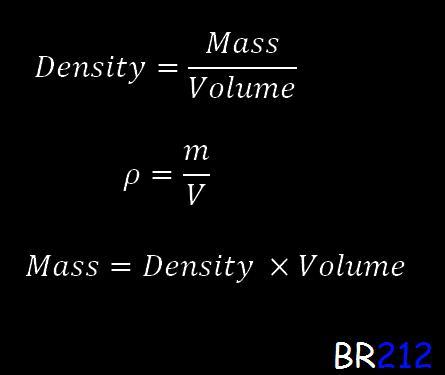
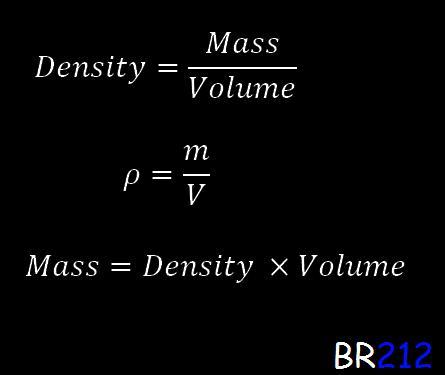
In Greek letters the density is expressed in letters ρ (read: rho) and is defined as the mass of the substance divided by its volume. The formula that states the relationship between them is

\boxed{ \ density = \frac{massa}{volum} \ }

with the symbol as follows

\boxed{ \ \rho = \frac{m}{V} \ }

Based on the formula, the standar units of density are kg/m³ or g/cm³.

Objects with identical types will allow the same density. Therefore it can be noted that density is one of the characteristics of a substance because it provides a specified value.

Since we have presented that

  • volume of ethylene glycol (V) = 387 mL
  • because 1 mL = 1 cm³ then 387 mL = 387 cm³
  • density of ethylene glycol (ρ) = 1.11 g/cm³

We need finding the mass (m) in grams of 387 mL ethylene glycol.

The formula can be rearranged to calculate the mass of an object.

\rho = \frac{m}{V} \rightarrow \boxed{ \ m = \rho \times V \ }

Mass = 1.11 \frac{g}{cm^3} \times 387 \ cm^3

If all other units are crossed out, generating the desired unit is grams, that means the problem is set in the correct dimensions

Mass = 429.57 grams

Hence, the mass of 387 mL ethylene glycol is 429.57 grams.

Note that density is

  • always constant
  • can be used as a conversion factor
  • can be used to identify an unknown hypothetical substance  
  • varies from element to element and substance to substance  
  • can be measured for all substances, solids, liquids, and gases.

How tight or heavy an object can be observed by comparing its density .

<h3>Learn more </h3>
  1. What represent the density of a 36 g object with a volume of 15 cm³? brainly.com/question/751226
  2. What is the mass, in grams, of a liquid containing a density of 1.50 g/ml and a volume of 3.50 liters? brainly.com/question/11893252
  3. Metal has a mass of 8.7 grams and a volume of 3.2 mL. Is it metal gold? brainly.com/question/12761926
<h3>Answer details  </h3>

Grade : Middle School

Subject : Physics

Chapter : Units of Measurement

Keywords : density, ethylene glycol, antifreeze, mass, grams, g/cm³, volume, mL, units, substance  
Kamila [148]2 years ago
8 0
Multiply the volume by the density. 1 ml = 1 cm^3

1.11 g/cm^3 * 1 cm^3/mL * 386 mL = 428 g

All your units cancel out except for g which is what you would expect since you want units of mass.
You might be interested in
A solution is prepared by dissolving 91.7 g fructose in 545 g of water. Determine the mole fraction of fructose if the final vol
oee [108]

Answer:

Mole fraction = 0,0166

Explanation:

Mole fraction is defined as mole of a compound per total moles of the mixture. In the solution, the solute is fructose and the solvent is water. That means you need to find moles of fructose and moles of water.

The molecular mass of fructose is 180,16g/mol and mass of water is 18,02 g/mol. Using these values:

91,7g fructose × (1mol / 180,16g) = <em>0,509 moles of fructose</em>

545g water × (1mol / 18,02g) = <em>30,24 moles of water</em>

Thus, mole fraction of fructose is:

\frac{0,509 moles}{0,509mol + 30,24mol} = 0,0166

<em>Mole fraction = 0,0166</em>

I hope it helps!

5 0
2 years ago
An organelle that is not found in this illustration of a cell would be
zloy xaker [14]

Answer:

The answer is cell wall

Explanation:

Because it is

8 0
2 years ago
Read 2 more answers
Two cars started at the same position and were driven through a city using different streets. The red car traveled north 2 miles
Bad White [126]

Answer:

C

green traveled les distance but still ended up in the same location as red

5 0
2 years ago
Read 2 more answers
A 25.0 g sample of an alloy was heated to 100.0 oC and dropped into a beaker containing 90 grams of water at 25.32 oC. The tempe
elena55 [62]

Answer:

The specific heat of the alloy C_{a} = 0.37 \frac{KJ}{Kg K}

Explanation:

Mass of an alloy m_{a} = 25 gm

Initial temperature T_{a} = 100°c = 373 K

Mass of water m_{w} = 90 gm

Initial temperature of water T_{w} = 25.32 °c = 298.32 K

Final temperature T_{f} = 27.18 °c = 300.18 K

From energy balance equation

Heat lost by alloy = Heat gain by water

m_{a} C_{a}  [T_{a} - T_{f}] = m_{w} C_w (T_{f} -T_{w} )

25 × C_{a} × ( 373 - 300.18 ) = 90 × 4.2 (300.18 - 298.32)

C_{a} = 0.37 \frac{KJ}{Kg K}

This is the specific heat of the alloy.

4 0
2 years ago
A poisoned pill contains 0.00048 moles of KCN. How many molecules are in this sample?
mario62 [17]

Answer:

2.89 \times  {10}^{20}  \:  \: molecules

Explanation:

The number of molecules of KCN can be found by using the formula

<h3>N = n × L</h3>

where n is the number of moles

N is the number of entities

L is the Avogadro's constant which is

6.02 × 10²³ entities

From the question we have

N = 0.00048 × 6.02 × 10²³

We have the final answer as

2.89 \times  {10}^{20}  \:  \:  \: molecules

Hope this helps you

7 0
1 year ago
Other questions:
  • When the elements in Group 1 are considered in order from top to bottom, each successive element at standard pressure has
    5·1 answer
  • An article about half-lives describes a daughter isotope. What is a daughter isotope?
    10·1 answer
  • Calculate the number of millimoles contained in 500mg of FeSO4•C2H4(NH3)2SO4.4H20 Calculate the number of grams of BaCrO4 that w
    8·1 answer
  • Suppose you have exactly 1 cup (237 g) of hot (100.0 °C) brewed tea in an insulated mug and that you add to it 2.50 × 10² g of i
    15·1 answer
  • Write an equation that shows the formation of a strontium ion from a neutral strontium atom
    10·1 answer
  • Describe how the Rube Goldberg device design that you created follows the law of conservation of energy. Be sure to include both
    15·1 answer
  • An element (gas) used to make colorfully lit advertising signs
    10·2 answers
  • A compound has a molecular formular of C12H24O6.What is the compound's empirical formula ​
    15·2 answers
  • gypsum is insoluble in water. you are asked to purify a sample of gypsum that is contaminated with a soluble salt.
    6·1 answer
  • How do combination circuits help prevent problems in circuits in a home? If it helps, think about a bedroom since all electrical
    5·1 answer
Add answer
Login
Not registered? Fast signup
Signup
Login Signup
Ask question!