answer.
Ask question
Login Signup
Ask question
All categories
  • English
  • Mathematics
  • Social Studies
  • Business
  • History
  • Health
  • Geography
  • Biology
  • Physics
  • Chemistry
  • Computers and Technology
  • Arts
  • World Languages
  • Spanish
  • French
  • German
  • Advanced Placement (AP)
  • SAT
  • Medicine
  • Law
  • Engineering
Natali5045456 [20]
2 years ago
15

Andrew kicks a ball along a straight path. The ball rolls straight forward for 13.2 meters. Then Andrew kicks the ball straight

back. The ball rolls back along the same path for 9.5 meters. What distance did the ball travel?
3.7 meters
0 meters
22.7 meters
125 meters
Physics
1 answer:
hram777 [196]2 years ago
4 0

Answer:

22.7 meters

Explanation:

Let's remind the difference between distance and displacement:

- distance: the total distance travelled by an object in all its paths

- displacement: the different between the final and initial position of the object

In this case, the problem asks to find the distance covered by the ball. This will be the sum of the distances covered by the ball in each part of its motion, therefore:

d=13.2 m+9.5 m=22.7 m

(instead, the displacement will be the difference between the final and initial position of the ball, therefore:

d=13.2 m-9.5 m=3.7 m)

You might be interested in
In pulling two identical carry-on bags through the airport, Mr. Myers and his 13 year old grandson, Vincent, do the same amount
Novay_Z [31]

Answer:

Mr Myers and his son use the same force to pull the bags between the gates

Explanation:

The work done by Mr. Myers in pulling the carryon bags = The work done by his 13 year old grandson in pulling the identical bag

Let F₁ represent the force used by Mr Myers, and let F₂ represent the force F₂ used by his grandson

Let d represent the distance through the gate

Therefore, given that Work done, W = Force, F × Distance, we have;

The work done by Mr Myers between the gates, W₁ = F₁ × d

The work done by his grandson between the gates, W₂ = F₂ × d

Where, the work done by both Mr Myers and his grandson are equal, we have;

W₁ = W₂ and therefore, F₁ × d = F₂ × d, which gives;

F₁ = F₂, the force used by both Mr Myers and his son between the gates are equal.

5 0
2 years ago
A bar 4.0m long weights 400 N. Its center of gravity is 1.5m from on end. A weight of 300N is attached at the light end. What ar
Debora [2.8K]

Answer:

The resulting, needed force for equilibrium is a reaction from a support, located at 2.57 meters from the heavy end. It is vertical, possitive (upwards) and 700 N.

Explanation:

This is a horizontal bar.

For transitional equilibrium, we just need a force opposed to its weight, thus vertical and possitive (ascendent). Its magnitude is the sum of the two weights, 400+300 = 700 N, since weight, as gravity is vertical and negative.

Now, the tricky part is the point of application, which involves rotational equilibrium. But this is quite simple if we write down an equation for dynamic momentum with respect to the heavy end (not the light end where the additional weight is placed). The condition is that the sum of momenta with respect to this (any) point of the solid bar is zero:

0=\Sigma_{i}M=400\cdot1.5+300\cdot4-d\cdot700

Where momenta from weights are possitive and the opposed force creates an oppossed momentum, then a negative term. Solving our unknown d:

d=\frac{400\cdot1.5+300\cdot4}{700} =2.57 m

So, the resulting force is a reaction from a support, located at 2.57 meters from the heavy end (the one opposed to the added weight end).

8 0
2 years ago
A 90 kg man stands in a very strong wind moving at 17 m/s at torso height. As you know, he will need to lean in to the wind, and
victus00 [196]

Answer:

a)  t=195.948N.m

b)  \phi=13.6 \textdegree

Explanation:

From the question we are told that:

Density \rho=1.225kg/m^2

Velocity of wind v=14m/s

Dimension of rectangle:50 cm wide and 90 cm

Drag coefficient \mu=2.05

a)

Generally the equation for Force is mathematically given by

F=\frac{1}{2}\muA\rhov^2

F=\frac{1}{2}2.05(50*90*\frac{1}{10000})*1.225*17^2

F=163.29

Therefore Torque

t=F*r*sin\theta

t=163.29*1.2*sin90

t=195.948N.m

b)

Generally the equation for torque due to weight is mathematically given by

t=d*Mg*sin90

Where

d=sin \phi

Therefore

t=sin \phi*Mg*sin90

195.948=833sin \phi

\phi=sin^{-1}\frac{195.948}{833}

\phi=13.6 \textdegree

5 0
2 years ago
The alpha particles leave visible tracks in the cloud chamber because
julia-pushkina [17]
<h2>Answer: Ionization </h2>

The inner atmosphere of a <u>cloud chamber</u> is composed of an easily ionizable gas, this means that little energy is required to extract an electron from an atom. <u>This gas is maintained in the supercooling state, so that a minimum disturbance is enough to condense it</u> in the same way as the water is frozen.

<h2>Then, when a charged particle with enough energy interacts with this gas, it <u>ionizes</u> it. </h2>

This is how alpha particles are able to ionize some atoms of the gas contained inside the chamber when they cross the cloud chamber.

These ionized atoms increase the surface tension of the gas around it allowing it to immediately congregate and condense, making it easily distinguishable inside the chamber like a <u>small cloud</u>. In this way, it is perfectly observable the path the individual particles have traveled, simply by observing the cloud traces left in the condensed gas.

6 0
2 years ago
In 1990, Dave Campos of the United States rode a special motorcycle called the Easyrider at an average speed of 518 km/h. Suppos
maks197457 [2]

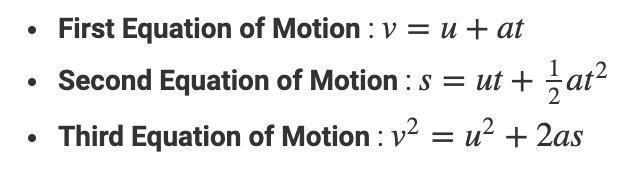
The distance travelled during the given time can be found out by using the equations of motion.

The distance traveled during the time interval is "13810.8 m".

First, we will find the deceleration of the motorcycle by using the first <em>equation of motion</em>:

v_f=v_it+at\\\\

where,

vi = initial velocity = (518 km/h)(\frac{1\ h}{3600\ s})(\frac{1000\ m}{1\ km}) = 143.89 m/s

vf = final veocity = 60 % of 143.89 m/s = (0.6)(143.89 m/s) = 86.33 m/s

a = deceleration = ?

t =time interval = 2 min = 120 s

Therefore,

86.33\ m/s = 143.89\ m/s + a(120\ s)\\\\a = \frac{86.33\ m/s - 143.89\ m/s}{120\ s}

a = -0.48 m/s²

Now, we will use the second <em>equation of motion </em>to find out the distance traveled (s):

s = v_it+\frac{1}{2}at^2\\\\s = (143.89\ m/s)(120\ s)+\frac{1}{2}(-0.48\ m/s^2)(120\ s)^2\\\\s = 17266.8\ m - 3456\ m

<u>s = 13810.8 m = 13.81 km</u>

<u />

Learn more about the equations of motion here:

brainly.com/question/20594939?referrer=searchResults

The attached picture shows the equations of motion.

6 0
2 years ago
Other questions:
  • Which energy source is formed when organic matter is trapped underground without exposure to air or moisture?. . A. natural gas.
    8·1 answer
  • If the mass of a material is 45 grams and the volume of the material is 8 cm^3, what would the density of the material be?
    8·1 answer
  • Energy is observed in two basic forms: potential and kinetic. Which of the following correctly matches these forms with a source
    7·1 answer
  • A 0.3 mm long invertebrate larva moves through 20oC water at 1.0 mm/s. You are creating an enlarged physical model of this larva
    10·1 answer
  • A kinesin that is transporting a secretory vesicle uses approximately 80 ATP molecules/s. Each ATP provides a kinesin molecule w
    7·1 answer
  • Levi observed properties of four different waves and recorded observations about each one in his chart. A 2-column table with 4
    12·2 answers
  • A group of students collected the data shown below while attempting to measure the coefficient of static friction (of course, it
    9·1 answer
  • What is the radius of an automobile tire that turns with a period of 0.091 s and has a linear
    5·1 answer
  • A projectile of mass 0.2 kg and an initial velocity of 50 m/s collides with the end of a blade attached to a turbine. The rotati
    5·1 answer
  • Alex has a 100 cm ruler pivoted at the centre. She ties a balloon filled with carbon doxide 16 cm from the pivot The total weigh
    5·1 answer
Add answer
Login
Not registered? Fast signup
Signup
Login Signup
Ask question!