answer.
Ask question
Login Signup
Ask question
All categories
  • English
  • Mathematics
  • Social Studies
  • Business
  • History
  • Health
  • Geography
  • Biology
  • Physics
  • Chemistry
  • Computers and Technology
  • Arts
  • World Languages
  • Spanish
  • French
  • German
  • Advanced Placement (AP)
  • SAT
  • Medicine
  • Law
  • Engineering
Paraphin [41]
2 years ago
6

You and your lab partner are asked to determine the density of an aluminum bar. the mass is known accurately (to four significan

t figures). you use a simple metric ruler to determine its size and calculate the results in
a. your partner uses a precision micrometer and obtains the results in
b. method a (g/cm3 ) method b (g/cm3 ) 2.2 2.703 2.3 2.701 2.7 2.705 2.4 5.811 the accepted density of aluminum is 2.702g/cm3 .
a. calculate the average density for each method. should all the experimental results be included in your calculations? if not, justify and omissions.
b. calculate the percent error for each methodâs average value.
c. which methodâs average value is more precise? which method is more accurate?

Physics
1 answer:
larisa [96]2 years ago
3 0
The given data is tabulated below

Measurement Method A  Method B
--------------------  --------------  --------------
           1                  2.2           2.703
           2                 2.3            2.701
           3                 2.7             2.705
           4                 2.4             5.811

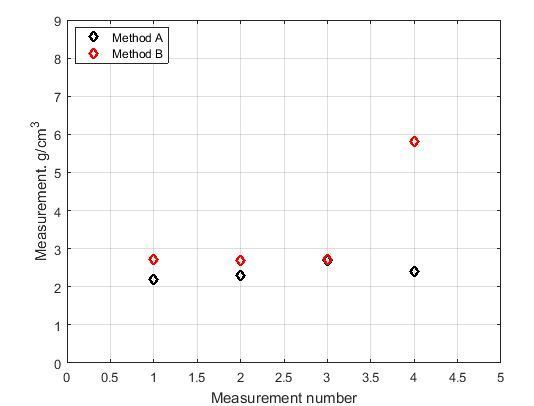
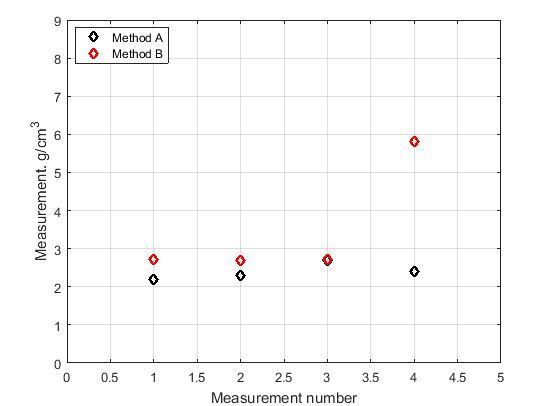
A graph of the data reveals that 5.811 from measurement B is an outlier, and should be rejected.

Part a: Calculate average density.
Method A:
Avg. density = (2.2+2.3+2.7+2.4)/4 = 2.4  g/cm³
Method B:
Avg. density = (2.703+2.701+2.705)/3 = 2.703 g/cm³

Answer:
Average densities are
2.4 g/cm³ by method A
2.703 g/cm³ by method B, with the outlier removed.

Part b: Calculate the percent error.
The true value is 2.702 g/cm³
Method A:
%error = 100*(|2.4 - 2.702|/2.702) = 11.2%
Method B:
%error = 100*(|2.703 - 2.702|/2.702) = 0.04%

Answer:
The percent error is
11.2 by method A,
0.04% by method B.

Part c: 
Method B is more accurate and more precise because its average value is closest to the true value and its %error is extremely small.


You might be interested in
At what time t is the turtle second time a distance of 10.0 cm from its starting point?
skad [1K]

Answer:

10 cm.

Explanation:

5 0
2 years ago
A charge of 4.9 x 10⁻¹¹ C is to be stored on each plate of a parallel-plate capacitor having an area of 150 mm2 and a plate sepa
Triss [41]

Answer:2.53*10^-10F

Explanation:

C=£o£r*A/d

Where £ is the permitivity of a constant

£o= 8.85*10^-12f/m

£r=6.3

A=150mm^2=0.015m^2

d=3.3mm= 0.0033m

C=8.85*10^-12*6.3*0.015/0.0033

C=8.85*6.3*10^-12*0.015/0.0033

C=55.755*0.015^-12/0.003

C=8.36/3.3*10^-13+3

C=2.53*10^-10F

7 0
2 years ago
In ideal flow, a liquid of density 850 kg/m3 moves from a horizontal tube of radius 1.00 cm into a second horizontal tube of rad
Crank

Answer:

a)   Q = π r₁ √ 2ΔP / rho [r₁² / r₂² -1] , b) Q = 3.4 10⁻² m³ / s , c)      Q = 4.8 10⁻² m³ / s

Explanation:

We can solve this fluid problem with Bernoulli's equation.

         P₁ + ½ ρ v₁² + ρ g y₁ = P₂ + ½ ρ v₂² + ρ g y₂

With the two tubes they are at the same height y₁ = y₂

        P₁-P₂ = ½ ρ (v₂² - v₁²)

The flow rate is given by

         A₁ v₁ = A₂ v₂

         v₂ = v₁ A₁ / A₂

We replace

         ΔP = ½ ρ [(v₁ A₁ / A₂)² - v₁²]

         ΔP = ½ ρ v₁² [(A₁ / A₂)² -1]

Let's clear the speed

         v₁ = √ 2ΔP /ρ[(A₁ / A₂)² -1]

The expression for the flow is

           Q = A v

           Q = A₁ v₁

           Q = A₁ √ 2ΔP / rho [(A₁ / A₂)² -1]

The areas are

            A₁ = π r₁

            A₂ = π r₂

We replace

        Q = π r₁ √ 2ΔP / rho [r₁² / r₂² -1]

Let's calculate for the different pressures

      r₁ = d₁ / 2 = 1.00 / 2

      r₁ = 0.500 10⁻² m

      r₂ = 0.250 10⁻² m

b) ΔP = 6.00 kPa = 6 10³ Pa

      Q = π 0.5 10⁻² √(2 6.00 10³ / (850 (0.5² / 0.25² -1))

       Q = 1.57 10⁻² √(12 10³/2550)

        Q = 3.4 10⁻² m³ / s

c) ΔP = 12 10³ Pa

        Q = 1.57 10⁻² √(2 12 10³ / (850 3)

         Q = 4.8 10⁻² m³ / s

5 0
2 years ago
This means that the speed at which the bullet travels across Earth's surface (its magnitude of horizontal velocity) does not aff
Dmitry_Shevchenko [17]

Answer: the speed at which it falls toward the Earth.


Explanation:


A bullet travelling across Earth's surface with some horizontal velocity is classical example of projectile motion.


Projectile motion is an idealization of the motion under the action of gravity neglecting the influence of the air (no drag force nor friction).


This  kind of motion is the result of two independent motions: vertical motion and horizontal motion.


The observed net velocity is the vectorial sum of the vertical and horizontal velocities.


The horizontal velocity is constant, since there is not any force acting in the horizontal axis. Thi is, the object, following the first Law of Newton (inertia law) tends to continue in uniform rectilinear movement (with zero acceleration).


The vertical velocity, this is the velocity at which the bullet falls toward the Earth, is influenced (accelerated) by the action of the gravity of the Earth. So, the vertical velocity is accelerated by the pull of the Earth.


Vertical and horizontal velocities are independent of each other, which means that the speed or the magnitude of the horizontal velocity does not affect the speed at which an object (the bullet) falls toward the Earth.

6 0
2 years ago
A 4.00-kg box sits atop a 10.0-kg box on a horizontal table. The coefficient of kinetic friction between the two boxes and betwe
natta225 [31]
First, we have to calculate the normal forces on different surfaces.The normal force on the 4.00 kg, N1 = (4)(9.8) = 39.2 N. The normal force on the 10.0 kg, N2 = (14)(9.8) = 137.2 N. Looking at the 10.0 kg block, the static forces that counteract the pulling force equals the sum of the friction from the two surfaces. Fc = N1 * 0.80 + N2 * 0.80 = 141.12 N. Since the counter force is less than the pulling force, the blocks start to move and hence, kinetic frictions are considered.


Therefore, f1 = uk * N1 = (0.60)(39.2) = 23.52 N.
4 0
2 years ago
Other questions:
  • A tall cylinder contains 30 cm of water. oil is carefully poured into the cylinder, where it floats on top of the water, until t
    8·2 answers
  • somewhere between the earth and the moon is a point where the gravitational attraction of the earth is canceled by the gravitati
    14·1 answer
  • What do fuel cells, batteries and, solar cells have in common A.the all produce static electricity B. they are all sources of di
    6·2 answers
  • The electric field at a point 2.8 cm from a small object points toward the object with a strength of 180,000 N/C. What is the ob
    8·1 answer
  • Diffraction spreading for a flashlight is insignificant compared with other limitations in its optics, such as spherical aberrat
    7·1 answer
  • A water wave traveling in a straight line on a lake is described by the equation:y(x,t)=(2.75cm)cos(0.410rad/cm x+6.20rad/s t)Wh
    11·1 answer
  • Quickly spinning the handle of a hand generator, Kristina is able to light three bulbs in a circuit. When she spins the generato
    11·1 answer
  • A stationary boat in the ocean is experiencing waves from a storm. The waves move at 59 km/h and have a wavelength of 145 m . Th
    15·1 answer
  • Natalia is studying a wave produced in her magnetics lab. This wave can move through the empty space in a vacuum and carries a l
    6·2 answers
  • 11. Scientists put a sample of water into a sealed tank. Water can be a solid, liquid, or gas. At first, the water was a liquid.
    5·1 answer
Add answer
Login
Not registered? Fast signup
Signup
Login Signup
Ask question!