answer.
Ask question
Login Signup
Ask question
All categories
  • English
  • Mathematics
  • Social Studies
  • Business
  • History
  • Health
  • Geography
  • Biology
  • Physics
  • Chemistry
  • Computers and Technology
  • Arts
  • World Languages
  • Spanish
  • French
  • German
  • Advanced Placement (AP)
  • SAT
  • Medicine
  • Law
  • Engineering
Mice21 [21]
2 years ago
7

An element is a main constituent of paper, diamond and clothes etc. It forms covalent bonds with itself and other elements:- (1)

identify the element (2) write the electron dot structure of its oxide. (3) draw the electron dot structure of methane and ethene.

Chemistry
2 answers:
melomori [17]2 years ago
7 0

Explanation:

1) The main constituting element in paper , diamond  and cloths is carbon atom.This because carbon atom has unique property of creating strong covalent bonds with other carbon atoms which give rises to complex organic  structures.

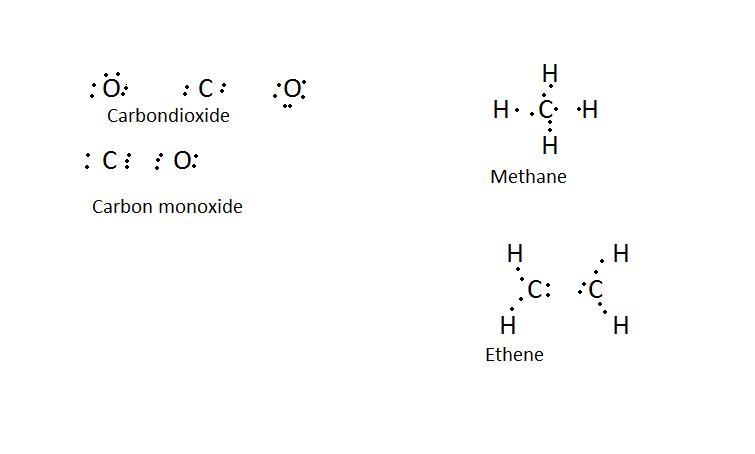
2) There two oxides formed by carbon which are : carbon-dioxide CO_2and carbon monoxide CO.

Structure are given in an image.

3) In molecule of methane there is a 1 mol of carbon.

Methane = CH_4

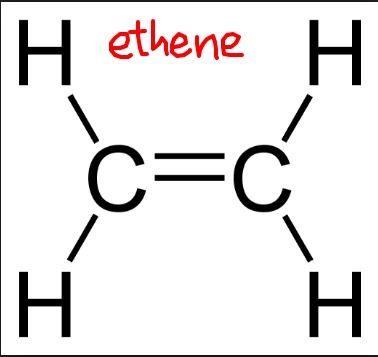
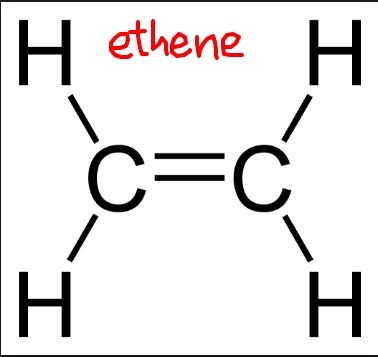
In 1 molecule of ethene there are two carbon atom double bonded to each other.

Ethene = C_2H_4

Electron dot structure of methane and ethene are given in an image

Dovator [93]2 years ago
6 0

Answer 1) Carbon - It is the element which is the main constituent of the paper in the form of cellulose, diamond is made of completely carbon and clothes are mostly made from carbon based fibers. Also, it forms covalent bonds with itself and other elements too because it has 4 valence electrons in its valence shell so, it can either donate or accept electrons to attain a stable octet state.


Answer 2) The electron dot structure of the oxides of carbon are of two types;

i) CO and ii) CO_{2}


The images are attached for the electron dot structures.


Answer 3) The structure of methane and ethene is attached in the image.

You might be interested in
What is the boiling point of cyclohexane at 620 mm hg?
Alchen [17]

The right answer is 271.78 degrees for cyclohexane.

For each liquid there is a precise relationship between pressure and boiling temperature, we can define the boiling temperature as the moment when the first bubble of vapor appears on the surface of a liquid.

8 0
2 years ago
A 100.0 ml sample of 0.18 m hclo4 is titrated with 0.27 m lioh. determine the ph of the solution after the addition of 30.0 ml o
gizmo_the_mogwai [7]
From the molarity and volume of HClO4, we can determine how many moles of H+ we initially have: 
     0.18 M HClO4 * 0.100 L HClO4 = 0.018 moles H+

We can determine how many moles of OH- we have from the molarity and volume of LiOH:
     0.27 M LiOH * 0.030 L LiOH = 0.0081 moles OH-

When the HClO4 and LiOH neutralize each other, the remaining will be
     0.018 moles H+ - 0.0081 moles OH- = 0.0099 moles of excess H+

This means that the molarity [H+] will be
     [H+] = 0.0099 moles H+ / (0.100 L + 0.030 L) = 0.07615 M

The pH of the solution will therefore be
     pH = -log [H+] = -log 0.07615 = 1.12
6 0
2 years ago
Read 2 more answers
Valproic acid, used to treat seizures and bipolar disorder, is composed of C, H, and O. A 0.165-g sample is combusted to produce
sergeinik [125]

Answer:

The empirical formula is = C_4H_8O

The formula of Valproic acid = C_8H_{16}O_2

Explanation:

Mass of water obtained = 0.166 g

Molar mass of water = 18 g/mol

Moles of H_2O = 0.166 g /18 g/mol = 0.00922 moles

2 moles of hydrogen atoms are present in 1 mole of water. So,

<u>Moles of H = 2 x 0.00922 = 0.01844 moles </u>

Molar mass of H atom = 1.008 g/mol

<u>Mass of H in molecule = 0.01844 x 1.008 = 0.018588 g </u>

Mass of carbon dioxide obtained = 0.403 g

Molar mass of carbon dioxide = 44.01 g/mol

Moles of CO_2 = 0.403 g  /44.01 g/mol = 0.009157 moles

1 mole of carbon atoms are present in 1 mole of carbon dioxide. So,

<u>Moles of C = 0.009157 moles </u>

Molar mass of C atom = 12.0107 g/mol

<u>Mass of C in molecule = 0.009157 x 12.0107 = 0.11 g </u>

<u>Given that the Valproic acid only contains hydrogen, oxygen and carbon. </u>So,

Mass of O in the sample = Total mass - Mass of C  - Mass of H

Mass of the sample = 0.165 g

<u>Mass of O in sample = 0.165 - 0.11 - 0.018588 = 0.036412 g  </u>

Molar mass of O = 15.999 g/mol

<u>Moles of O  = 0.036412  / 15.999  = 0.002276 moles</u>

<u></u>

<u>Taking the simplest ratio for H, O and C as: </u>

<u>0.01844 : 0.002276 : 0.009157</u>

<u> = 8 : 1 : 4</u>

The empirical formula is = C_4H_8O

Molecular formulas is the actual number of atoms of each element in the compound while empirical formulas is the simplest or reduced ratio of the elements in the compound.

Thus,  

Molecular mass = n × Empirical mass

Where, n is any positive number from 1, 2, 3...

Mass from the Empirical formula = 4×12 + 8×1 + 16= 72 g/mol

Molar mass = 144 g/mol

So,  

Molecular mass = n × Empirical mass

144 = n × 72

<u>⇒ n = 2</u>

The formula of Valproic acid = C_8H_{16}O_2

7 0
2 years ago
Zinc sulfide reacts with oxygen according to the reaction 2ZnS(s)+3O2(g)→2ZnO(s)+2SO2(g) A reaction mixture initially contains 5
LenKa [72]

Answer:

The answer to your question is: Excess oxygen = 2.3 mol

Explanation:

Data

ZnS = 5 mol

O2 = 9.8 mol

Excess reactant = ?

Balanced reaction

                                 2ZnS(s) + 3O2(g) → 2ZnO(s) + 2SO2(g)

MW ZnS = 65 + 32 = 97 x 2 = 194 g

MW O2 = 16 x  6 = 96 g

                           2 mol of ZnS  ------------------- 3 mol O2


Ratio from the reaction = 3 mol O2/ 2 mol ZnS

                                      = 1.5

Ratio from the quantities in the experiment = 9.8 mol O2 / 5 mol of ZnS

                                                                        = 1.96

Excess reactant = Oxygen because the ratio increases


                                2 mol of ZnS  ------------------- 3 mol O2

                                5 mol of ZnS  -------------------  x

                                x = (5 x 3) / 2

                               x = 7.5 mol of O2

Excess Oxygen = 9.8 mol - 7.5 mol

Excess oxygen = 2.3 mol

4 0
2 years ago
A sample of 0.300 mg pure chromium was added to excess hydrochloric acid to form a 10.0 mL aqueous solution of a chromium (III)
DerKrebs [107]

extinction coefficient (ε) = 347 L·mol⁻¹·cm⁻¹

Explanation:

The chemical reaction between chromium (Cr) and hydrochloric acid (HCl):

2 Cr + 6 HCl → 2 CrCl₃ + 3 H₂

number of moles = mass / molar weight

number of moles of Cr = 0.3 × 10⁻³ (g) / 52 (g/mole)

number of moles of Cr = 5.77 × 10⁻⁶ moles

From the chemical reaction we see that 2 moles of Cr will produce 2 moles of CrCl₃ so 5.77 × 10⁻⁶ moles of Cr will produce 5.77 × 10⁻⁶ moles of CrCl₃.

molar concentration = number of moles / volume (L)

molar concentration of CrCl₃ = 5.77 × 10⁻⁶ / 10 × 10⁻³

molar concentration of CrCl₃ = 5.77 × 10⁻⁴ moles / L

Now we need to transform percent transmittance (%T) in absorbance (A) using the following formula:

A = 2 - log (%T)

A = 2 - log (62.5)

A = 2 - 1.8

A = 0.2

We know that absorbance (A) is defined in respect with extinction coefficient (ε), cell length (l) and concentration (c):

A = εlc

ε = A / lc

ε = 0.2 / (1 × 5.77 × 10⁻⁴)

ε = 0.0347 × 10⁴

ε = 347 L·mol⁻¹·cm⁻¹

Learn more about:

molar concentration

brainly.com/question/13971392

#learnwithBrainly

7 0
2 years ago
Other questions:
  • A gas can holds 2.9 gal of gasoline.<br><br><br> What is this quantity in cubic centimeters?
    5·1 answer
  • Based on the crystal-field strengths cl- &lt; f- &lt; h2o &lt; nh3 &lt; h2nc2h4nh2, which octahedral ti (iii) complex below has
    9·1 answer
  • 4.8g of calcium is added to 3.6g of water. The following reaction occurs
    8·1 answer
  • Which of the following statements about monosaccharide structure is true?
    7·1 answer
  • The values used in the scale of pH and pOH are derived from a system designed by ______. Gordonsen Sorenson Curie Dalton
    10·1 answer
  • A sample of pure NO2 is heated to 337?C at which temperature it partially dissociates according to the equation2NO2(g)?2NO(g)+O2
    15·1 answer
  • Oil is a fossil fuel used to run cars, heat up homes, and produce electricity. Oil can be removed from the bottom of the ocean t
    7·3 answers
  • 1.05 Quiz: Measure Angles
    13·2 answers
  • A higher temperature of fresh concrete results in a __________ hydration of cement.
    11·1 answer
  • A gas mixture contains HBr, NO2, and C2H6 at STP. If a tiny hole is made in the container, which gas will effuse fastest? NO2 C2
    12·1 answer
Add answer
Login
Not registered? Fast signup
Signup
Login Signup
Ask question!