answer.
Ask question
Login Signup
Ask question
All categories
  • English
  • Mathematics
  • Social Studies
  • Business
  • History
  • Health
  • Geography
  • Biology
  • Physics
  • Chemistry
  • Computers and Technology
  • Arts
  • World Languages
  • Spanish
  • French
  • German
  • Advanced Placement (AP)
  • SAT
  • Medicine
  • Law
  • Engineering
Bas_tet [7]
2 years ago
12

Write a chemical equation representing the first ionization energy for lithium. use e− as the symbol for an electron.

Chemistry
2 answers:
horsena [70]2 years ago
7 0

\boxed{{\text{Li}} \to {\text{L}}{{\text{i}}^ + } + {{\text{e}}^ - }} is the chemical equation that represents the first ionization energy of lithium.

Further Explanation:

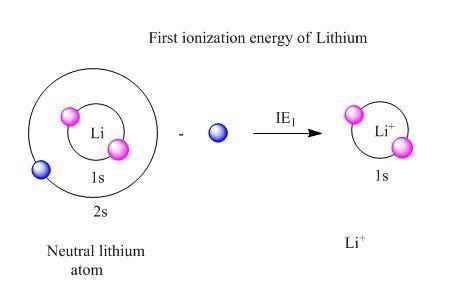
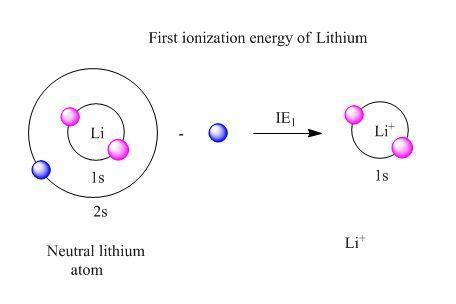
Ionization energy is the amount of energy that is required to remove the most loosely bound valence electrons from the isolated neutral gaseous atom. It is denoted by IE. The value of IE is related to the ease of removing the outermost valence electrons. If these electrons are removed so easily, small ionization energy is required and vice-versa. It is inversely proportional to the size of the atom.

Ionization energy is further represented as first ionization, second ionization and so on. When the first electron is removed from a neutral, isolated gaseous atom, the energy needed for the purpose is known as the first ionization energy, written as  {\text{I}}{{\text{E}}_{\text{1}}}. Similarly, when the second electron is removed from the positively charged species (cation), the ionization energy is called the second ionization energy \left( {{\text{I}}{{\text{E}}_2}} \right) and so on.

The atomic number of lithium is 3. So its electronic configuration is 1{s^2}2{s^1}. Its outermost electron is present in 2<em>s</em> orbital. The amount of energy required to remove this electron of lithium atom is known as the first ionization energy of lithium.

The equation that represents the first ionization of lithium is {\text{Li}} \to {\text{L}}{{\text{i}}^ + } + {{\text{e}}^ - }.

Learn more:

1. The subatomic particle with the least mass: brainly.com/question/2224691

2. Number of carbon atoms in 1.3-carat diamond: brainly.com/question/4235993

Answer details:

Grade: Senior School

Subject: Chemistry

Chapter: Periodic classification of elements

Keywords: first ionization energy, lithium, electronic configuration, atomic number, electron, neutral, isolated, gaseous atom, IE1., equation, size of the atom.

just olya [345]2 years ago
4 0

The chemical equation representing the first ionization energy for lithium is given by;

Li → Li + e-

<h2>Further Explanation; </h2><h3>Ionization energy</h3>
  • Ionization energy is the energy required to remove outermost electrons from the outermost energy level. Energy is required to remove an electron from an atom.
  • The closer an electron is to the nucleus the more energy is required, since the electron is more tightly bound to the atom thus making it more difficult to remove, hence higher ionization energy.
  • Ionization energy increases across the periods and decreases down the group from top to bottom.  
  • Additionally, the ionization energy increases with subsequent removal of a second or a third electron.
<h3>First ionization energy  </h3>
  • This is the energy required to remove the first electron from the outermost energy level of an atom.
  • Energy needed to remove the second electron to form a divalent cation is called the second ionization energy.
<h3>Trends in ionization energy  </h3><h3>1. Down the group(top to bottom)</h3>
  • Ionization energy decreases down the groups in the periodic table from top to bottom.
  • It is because as you move down the group the number of energy levels increases making the outermost electrons get further from the nucleus reducing the strength of attraction to the nucleus.
  • This means less energy will be required compared to an atoms of elements at the top of the groups.
<h3>2. Across the period  (left to right)</h3>
  • Ionization energy increases across the period from left to right.
  • This can be explained by an increase in nuclear energy as extra protons are added to the nucleus across the period increasing the strength of attraction of electrons to the nucleus.
  • Consequently, more energy is needed to remove electrons from the nucleus.

Keywords: Ionization energy, periodic table, energy levels, electrons

<h3>Learn more about</h3>
  • Ionization energy: brainly.com/question/1971327
  • Trend in ionization energy: brainly.com/question/1971327
  • First ionization energy: brainly.com/question/1971327

Level: High school  

Subject: Chemistry  

Topic: Periodic table and chemical families  

Sub-topic: Ionization energy

You might be interested in
How much 2 M HBr is needed to neutralize 380 mL of 0.1 M NH4OH?
Nata [24]

Answer:

19ml

Explanation:

trust me

8 0
2 years ago
For each of the following substituents, indicate whether it withdraws electrons inductively, donates electrons by hyperconjugati
AveGali [126]

Answer:

a. withdraws electrons inductively

b. donates electrons by hyperconjugation

c. donates electrons by resonance

d.  withdraws electrons inductively

Explanation:

a.  The bromide ion is a highly electronegative ion (in the halide series). Electronegative substituents on acids increase the acidity by inductive electron withdrawal method. The higher the electronegativity of a substance, the greater the acidity. The halogens have this order of electronegativity:

F > Cl > Br>I

b.  The carboxyl groups have a stabilization of the sigma and pi bonds. This is achieved through a special delocalization of electrons.  Because of the delocalization, hyperconjugation is the result effect.

c. The NHCH₃ group has a highly electonegative nitrogen atom that pulls the electron cloud towards itself. In this case, it withdraws electrons inductively. As a result, it donates electrons by resonance.

d. The OCH₃ group has a highly electonegative oxygen atom. This oxygen atom withdraws electron cloud towards itself. As a result, it withdraws electrons inductively.

3 0
2 years ago
We have an object with a density of 620 g/ cm3 and a volume of 75 cm3. What is the mass of this object?
Anna11 [10]
M=D*V
D=620 g/cm³
V=75 cm³

m= 620 g/cm³ * 75 cm³=46500 g
m=46500g
8 0
2 years ago
At 800 K, the equilibrium constant, Kp, for the following reaction is 3.2 × 10⁻⁷. 2 H2S(g) ⇌ 2 H2(g) + S2(g) A reaction vessel a
djverab [1.8K]

Answer:

0.008945 atm

Explanation:

In the reaction:

2H2S(g) ⇌ 2 H2(g) + S2(g)

Kp is defined as:

Kp = P_{H_{2}}^2P_{S_{2}} / P_{H_{2}S}^2

<em>Where P is the pressure of each compound in equilibrium.</em>

If initial pressure of H2S is 3.00atm, concentrations in equilibrium are:

H2S = 3.00 atm - 2X

H2 = 2X

S2: = X

Replacing:

3.2x10^{-7} = (2X)^2X / (3-2X)^2

3.2x10^{-7} = 4X^3 / 9- 6X+4X^2

0 = 4X³ - 1.28x10⁻⁶X² + 1.92x10⁻⁶X - 2.88x10⁻⁶

Solving for X:

X = 0.008945 atm

As in equilibrium, pressure of S2 is X, <em>pressure is 0.008945 atm</em>

7 0
2 years ago
In a group assignment, students are required to fill 10 beakers with 0.720 M CaCl2. If the molar mass of CaCl2 is 110.98 g/mol a
8_murik_8 [283]
The answer is 200 g.

If the molar mass of CaCl2 is 110.98 g/mol, this means there are 110.98 g in 1 L of 1 M solution.
Let's find how many g of CaCl2 are present in 0.720 M.
110.98 g : 1 M = x : 0.720 M
x = 110.98 g * 0.720 M : 1 M 
x = 79.90 g

So there are 79.90 g in 0.720 M. In other words, in 1 L of 0.720 M solution there will be  79.90 g.

Now, we need to prepare ten beakers with 250 mL of solutions:
10 * 250 mL = 2500 mL = 2.5 L

79.90 g : 1 L = x : 2.5 L
x = 79.90 g * 2.5 L : 1 L
x = 199.75 g ≈ 200 g
8 0
2 years ago
Read 2 more answers
Other questions:
  • Consider a triprotic acid like phosphoric acid or citric acid. which expression correctly describes the relative magnitudes of t
    11·1 answer
  • In the compound k[co(c2o4)2(h2o)2] (where c2o42– = oxalate) the oxidation number and coordination number of cobalt are, respecti
    8·2 answers
  • Current of 250. a flows for 24.0 hours at an anode where the reaction occurring is as follows: mn2+(aq) + 2h2o(l) → mno2(s) + 4h
    8·2 answers
  • Reaction 1: c3h8(g)+5o2(g)→3co2(g)+4h2o(g), δh1=−2043 kj reaction 2: 6c3h8(g)+30o2(g)→18co2(g)+24h2o(g), δh2=?
    10·2 answers
  • Hydrogen gas reacts rapidly with oxygen gas in the presence of a platinum catalyst. Which equation correctly represents this
    13·2 answers
  • At 298 K and 1 atm, bromine is a liquid with a high vapor pressure, whereas chlorine is a gas. This provides evidence that, unde
    13·1 answer
  • A 1.80 g sample of barium chloride hydrate, BaCl2 ⋅ xH2O is treated with excess sulfuric acid, forming a BaSO4 precipitate which
    6·2 answers
  • For maleic acid, hoocch=chcooh, ka1 = 1.42  10–2 and ka2 = 8.57  10–7 . what is the concentration of maleate ion (–oocch=chcoo
    12·2 answers
  • Identify the true statements regarding alpha-1,6 linkages in glycogen.
    11·1 answer
  • Lisa’s book measures 40 cm x 10 cm x 2 cm. What is the volume of her book
    7·2 answers
Add answer
Login
Not registered? Fast signup
Signup
Login Signup
Ask question!