answer.
Ask question
Login Signup
Ask question
All categories
  • English
  • Mathematics
  • Social Studies
  • Business
  • History
  • Health
  • Geography
  • Biology
  • Physics
  • Chemistry
  • Computers and Technology
  • Arts
  • World Languages
  • Spanish
  • French
  • German
  • Advanced Placement (AP)
  • SAT
  • Medicine
  • Law
  • Engineering
Olin [163]
2 years ago
3

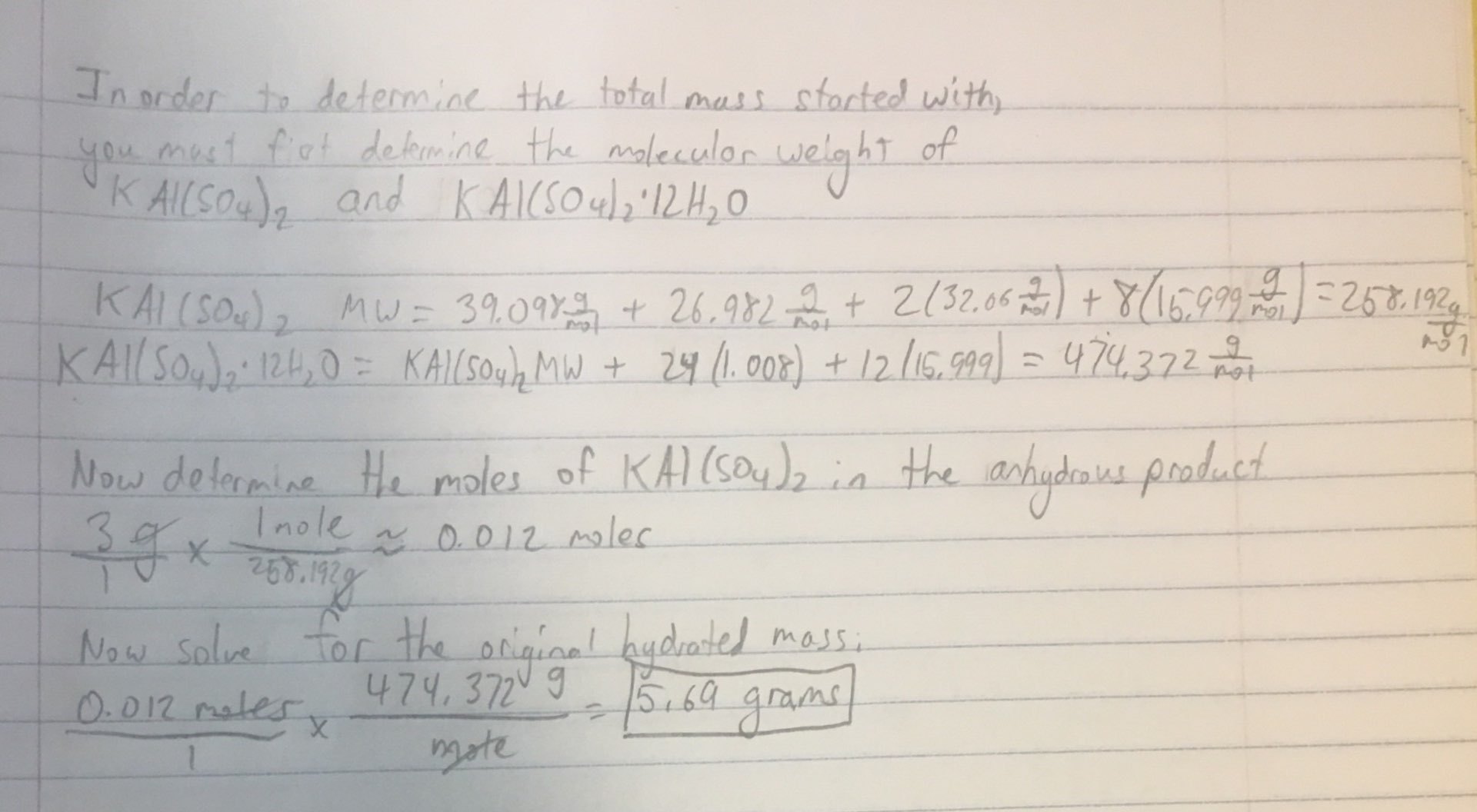
Suppose Harry begins with the hydrate KAl(SO4)2·12H2O. After dehydration he finds that he is left with 3.0 g of the an-hydrate K

Al(SO4)2. How many grams did he start with?

Chemistry
2 answers:
worty [1.4K]2 years ago
5 0
I provided an explanation in the image.

nadezda [96]2 years ago
3 0

Harry started with \boxed{{\text{5}}{\text{.5 grams}}} of  {\text{KAl}}{\left( {{\text{S}}{{\text{O}}_{\text{4}}}} \right)_{\text{2}}} \cdot{\text{12}}{{\text{H}}_{\text{2}}}{\text{O}} hydrated salt.

Further explanation:

Mole is the measure of the amount of substance. Mole is the relation between the mass of the substance and molar mass of a substance. It is defined as the mass of a substance in grams divided by its molar mass (g/mol).

The expression to calculate the number of moles is as follows:

{\text{Number of moles}}\;=\;\dfrac{{{\text{Given mass}}\left({\text{g}}\right)}}{{{\text{molar mass}}\left({{\text{g/mol}}}\right)}}

Therefore, the formula to calculate the mass of the given compound is,

{\text{Mass}}\left({\text{g}} \right)=\left({{\text{Number of moles}}}\right)\left( {{\text{molar mass}}\left({{\text{g/mol}}}\right)}\right)

The molar mass of  {\text{KAl}}{\left( {{\text{S}}{{\text{O}}_{\text{4}}}} \right)_{\text{2}}} \cdot{\text{12}}{{\text{H}}_{\text{2}}}{\text{O}} is 474.3884g/mol.

The molar mass of  {\text{KAl}}{\left({{\text{S}}{{\text{O}}_{\text{4}}}}\right)_{\text{2}}} is 258.2050 g/mol.

Therefore, mass of 12{{\text{H}}_2}{\text{O}}  molecules is,

\begin{aligned}{\text{Mass}}\left( {\text{g}} \right)&={\text{Moles}}\times{\text{molar mass of }{{\text{H}}_2}{\text{O}}\\&=12{\text{ mol }}\times 18{\text{ g/mol }}\\&=216{\text{ g}}\\\end{aligned}

Since initially in {\text{KAl}}{\left( {{\text{S}}{{\text{O}}_{\text{4}}}} \right)_{\text{2}}} \cdot{\text{12}}{{\text{H}}_{\text{2}}}{\text{O}} , 1 mole of   {\text{KAl}}{\left({{\text{S}}{{\text{O}}_{\text{4}}}}\right)_{\text{2}}} contained 12 moles of {{\text{H}}_2}{\text{O}} . Thus 258.2050 g of {\text{KAl}}{\left({{\text{S}}{{\text{O}}_{\text{4}}}}\right)_{\text{2}}} should contains 216 g of {{\text{H}}_2}{\text{O}} before evaporation.

Therefore, the mass of {{\text{H}}_2}{\text{O}} contained by 1 g of   {\text{KAl}}{\left({{\text{S}}{{\text{O}}_{\text{4}}}}\right)_{\text{2}}} is calculated as,

{\text{Mass}}\left({\text{g}}\right){\text{ of }}{{\text{H}}_2}{\text{O in 1 g of KAl}}{\left( {{\text{S}}{{\text{O}}_{\text{4}}}} \right)_{\text{2}}}{\text{ }}=\dfrac{{{\text{216 g of }}{{\text{H}}_2}{\text{O}}}}{{258.2050{\text{ g of KAl}}{{\left({{\text{S}}{{\text{O}}_{\text{4}}}} \right)}_{\text{2}}}}}

Therefore, the mass of {{\text{H}}_2}{\text{O}} contained by 3.0 g of   {\text{KAl}}{\left({{\text{S}}{{\text{O}}_{\text{4}}}}\right)_{\text{2}}} is calculated as follows:

\begin{aligned}{\text{Mass}}\left({\text{g}} \right){\text{ of }}{{\text{H}}_2}{\text{O in 3 g of KAl}}{\left({{\text{S}}{{\text{O}}_{\text{4}}}}\right)_{\text{2}}}&=\dfrac{{{\text{216 g of }}{{\text{H}}_2}{\text{O}}}}{{258.2050{\text{ g of KAl}}{{\left( {{\text{S}}{{\text{O}}_{\text{4}}}}\right)}_{\text{2}}}}}\times 3{\text{ g of KAl}}{\left({{\text{S}}{{\text{O}}_{\text{4}}}}\right)_{\text{2}}}\\&=2.50{\text{ g }}\\\end{aligned}

This 2.5 g is the mass of water that is evaporated from hydrated salt.

The total mass of hydrated of {\text{KAl}}{\left( {{\text{S}}{{\text{O}}_{\text{4}}}} \right)_{\text{2}}} \cdot{\text{12}}{{\text{H}}_{\text{2}}}{\text{O}} taken initially by harry is the sum of the mass of water that is evaporated and mass of dehydrated salt that is left after evaporation process.

\begin{aligned}{\text{Total mass of hydrated salt}}&={{\text{m}}_{{\text{KAl}}{{\left( {{\text{S}}{{\text{O}}_{\text{4}}}}\right)}_{\text{2}}}}}+{{\text{m}}_{{{\text{H}}_2}{\text{O evaporated}}}}\\&=3.0{\text{ g}}+{\text{2}}{\text{.5 g}}\\&=5.5{\text{ g }}\\\end{aligned}

Learn more:

1. Determine the number grams of solute in 500 ml of 0.189 M KOH.: brainly.com/question/2847466

2. Rank the gases in decreasing order of effusion:brainly.com/question/1946297

Answer details:

Grade: Senior school

Subject: Chemistry

Chapter: Mole concept

Keywords: harry, hydrate salt, KAl(SO4)2•12H2O, dehydration process, hydration process, anhydrated salt, KAl(SO4)2, 3.0 gram KAl(SO4)2, grams of start with, 5.5 g.
You might be interested in
SEP Use Models Why does the number of electrons in each principal energy shell increase as the number of the shell increases?
zlopas [31]

Answer:

See explanation

Explanation:

The number of electrons in each principal energy shell increases as the number of shells increases because more electronic orbitals become available to accommodate the electrons.

For instance, the n= 2 level only accommodates eight electrons in the s and p orbitals whereas the n=3 level accommodates 18 electrons in s, p and d orbitals respectively.

Each principal level accommodates 2n^2 electrons where n= the principal energy shell.

4 0
1 year ago
3. In what grade level do students grow the quickest?
Vadim26 [7]

Answer:

Independent Variable: Grade Level

Dependent Variable: Growth in height

Hypothesis: Students in [Insert the grade level you believe will grow the quickest here] will experience the quickest growth in height.

Explanation:

Independent variables are the factors in which you manipulate to gain your results, in this case you would be changing the grade level you would observe to see the height.

Dependent variables are the factors that respond to changes in the independent variables. You don't control these events, you simply observe them. In this case, you merely observe the growth in height in accordance to the different grade levels you observe.

For the hypothesis, you would create your own hypothesis based on a guess you have. You create a hypothesis not based on the data, but on what you believe will be correct before doing the experiment. It doesn't have to be the correct answer, but just your thoughts.

3 0
2 years ago
What mass of 2-bromopropane could be prepared from 25.5 g of propene? Assume a 100% yield of product.
Mamont248 [21]

Answer:

78.46 grams of  2-bromopropane could be prepared from 25.5 g of propene

Explanation:

C_3H_6+HBr\rightarrow C_3H_7Br

Moles of propene = \frac{25.5 g}{39 g/mol}=0.6538 mol

According to reaction, 1 mole of propene gives 1 mole of propane.

Then 0.6538 moles of bromo-propane will give:

0.6538 mol\times 120 g/mol=78.46 g

78.46 grams of  2-bromopropane could be prepared from 25.5 g of propene.

5 0
2 years ago
How can there be more than 1000 different atoms when there are only about 100 different elements?
LekaFEV [45]
Actually, there are only about 100 atoms that have been yet discovered. But each element has many different kinds of atom. For instance, carbon. Do you know carbon has more than 30 or 50 different types of atoms? Well, how? There are isotopes. Don't think that there is only one carbon atom which has 6 electrons and 6 protons and 6 neutrons. There are more. C-13 has 6 electrons and 6 protons and 7 neutrons. While, C-14 has 6 electrons and 6 protons and 8 neutrons. I just showed you three stable isotopes of carbon(element). But, what is really an isotope?? Did you notice that all of these atoms had the same number of protons and electron but different numbers of neutrons? This is really an isotope. Well, if an atom takes a few more electrons or gives off a few electrons, it still stays the same element/ atom type. Just like that an element can have atoms of different neutron number. It may be less or more. It doesn't affect the atom much: just makes an isotope. But it does affect the atomic mass number or radioactivity of an atom. So, an element can have many different forms of isotopes of its atoms. In this way, being only 100 atoms, there can 1000 atoms or (more than that!). 

To make it more clear-

Definition of ISOTOPE: <span>any of two or more forms of a </span>chemical<span> element, having the same number of protons and electrons in the nucleus, or the same atomic number, but having different numbers of neutrons</span>

HOPE YOU UNDERSTOOD THE MATTER:-))


8 0
2 years ago
Read 2 more answers
A buffer is prepared by mixing hypochlorous acid ( HClO ) and sodium hypochlorite ( NaClO ) . If a strong base, such as NaOH , i
Dafna1 [17]

<u>Answer:</u> The balanced chemical equation is written below.

<u>Explanation:</u>

We are given:

A weak acid that is hypochlorous acid (HClO) and basic salt that is sodium hypochlorite (NaClO)

When a strong base is added to the buffer, the hydroxide ion will be neutralized by hydrogen ions from the acid.

So, the buffer component that neutralizes the additional hydroxide ions in the solution is HClO

The chemical equation for the neutralization of hydroxide ion with acid follows:

HClO+OH^-\rightarrow H_2O+ClO^-

Hence, the balanced chemical equation is written below.

4 0
2 years ago
Other questions:
  • Here is a sketch of a 2px orbital: This sketch is about 800pm wide. The coordinate ( x , y , and z ) axes are also shown. You ca
    15·1 answer
  • how many moles of hydrogen are evolved when an excess of sodium metal is added to one mole of citric acid?
    7·1 answer
  • What reaction is depicted by the given equation: Au3+ + 3e− Au
    14·2 answers
  • Within a substance, atoms that collide frequently and move independently of one another are most likely in which state of matter
    15·1 answer
  • Hbr addition to an alkene is a ch221 reaction with which you should be familiar. when peroxides are present, one regioisomer is
    5·1 answer
  • When the reaction mixture is worked-up, it is first washed three times with 5% sodium bicarbonate, and then with a saturated nac
    7·1 answer
  • An allergy medicine is usually stored in a cabinet at the room temperature where it’s molecules move around each other. By mista
    12·1 answer
  • What mass of solid NaOH (97.0 % by mass) is required to prepare 1.00 L of a 10.0% solution of NaOH by mass? The density of the 1
    10·1 answer
  • Consider a mystery compound having the formula MxTy. If the compound is not an acid, if it contains only two elements, and if M
    15·2 answers
  • A student wants to reclaim the iron from an 18.0-gram sample of iron(III) oxide, which
    10·2 answers
Add answer
Login
Not registered? Fast signup
Signup
Login Signup
Ask question!
