answer.
Ask question
Login Signup
Ask question
All categories
  • English
  • Mathematics
  • Social Studies
  • Business
  • History
  • Health
  • Geography
  • Biology
  • Physics
  • Chemistry
  • Computers and Technology
  • Arts
  • World Languages
  • Spanish
  • French
  • German
  • Advanced Placement (AP)
  • SAT
  • Medicine
  • Law
  • Engineering
sdas [7]
2 years ago
13

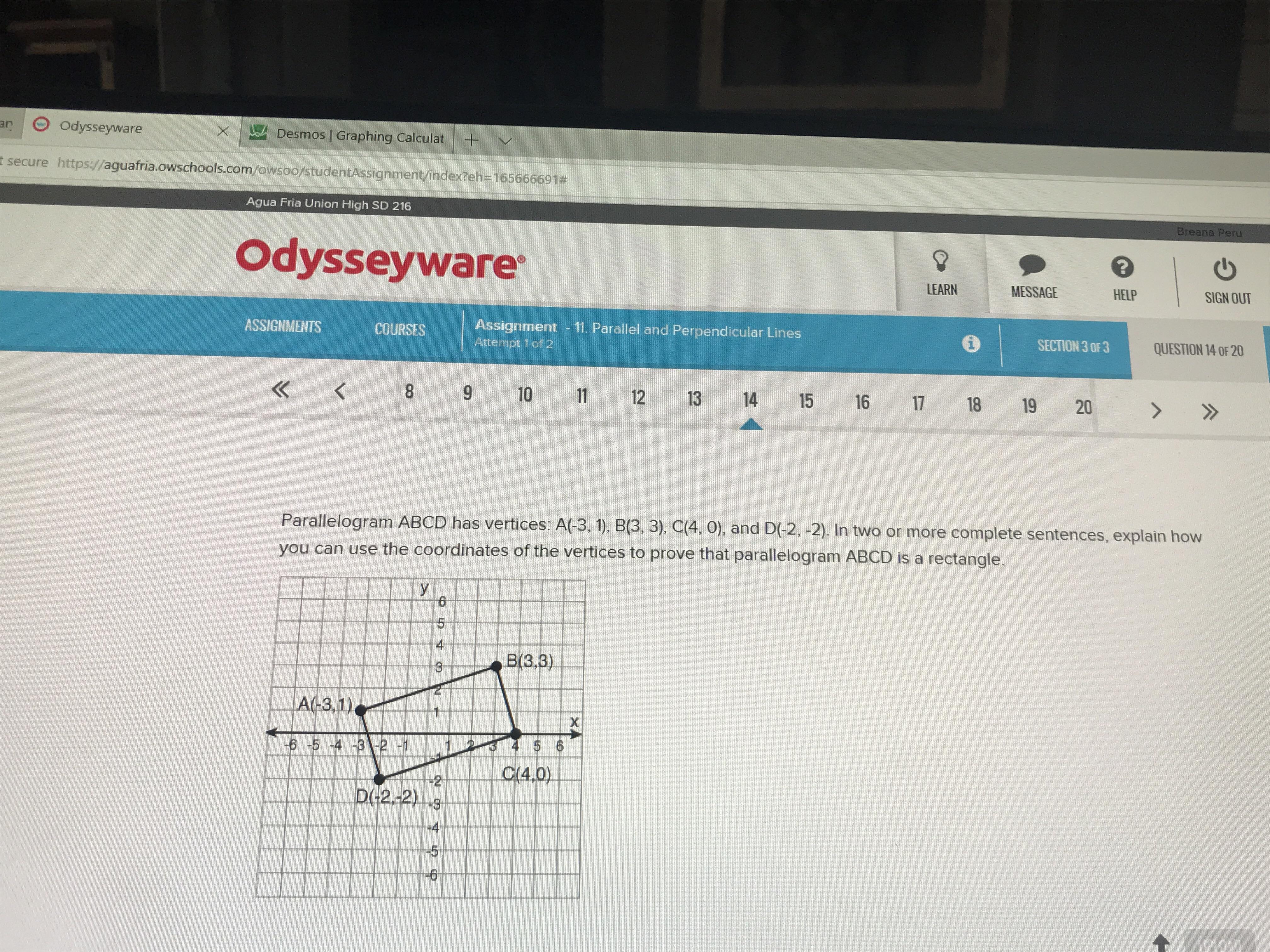
Parallelogram ABCD has vertices: A(-3, 1), B(3, 3), C(4, 0), and D(-2, -2). In two or more complete sentences, explain how you c

an use the coordinates of the vertices to prove that parallelogram ABCD is a rectangle.

Mathematics
2 answers:
mina [271]2 years ago
4 0
You have to shoe that the angles between adjacent sides = 90 degrees. You do do this by showing the adjacent sides are perpendicular  by comparing their slopes. 
raketka [301]2 years ago
3 0

Answer:

Step-by-step explanation:

Remember, the slope of parallel lines is the same, while the slope of perpendicular lines is the negative reciprocal of each other.

We are given that points a(-3,1), b(3,3), c(4,0) and d(-2,-2). Let’s first identify the relationships between the lines that form the sides of rectangle ABCD.

Lines AD and BC are parallel

Lines AB and DC are parallel

Lines AB and AD are perpendicular

Lines BC and DC are perpendicular

Lines AD and BC are parallel, since the two lines share a slope of -3.

Lines AB and DC are parallel, since they both share a slope of 1/3.

Lines CD and BC are perpendicular, since they are the opposite reciprocal of each other. CD has a slope of 1/3. BC has a slope of -3.

Lines DC and AD are perpendicular as well. DC has a slope of 1/3. AD has a slope of -3.

Using this information, we can arrive at the conclusion that parallel lines DC and AB intersect with parallel lines BC and AD. The intersection of these pairs of parallel lines make up the sides of rectangle ABCD, which proves that the vertices of the parallelogram forms a rectangle.

You might be interested in
5.63x10^-5 in standard form
NemiM [27]

Answer:

the correct anser is 0.0000563

Step-by-step explanation:

you move the decimal point to the left 5 spaces because it is negative

5 0
2 years ago
Logan can read at a rate of 2/3 page per minute. At that rate, how many pages can he read in 2 hours?
Anon25 [30]

Answer:

240- 360

Step-by-step explanation:

You have to find out how many minutes in an hour which is 60. Then multiply it by 2 for 2 hours to get 120. Then you multiply 2x120 to get 240. Then you multiply 3x120 to get 360.

I'm not sure if this is correct but this is how I would go about it. :)

7 0
2 years ago
Explain how making a table helps to compare two or more sets of data that have been presented in different ways.
vlabodo [156]
Making a table helps compare two or more sets of data because you can see how much it has increased or decreased. 
4 0
2 years ago
Read 2 more answers
"An ordinance requiring that a smoke detector be installed in all previously constructed houses has been in effect in a particul
Galina-37 [17]

Answer:

a) Probability that the claim is rejected when the actual value of p is 0.8 = P(X ≤ 15) = 0.0173

b) Probability of not rejecting the claim when p = 0.7, P(X > 15) = 0.8106

when p = 0.6, P(X > 15) = 0.4246

c) Check Explanation

The error probabilities are evidently lower when 15 is replaced with 14 in the calculations.

Step-by-step explanation:

p is the true proportion of houses with smoke detectors and p = 0.80

The claim that 80% of houses have smoke detectors is rejected if in a sample of 25 houses, not more than 15 houses have smoke detectors.

If X is the number of homes with detectors among the 25 sampled

a) Probability that the claim is rejected when the actual value of p is 0.8 = P(X ≤ 15)

This is a binomial distribution problem

A binomial experiment is one in which the probability of success doesn't change with every run or number of trials (probability that each house has a detector is 0.80)

It usually consists of a number of runs/trials with only two possible outcomes, a success or a failure (we are sampling 25 houses with each of them either having or not having a detector)

The outcome of each trial/run of a binomial experiment is independent of one another.

Binomial distribution function is represented by

P(X = x) = ⁿCₓ pˣ qⁿ⁻ˣ

n = total number of sample spaces = 25 houses sampled

x = Number of successes required = less than or equal to 15

p = probability of success = probability that a house has smoke detectors = 0.80

q = probability of failure = probability that a house does NOT have smoke detectors = 1 - p = 1 - 0.80 = 0.20

P(X ≤ 15) = Sum of probabilities from P(X = 0) to P(X = 15) = 0.01733186954 = 0.01733

b) Probability of not rejecting the claim when p= 0.7 when p= 0.6

For us not to reject the claim, we need more than 15 houses with detectors, hence, th is probability = P(X > 15), but p = 0.7 and 0.6 respectively for this question.

n = total number of sample spaces = 25 houses sampled

x = Number of successes required = more than 15

p = probability that a house has smoke detectors = 0.70, then 0.60

q = probability of failure = probability that a house does NOT have smoke detectors = 1 - p = 1 - 0.70 = 0.30

And 1 - 0.60 = 0.40

P(X > 15) = sum of probabilities from P(X = 15) to P(X = 25)

When p = 0.70, P(X > 15) = 0.8105639765 = 0.8106

When p = 0.60, P(X > 15) = 0.42461701767 = 0.4246

c) How do the "error probabilities" of parts (a) and (b) change if the value 15 in the decision rule is replaced by 14.

The error probabilities include the probability of the claim being false.

When X = 15

(Error probability when p = 0.80) = 0.0173

when p = 0.70, error probability = P(X ≤ 15) = 1 - P(X > 15) = 1 - 0.8106 = 0.1894

when p = 0.60, error probability = 1 - 0.4246 = 0.5754

When X = 14

(Error probability when p = 0.80) = P(X ≤ 14) = 0.00555

when p = 0.70, error probability = P(X ≤ 14) = 0.0978

when p = 0.60, error probability = P(X ≤ 14) = 0.4142

The error probabilities are evidently lower when 15 is replaced with 14 in the calculations.

Hope this Helps!!!

6 0
2 years ago
Dmitri wants to cover the top and sides of the box shown with glass tiles that are 3 5 mm square How many tiles does he need 20
Anna35 [415]
Lets split the box in pieces and then add:
top = 20*15 = 300
sidesA = 2*20*9 = 360, is multiplied  by 2 cause there are 2 sides like this
sidesB = 2*9*15 = 270, is multiplied  by 2 cause there are 2 sides like this
so in total we have:
total = 300 + 360 + 270 = 930 cm^2
if we express this quantity in mm^2 we have:
<span>1cm² = 100 mm²</span>total = 930*100 = 93000 mm^2
so if the tiles are 5 mm^2 we need:
total tiles = <span>93000/5 = 18600
we need 18600 tiles of 5 mm^2</span>
8 0
2 years ago
Other questions:
  • Clay is playing darts. his dartboard contains ten equal-sized zones with point values from 1 to 10. write code that simulates hi
    7·2 answers
  • Tiny's Tattoo Parlor sold 389 tattoos this month. 43 of those tattoos were arm tattoos. Based on this data, what is a reasonable
    13·2 answers
  • In the diagram below what is the approximate length of the minor arc XY
    6·2 answers
  • What number must we multiply by $-\frac23$ to get a product of $\frac34$?
    13·1 answer
  • Suppose the equation for line A is given by 12x=9y+27. If line A and B are perpendicular and the point (16,-12) lies on line B,
    11·2 answers
  • In a single line of people waiting to purchase tickets for a movie, there are currently 10 people behind Shandra. If 3 of the pe
    15·1 answer
  • To estimate LaTeX: \muμ, the mean salary of full professors at American colleges and universities, you obtain the salaries of a
    6·1 answer
  • What is the decibel level of the sound of a ticking clock with intensity 10−9 watts per square inch? Use a logarithmic model to
    7·2 answers
  • One smartphone plan costs $52 per month for talk and messaging and $8 per gigabyte of data used each month. A second smartphone
    8·1 answer
  • In ΔVWX, x = 5.3 inches, w = 7.3 inches and ∠W=37°. Find all possible values of ∠X, to the nearest 10th of a degree.
    15·2 answers
Add answer
Login
Not registered? Fast signup
Signup
Login Signup
Ask question!