answer.
Ask question
Login Signup
Ask question
All categories
  • English
  • Mathematics
  • Social Studies
  • Business
  • History
  • Health
  • Geography
  • Biology
  • Physics
  • Chemistry
  • Computers and Technology
  • Arts
  • World Languages
  • Spanish
  • French
  • German
  • Advanced Placement (AP)
  • SAT
  • Medicine
  • Law
  • Engineering
Ipatiy [6.2K]
2 years ago
8

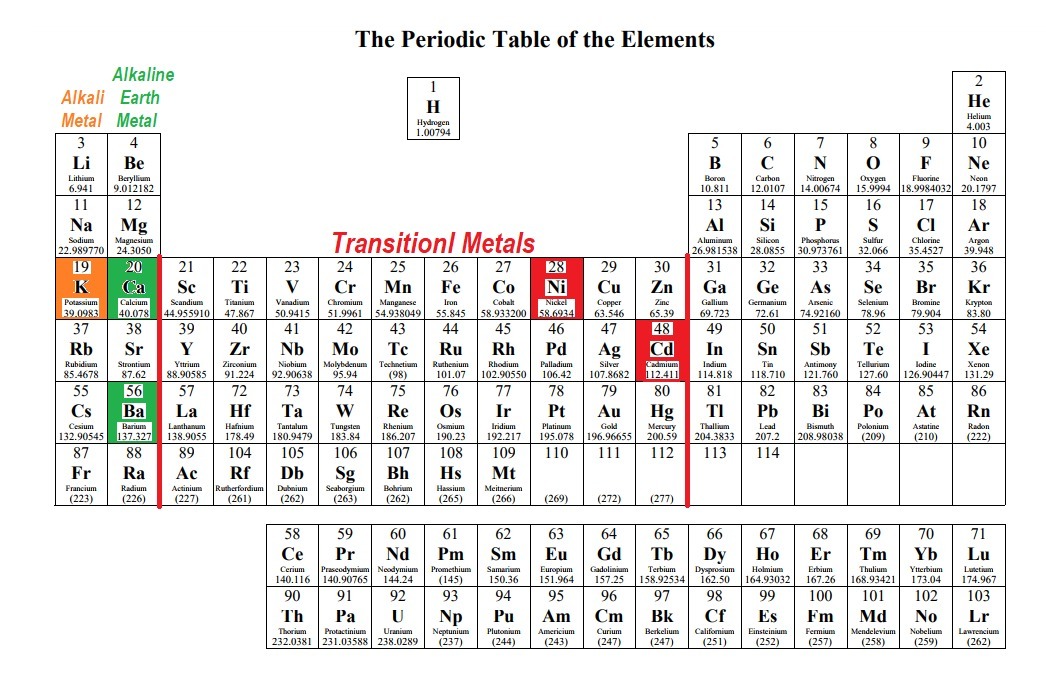
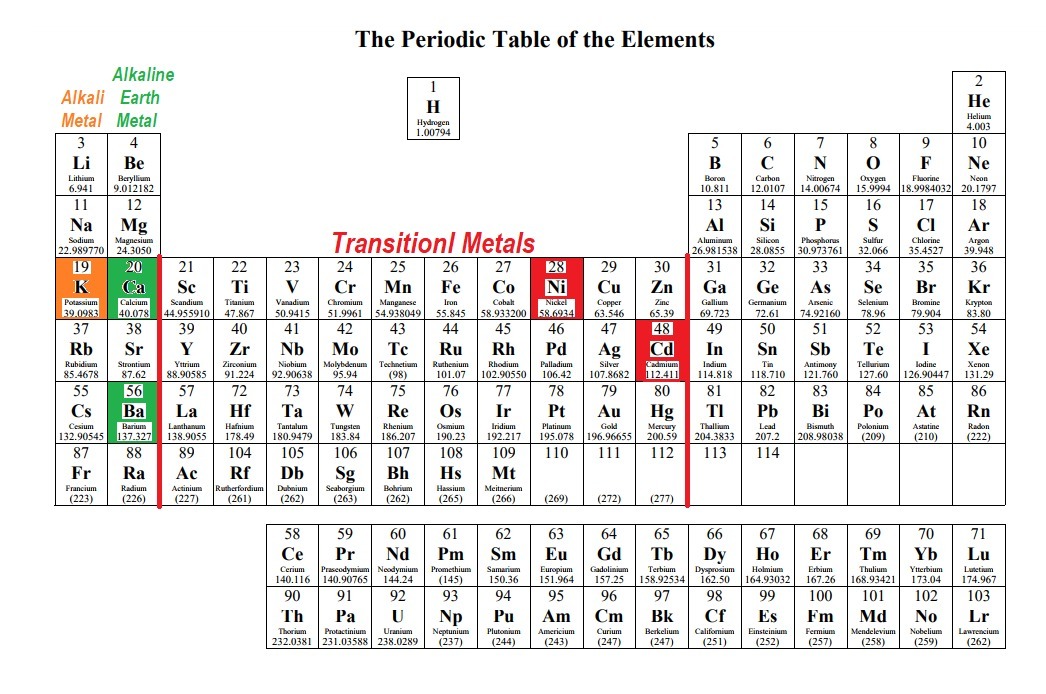
Use the drop-down menus to classify the elements as alkali metals, alkaline earth metals, or transition metals.

Chemistry
2 answers:
Rama09 [41]2 years ago
7 0

Nickel (Ni):  transition metal

Potassium (K): alkali metal

Cadmium (Cd):  transition metal

Calcium (Ca): alkaline earth metal

Barium (Ba): alkaline earth metal

aleksley [76]2 years ago
3 0
The following are the classification of each element above:

Nickel - Transitional Metal
Potassium- Alkali Metal
Cadmium- Transitional Metal
Calcium- Alkaline Earth Metal
Barium- Alkaline Earth Metal

I attached a color-coded, labelled period table that will help to see the derivative of my responses.

You might be interested in
When sodium reacts with chlorine, sodium chloride is produced. Andrew represented this reaction with this equation: Na + Cl2 → 2
My name is Ann [436]
When sodium metal reacts with chlorine gas, the product would be sodium chloride or the table salt. The balanced chemical reaction would be:

2Na + Cl2 = 2NaCl

IN balancing reactions, it is important to remember that the number of atoms at each side should be equal. Hope this answers the question.
4 0
2 years ago
Read 2 more answers
In a hexagonal-close-pack (hcp) unit cell, the ratio of lattice points to octahedral holes to tetrahedral holes is 1:1:2. What i
Alex777 [14]

Explanation:

In a hexagonal-close-pack (HCP) unit cell, the ratio of lattice points to octahedral holes to tetrahedral holes =  1 : 1 : 2

let the :

Number of lattice point = 1x.

Number of octahedral points = 1x

Number of tetrahedral  points = 2x

If anions occupy the HCP lattice points and cations occupy half of the tetrahedral holes.

Number of anions occupying the HCP lattice points, A= 1x

Number of cations occupying the tetrahedral points, B =  \frac{2x}{2}=x

The formula of the compound will be = A_{1x}B_{1x}=AB

If anions occupy the HCP lattice points and cations occupy all of the tetrahedral holes.

Number of anions occupying the HCP lattice points, A= 1x

Number of cations occupying the tetrahedral points, B =  2x

The formula of the compound will be = A_{1x}B_{2x}=AB_2

6 0
2 years ago
Recall that your hypothesis is that these values are the fraction of atoms that are still radioactive after n half-life cycles.
jolli1 [7]

Answer : A= 0.5, B = 0.25 , C = 0.125, D = 0.015625 and E = 0.00390625

Explanation :

Half life of a substance is defined as the amount of time taken by the substance to reduce to half of its original amount.

Here n represents the number of half lives.

The amount of substance that remains after n half lives can be calculated using the given formula, 0.5^{n}

So when we have n =1,

Fraction of substance that remains = 0.5¹ = 0.5.

That means after first half life over, the amount of substance that remains is 0.5 times that of original.

Therefore we have A = 0.5

When n = 2, we have 0.5² = 0.25

So when 2 half lives are over, the amount of substance that remains is 0.25 times that of original

Therefore B = 0.25

When n = 3, we have 0.5³ = 0.125

So when 3 half lives are over, the amount of substance that remains is 0.125 times that of original.

Therefore we have C = 0.125

When n = 6 , we have 0.5⁶ = 0.015625

So D = 0.015625

When n = 8, we have 0.5⁸ = 0.00390625

Therefore E = 0.00390625

The values for A, B, C, D and E are 0.5, 0.25, 0.125, 0.015625 and 0.00390625 respectively.
8 0
2 years ago
Read 2 more answers
Determine the empirical formula for compounds that have the following analyses: a. 66.0% barium and 34.0% chlorine b. 80.38% bis
almond37 [142]

Answer: a) BaCl_2

b)  BiO_3H_3

Explanation:

If percentage are given then we are taking total mass is 100 grams.

So, the mass of each element is equal to the percentage given.

a) Mass of Ba= 66.06 g

Mass of Cl = 34.0 g

Step 1 : convert given masses into moles.

Moles of Ba =\frac{\text{ given mass of ba}}{\text{ molar mass of Ba}}= \frac{66.06g}{137g/mole}=0.48moles

Moles of Cl = \frac{\text{ given mass of Cl}}{\text{ molar mass of Cl}}= \frac{34g}{35.5g/mole}=0.96moles[/tex]

Step 2 : For the mole ratio, divide each value of moles by the smallest number of moles calculated.

For Ba = \frac{0.48}{0.48}=1

For O =\frac{0.96}{0.48}=2

The ratio of Ba: Cl= 1:2

Hence the empirical formula is BaCl_2

b) Mass of Bi= 80.38 g

Mass of O= 18.46 g

Mass of H = 1.16 g

Step 1 : convert given masses into moles.

Moles of Bi =\frac{\text{ given mass of ba}}{\text{ molar mass of Ba}}= \frac{80.38g}{209g/mole}=0.38moles

Moles of O= \frac{\text{ given mass of O}}{\text{ molar mass of O}}= \frac{18.46g}{16g/mole}=1.15moles

Moles of H=\frac{\text{ given mass of H}}{\text{ molar mass of H}}= \frac{1.16g}{1g/mole}=1.16moles

Step 2 : For the mole ratio, divide each value of moles by the smallest number of moles calculated.

For Bi= \frac{0.38}{0.38}=1

For O =\frac{1.15}{0.38}=3

For H=\frac{1.16}{0.38}=3

The ratio of Bi: O: H= 1:3: 3

Hence the empirical formula is BiO_3H_3

6 0
2 years ago
Calculate the molarity of sodium chloride in a half-normal saline solution (0.45% NaCl). The molar mass of NaCl is
Rus_ich [418]

Answer:

0.077 M

Explanation:

Data Given :

The concentration of half normal (NaCl) saline = 0.45g / 100 g

So,

Volume of Solution = 100 g = 100 mL

Volume of Solution in Liter = 100 mL / 1000

Volume of Solution = 0.1 L

molar mass of NaCl = 58.44 g/mol

Molarity:

Molarity is the representation of the solution. It is amount of solute in moles per liter of solution and represented by M

Formula used for Molarity

                M = moles of solute / Liter of solution . . . . . . . . . . (1)

Now to find number of moles of Nacl

                no. of moles of NaCl = mass of NaCl / molar mass

                no. of moles of NaCl = 0.45g / 58.44 g/mol

               no. of moles of NaCl = 0.0077 g

Put values in the eq (1)

                  M = moles of solute / Liter of solution . . . . . . . . . . (1)

                  M = 0.0077 g / 0.1 L

                  M = 0.077 M

So the molarity of half-normal saline solution (0.45% NaCl) = 0.077 M

3 0
2 years ago
Other questions:
  • A reagent bottle on the shelf labeled 0.5m nacl was used in place of the 0.5 m cacl2. assuming c2o4^2- to be in excess, what wou
    11·1 answer
  • What is the stoichiometric ratio between BaCl2 and NaCl
    11·1 answer
  • A solution is a special mixture where you cannot see the individual substances that are mixed. You look at two bowls of ice crea
    5·1 answer
  • A compound contains 81.1 boron with the remainder being hydrogen what is the empirical formula of the compound
    9·1 answer
  • A solution of SO2 in water contains 0.00023 g of SO2 per liter of solution. What is the concentration of SO2 in ppm? in ppb?
    7·2 answers
  • Question 2 Here are four sketches of pure substances. Each sketch is drawn as if a sample of the substance were under a microsco
    5·1 answer
  • Calculate the grams of so2 gas present at stp in a 5.9 l container. (r = 0.0821 l·atm/k·mol)
    15·1 answer
  • Air in a 0.3 m3 cylinder is initially at a pressure of 10 bar and a temperature of 330K. The cylinder is to be emptied by openin
    11·1 answer
  • Which of these was not proposed by john dalton in 1805?
    13·1 answer
  • What is the herbivore in the following food chain: algae → fish → herons?
    8·1 answer
Add answer
Login
Not registered? Fast signup
Signup
Login Signup
Ask question!