answer.
Ask question
Login Signup
Ask question
All categories
  • English
  • Mathematics
  • Social Studies
  • Business
  • History
  • Health
  • Geography
  • Biology
  • Physics
  • Chemistry
  • Computers and Technology
  • Arts
  • World Languages
  • Spanish
  • French
  • German
  • Advanced Placement (AP)
  • SAT
  • Medicine
  • Law
  • Engineering
Dimas [21]
2 years ago
4

Cyclist competes in a one-lap race around a flat, circular course of radius 140 m . starting from rest and speeding up at a cons

tant rate throughout the race, the cyclist covers the entire course in 60 s . the mass of the bicycle (including the rider) is 76 kg . what is the magnitude of the net force fnet acting on the bicycle as it crosses the finish line?

Physics
2 answers:
Vaselesa [24]2 years ago
6 0
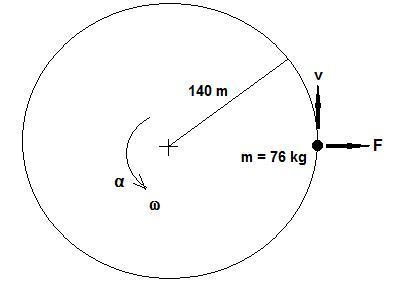
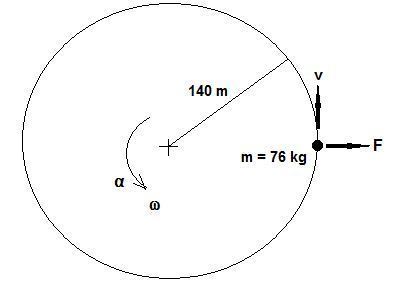
Refer to the diagram shown below.

The angular distance traveled in one lap is θ = 2π radians.

Let  α =  the angular acceleration, rad/s².
Because 1 lap was completed in t = 60 s, therefore the angular acceleration is given by
θ = (1/2)*α*t²
That is,
2π rad = 0.5*(α rad/s²)*(60 s)² 
2π = 1800 α
α = 3.49 x 10⁻³ rad/s²

The angular velocity at the end of the lap is
ω = αt
    = (3.49 x 10⁻³ rad/s²)*(60 s)
    = 0.2094 rad/s

The tangential velocity is
v = rω = (140 m)*(0.2094) = 29.32 m/s

The centripetal force acting on the cyclist at the finish line is
F = m*r*ω²
   = (76 kg)*(140 m)*(0.2094 rad/s)²
   = 466.5 N

Answer: 466.5 N

Rashid [163]2 years ago
3 0

The magnitude of the net of force is about 470 Newton

\texttt{ }

<h3>Further explanation</h3>

Centripetal Acceleration can be formulated as follows:

\large {\boxed {a = \frac{ v^2 } { R } }

<em>a = Centripetal Acceleration ( m/s² )</em>

<em>v = Tangential Speed of Particle ( m/s )</em>

<em>R = Radius of Circular Motion ( m )</em>

\texttt{ }

Centripetal Force can be formulated as follows:

\large {\boxed {F = m \frac{ v^2 } { R } }

<em>F = Centripetal Force ( m/s² )</em>

<em>m = mass of Particle ( kg )</em>

<em>v = Tangential Speed of Particle ( m/s )</em>

<em>R = Radius of Circular Motion ( m )</em>

Let us now tackle the problem !

\texttt{ }

<u>Given:</u>

period of the circular motion = T = 60 s

mass of the the bicycle = m = 76 kg

radius of the circuit = R = 140 m

<u>Unknown:</u>

magnitude of the net force = ΣF = ?

<u>Solution:</u>

<em>We will use this following formula to find the tangential acceleration of the cyclist:</em>

s = ut + \frac{1}{2}at^2

2\pi R = 0(T) + \frac{1}{2}a(T)^2

2\pi (140) = 0 + \frac{1}{2}a(60)^2

280\pi = 1800a

a = 280 \pi \div 1800

a = \frac{7}{45} \pi \texttt{ m/s}^2

\texttt{ }

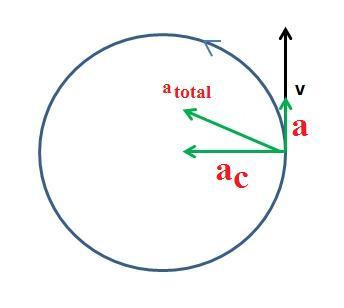
<em>Next we will find the centripetal acceleration of the cyclist as it crosses the finish line:</em>

a_c = v^2 \div R

a_c = ( u + aT )^2 \div R

a_c = ( 0 + \frac{7}{45} \pi(60))^2 \div 140

a_c = \frac{28}{45} \pi^2 \texttt{ m/s}^2

\texttt{ }

<em>Finally we could calculate the magnitude of the net force by using Newton's 2nd Law Of Motion as follows:</em>

\Sigma F = m\sqrt{a^2 + a_c^2}

\Sigma F = 76 \sqrt{(\frac{7}{45}\pi)^2+(\frac{28}{45}\pi^2)^2}

\Sigma F \approx 470 \texttt{ Newton}

\texttt{ }

<h3>Learn more</h3>
  • Impacts of Gravity : brainly.com/question/5330244
  • Effect of Earth’s Gravity on Objects : brainly.com/question/8844454
  • The Acceleration Due To Gravity : brainly.com/question/4189441

\texttt{ }

<h3>Answer details</h3>

Grade: High School

Subject: Physics

Chapter: Circular Motion
You might be interested in
An object with a mass m slides down a rough 37° inclined plane where the coefficient of kinetic friction is 0.20. If the plane i
hodyreva [135]

Answer: 9.312 m/s

Explanation:

The friction force (opposite to the motion) is Fa = μ*m*g*cos(α) with μ = kinetic friction. The force that makes the motion is

F = m*g*sin(α).

The Newton's law gives:

F - Fa = m*a

m*g*sin(α) - μ*m*g*cos(α) = m*a

g*sin(α) - μ*g*cos(α) = a so a = 4.335 m/s²

It's a uniformly accelerated motion:

Space

S = 0.5*a*t²

10 = 0.5*a*t²

=> t = 2.148 s

Velocity

V = a*t = 9.312 m/s.

5 0
2 years ago
At one point in the rescue operation, breakdown vehicle A is exerting a force of 4000 N and breakdown vehicle B is exerting a fo
lukranit [14]

Answer:

1.) Magnitude = 5596 N

2.) Direction = 60 degrees

Explanation: You are given that the breakdown vehicle A is exerting a force of 4000 N at angle 45 degree to the vertical and breakdown vehicle B is exerting a force of 2000 N

Let us resolve the two forces into X and Y component

Sum of the forces in the X - component will be 4000 × cos 45 = 2828.43 N

Sum of the forces in the Y - component will be 2000 + ( 4000 × sin 45 )

= 2000 + 2828.43

= 4828.43 N

The resultant force R will be

R = sqrt ( X^2 + Y^2 )

Substitutes the forces at X component and Y component into the formula

R = sqrt ( 2828.43^2 + 4828.43^2 )

R = sqrt ( 31313752.53 )

R = 5595.87 N

The direction will be

Tan Ø = Y/X

Substitute Y and X into the formula

Tan Ø = 4828.43 / 2828.43

Tan Ø = 1.707106

Ø = tan^-1( 1.707106 )

Ø = 59.64 degree

Therefore, approximately, the magnitude and direction of the resultant force on the truck are 5596 N and 60 degree respectively.

8 0
2 years ago
Considerable scientific work is currently under way to determine whether weak oscillating magnetic fields such as those found ne
slega [8]

Answer:

\epsilon = 2.96 \times 10^{-11} \ V

Explanation:

given,

magnetic field strength =  1.40 ✕ 10⁻³ T

frequency of oscillation = 60 Hz

diameter of RBC = 7.5 μm

EMF = ?

\epsilon = NBA\omega

\epsilon = NB(\pi\ r^2)\ (2\pi f)

\epsilon = NB(\pi\ (\dfrac{d}{2})^2)\ (2\pi f)

\epsilon = (1)\ 1.4 \times 10^{-3}(\pi\ (\dfrac{7.5 \times 10^{-6}}{2})^2)\ (2\pi\times 60)

\epsilon = 2.96 \times 10^{-11} \ V

maximum emf that can generate around the perimeter of the cell \epsilon = 2.96 \times 10^{-11} \ V

5 0
2 years ago
A system delivers 1275 j of heat while the surroundings perform 855 j of work on it. calculate ∆esys in j.
kakasveta [241]
The first law of thermodynamics says that the variation of internal energy of a system is given by:
\Delta U = Q + W
where Q is the heat delivered by the system, while W is the work done on the system.

We must be careful with the signs here. The sign convention generally used is:
Q positive = Q absorbed by the system
Q negative = Q delivered by the system
W positive = W done on the system
W negative = W done by the system

So, in our problem, the heat is negative because it is releaed by the system: 
Q=-1275 J
while the work is positive because it is performed by the surrounding on the system:
W=+855 J

So, the variation of internal energy of the system is
\Delta U = -1275 J+855 J=-420 J
6 0
2 years ago
A heat pump absorbs heat from the cold outdoors at 3°c and supplies heat to a house at 20°c at a rate of 30,000 kj/h. if the p
Mazyrski [523]
A heat pump absorbs heat from the cold outdoors at 3 C and supplies heat to a
house at 20 C at a rate of 30,000 kJ/h. If the power consumed by the heat pump
<span>is 3 kW, find the coefficient of performance of the heat pump.</span>
6 0
2 years ago
Other questions:
  • A box mass of 24kg is being pulled horizontally on a rough surface by an applied force of 585N. The coefficient of kinetic frict
    9·2 answers
  • Jack (mass 52.0 kg ) is sliding due east with speed 8.00 m/s on the surface of a frozen pond. he collides with jill (mass 49.0 k
    9·1 answer
  • Order the steps to take when drawing electron dot diagrams. Count the dots to make sure that all of the valence electrons are re
    17·3 answers
  • An arrow is launched upward with an initial speed of 100 meters per second (m/s). The equations above describe the constant-acce
    13·1 answer
  • A 0.60-kilogram softball initially at rest is hit with a bat. The ball is in contact with the bat for 0.20 second and leaves the
    15·1 answer
  • Technician A says test lights are great for quick tests on non-computerized circuits. Technician B says you can use a test light
    5·1 answer
  • If the activation energy for a given compound is found to be 103 kJ/mol, with a frequency factor of 4.0 × 10¹³ s-1, what is the
    10·2 answers
  • A 385-g tile hangs from one end of a string that goes over a pulley with a moment of inertia of 0.0125 kg ⋅ m2 and a radius of 1
    12·1 answer
  • An astronaut holds a rock 100m above the surface of Planet XX. The rock is then thrown upward with a speed of 15m/s, as shown in
    11·1 answer
  • An astronaut stands on the surface of an asteroid. The astronaut then jumps such that the astronaut is no longer in contact with
    6·1 answer
Add answer
Login
Not registered? Fast signup
Signup
Login Signup
Ask question!